
Where can a training provider build a credible offer in the East Midlands? Start by separating the region from the combined authority, then follow the programme. Adult skills, Bootcamps, council learning and supported employment can have different leads, even in the same place.
This fact file brings the funding, local skills evidence, deprivation, council roles and current provider landscape into one report. It is designed to help providers decide where to investigate, what to prepare and how to enter the market with a deliverable proposition.
In this article
The East Midlands is larger than EMCCA
East Midlands Combined County Authority (EMCCA), covers Derby, Derbyshire, Nottingham and Nottinghamshire. It does not cover the whole East Midlands region. This fact file also includes Leicester, Leicestershire, Rutland, North Northamptonshire, West Northamptonshire and Lincolnshire county.
Together, those places contain 35 district or unitary council areas. County councils add a further layer of responsibility in Derbyshire, Nottinghamshire, Leicestershire and Lincolnshire. A district’s role in employers, communities and referrals is different from the authority that holds or commissions ASF provision.
Two wider programmes cross the statistical regional boundary. Greater Lincolnshire includes Lincolnshire county and the two northern Lincolnshire councils, which sit in Yorkshire and the Humber. The South Midlands employment and LSIP geography connects Northamptonshire with places in the East of England and South East. Whole-area budgets must not be presented as East Midlands-only funding.
For providers, the practical map has four parts: EMCCA; Leicester, Leicestershire and Rutland; Northamptonshire; and Lincolnshire within Greater Lincolnshire. Even within those groupings, the buyer can change by programme. Check learner residence, delivery scope, the accountable body and the procurement operator before building the offer.
Funding geography / routes to market
One region. Four different commissioning pictures.
EMCCA · 17 district or unitary areas
EMCCA
01 / Route to understandEstablished grants and contracts. Bootcamp call-offs use RM6348; the right supplier-platform registration matters.
9 district or unitary areas
Leicester, Leicestershire and Rutland
02 / Route to understandLeicester City Council runs the evidenced Bootcamp grant route. City, county and Rutland adult learning have separate channels.
2 unitary councils
Northamptonshire
03 / Route to understandNorth Northamptonshire leads shared adult learning. West Northamptonshire leads the separately evidenced Bootcamp programme.
7 district areas within a wider funding system
Lincolnshire
04 / Route to understandGLCCA holds the devolved allocation. Lincolnshire County Council operates relevant procurement through PANACEA.
Rounded figures retain their programme and period. The EMCCA and Greater Lincolnshire figures include ASF, Bootcamps, FCfJ and additional engineering. The other figures cover Bootcamps only. They are not comparable total adult skills budgets and must not be added.
Who has the money, and what does each figure mean?
EMCCA’s published single adult skills allocation for academic year 2026/27 is £60,020,215. That includes core Adult Skills Fund (ASF), Skills Bootcamps and Free Courses for Jobs (FCfJ) excluding the engineering addition. A further £636,910 for engineering brings the TA-calculated total to £60,657,125.
Greater Lincolnshire’s equivalent published single allocation is £21,269,625, with £224,734 additional engineering. The resulting £21,494,359 covers the whole combined county authority, including North Lincolnshire and North East Lincolnshire. A Lincolnshire county-only split was not established from the evidence reviewed.
The national Skills Bootcamps allocations give £1.5m for Leicester and Leicestershire and £1.5m for West Northamptonshire for financial year 2026/27. Each includes a £400,000 construction component. These are Bootcamp allocations, not the whole adult skills market in those places.
Leicester City Council’s current-year delivery call offered £1.275m from the wider £1.5m programme allocation. That call budget is a deployment of the funding, not another pot to add to it. Likewise, provider allocations, framework values and contract awards show different stages in the same commissioning system.
Academic year 2026/27 runs from 1st August 2026 to 31st July 2027. Financial year 2026/27 runs from 1st April 2026 to 31st March 2027. Keep the periods, funding streams and geographical scope intact. There is no reliable single regional total formed by adding the figures below.
Funding scale: retain the programme, period and boundary
Use the allocation to understand scale, then establish how much has already been committed and which entry route remains available.
EMCCA: calculated totalAcademic year 2026/27 · Single allocation plus engineering£60,657,125
| Area / component | Amount | Scope |
|---|---|---|
| core ASF | £53,204,111 | Academic year 2026/27; Derby, Derbyshire, Nottingham and Nottinghamshire |
| Skills Bootcamps component | £2,032,745 | Included in the single allocation |
| FCfJ excluding engineering | £4,783,359 | Included in the single allocation |
| published single allocation | £60,020,215 | Academic year 2026/27 |
| additional engineering | £636,910 | Separate allocation |
| calculated total | £60,657,125 | Single allocation plus engineering |
Greater Lincolnshire: calculated totalAcademic year 2026/27 · Whole CCA; includes Bootcamps and FCfJ£21,494,359
| Area / component | Amount | Scope |
|---|---|---|
| published single allocation | £21,269,625 | Academic year 2026/27; whole CCA, not Lincolnshire county alone |
| additional engineering | £224,734 | Whole CCA |
| calculated total | £21,494,359 | Whole CCA; includes Bootcamps and FCfJ |
Leicester and Leicestershire: Skills BootcampsFinancial year 2026/27 · Financial year 2026/27; includes £400,000 construction£1,500,000
| Area / component | Amount | Scope |
|---|---|---|
| Skills Bootcamps | £1,500,000 | Financial year 2026/27; includes £400,000 construction |
West Northamptonshire: Skills BootcampsFinancial year 2026/27 · Financial year 2026/27; includes £400,000 construction£1,500,000
| Area / component | Amount | Scope |
|---|---|---|
| Skills Bootcamps | £1,500,000 | Financial year 2026/27; includes £400,000 construction |
Sources: national 2026/27 adult skills grant determination and Skills Bootcamps allocation publication. Calculated totals use the published single-allocation amounts. These are government allocations, not uncommitted balances, actual expenditure or procurement ceilings.
Which skills gaps are worth building an offer around?
The region draws on four LSIP geographies. The East Midlands LSIP covers the EMCCA area; Leicester, Leicestershire and Rutland has a separate plan; Northamptonshire sits within the South-east Midlands plan; and Lincolnshire county sits within Greater Lincolnshire. A plan’s title does not make its evidence applicable to every local authority in the statistical region.
Use the sector headings to locate the market, then read for occupations, levels and practical barriers. Advanced manufacturing, logistics, construction, food production, digital capability and workforce progression can create very different requirements across these places. A sector priority alone does not establish a funded course or a live vacancy.
The East Midlands profile uses the substantive March 2026 draft held in EMCCA’s committee papers. A final approved PDF was not retrieved. The profile is labelled accordingly; draft proposals should not be treated as adopted commissioning commitments.
The commercial question is what training changes at work. Establish whether the employer needs a new entrant, an experienced worker with a new competence, a supervisor, a technical specialist or better use of existing systems. Those needs call for different entry criteria, practical facilities and evidence of outcomes.
Four LSIP geographies / local delivery implications
Read the occupational problem beneath the sector heading.
Derby, Derbyshire, Nottingham and Nottinghamshire
Employer representative body: Federation of Small Businesses
March 2026 substantive draft; final approved plan not verified.
Local priorities: Advanced manufacturing · Clean energy · Construction · Visitor economy · Creative and cultural · Education · Health and social care · Life sciences
System priorities: Address occupational shortages in priority sectors; Build provider capacity for industry-relevant delivery; Upskill the existing workforce: modular, flexible, digital; Deepen employer engagement in shaping and delivering skills; Link skills to EMCCA investment and places; Transform careers information, advice and guidance, and awareness of technical routes.
A growth-sector label is only the starting point. The stronger offer solves a particular occupation, replacement need and practical delivery constraint. In clean energy, adapting the existing workforce can be more immediately useful than creating a wholly new job pathway.
Explore occupations, levels and delivery implications
| Priority | Evidence and delivery implications |
|---|---|
| SSA 4: Engineering and Manufacturing TechnologiesAdvanced manufacturing | Build practical Level 2 to 5 pathways for welders, CNC setters, machinists, maintenance fitters and engineering technicians. Add CAD/CAM, robotics, controls and data skills; replacement demand remains important even where total manufacturing employment is projected to fall. |
| SSA 4: Engineering and Manufacturing TechnologiesSSA 5: Construction, Planning and the Built EnvironmentClean energy | Upskill existing trades for heat pumps, solar, EV charging, whole-house retrofit and digital compliance. Electricians, plumbers, pipe fitters, site supervisors and project managers need applied competence and whole-system understanding, with short modules that fit operational schedules. |
| SSA 5: Construction, Planning and the Built EnvironmentConstruction | Upskill existing trades for heat pumps, solar, EV charging, whole-house retrofit and digital compliance. Electricians, plumbers, pipe fitters, site supervisors and project managers need applied competence and whole-system understanding, with short modules that fit operational schedules. |
| SSA 7: Retail and Commercial EnterpriseSSA 8: Leisure, Travel and TourismVisitor economy | Chef and hospitality-supervisor shortages sit alongside demand for digital operations, revenue management and customer service. Creative businesses need technical theatre, audio/visual production and practical digital skills, plus pricing, intellectual property and commercial skills suited to freelancers. |
| SSA 9: Arts, Media and PublishingCreative and cultural | Chef and hospitality-supervisor shortages sit alongside demand for digital operations, revenue management and customer service. Creative businesses need technical theatre, audio/visual production and practical digital skills, plus pricing, intellectual property and commercial skills suited to freelancers. |
| SSA 13: Education and TrainingEducation | Strengthen care-worker and senior-care progression, digital care records, medication management and supervision. Education has its own workforce constraint: SEND/SEMH support and industry-current FE technical lecturers are essential to sustaining the wider skills pipeline. |
| SSA 1: Health, Public Services and CareHealth and social care | Strengthen care-worker and senior-care progression, digital care records, medication management and supervision. Education has its own workforce constraint: SEND/SEMH support and industry-current FE technical lecturers are essential to sustaining the wider skills pipeline. |
| SSA 2: Science and MathematicsSSA 4: Engineering and Manufacturing TechnologiesLife sciences | Combine laboratory and biotech technician routes with quality assurance, regulatory practice, laboratory informatics and automated equipment. Existing scientists also need commercialisation, leadership and data capability to translate technical strength into business growth. |
| Delivery capacity across sectors | Employers want practical work readiness, short modular upskilling and a simpler route through the skills system. Industry-current tutors, modern equipment, shared or micro-placements and transport-aware delivery can be as decisive as the qualification itself. |
Useful anchors in the plan: Infinity Park Derby and Staveley; Peak District and Sherwood Forest; East Midlands Investment Zone, Freeport and STEP.
Leicester, Leicestershire and Rutland
Employer representative body: East Midlands Chamber of Commerce
Approved 2026 to 2029 plan; local analysis scoped to the area shown.
Local priorities: Advanced manufacturing · Logistics · Construction · Life sciences · Health and social care · Sports and leisure
System priorities: Flexible and inclusive skills pathways; Wider participation and access; Employability and workplace readiness; Digital, data and AI skills across sectors; Job-linked green skills for clean growth, retrofit and electrification.
The opportunity is not simply another course in a priority sector. Make progression understandable, build employer practice into delivery and remove the access barriers that stop residents entering the existing offer.
Explore occupations, levels and delivery implications
| Priority | Evidence and delivery implications |
|---|---|
| SSA 4: Engineering and Manufacturing TechnologiesAdvanced manufacturing | Link engineering, skilled trades and production roles to automation, robotics and digital manufacturing. Build visible Level 3 to 5 technical progression, with routes onward to higher-level study and employer practice. |
| SSA 4: Engineering and Manufacturing TechnologiesSSA 7: Retail and Commercial EnterpriseLogistics | Connect warehouse and driver entry routes to supply-chain coordination, transport management and digital logistics. Fleet electrification creates a practical upskilling requirement alongside core logistics competence. |
| SSA 5: Construction, Planning and the Built EnvironmentConstruction | Target skilled trades, building technicians and construction managers with retrofit, heat-pump installation and modern construction methods. Green provision should follow live jobs and project pipelines, with upskilling for the existing workforce. |
| SSA 2: Science and MathematicsSSA 4: Engineering and Manufacturing TechnologiesLife sciences | Support laboratory technicians, biological scientists and research roles through laboratory techniques, advanced technical skills and innovation capability. Clarify how learners progress from technical entry routes to higher-level roles. |
| SSA 1: Health, Public Services and CareHealth and social care | Build care and allied-health workforce capacity and retention, combining clinical or care skills with digital health technologies. Access support and clear progression matter alongside the curriculum. |
| SSA 8: Leisure, Travel and TourismSports and leisure | Develop coaching, physical activity and leisure-management capability linked to health, wellbeing and community engagement. Employer practice and workplace readiness should connect qualifications to delivery roles. |
Useful anchors in the plan: Community, voluntary and faith organisations; FE, HE and independent training providers.
North and West Northamptonshire within the South Midlands LSIP
Employer representative body: Northamptonshire Chamber of Commerce (incorporating Milton Keynes Chamber)
Approved 2026 to 2029 plan; local analysis scoped to the area shown.
Local priorities: Construction, retrofit, net zero and infrastructure · Health and social care · Logistics and supply chain · Advanced manufacturing and engineering · Digital, AI and cross-cutting skills · Food, drink, hospitality and the creative/visitor economy
System priorities: Inclusion, NEET, SEND and entry-level skills is the seventh priority in the detailed local-needs table; The executive summary presents clean energy/net zero separately; the detailed table groups it with construction and adds inclusion.
The plan’s sharpest message is that availability and accessibility are different problems. Translate a course catalogue into a usable route: the right licence, hands-on practice, a realistic journey to training and a visible next step beyond entry level.
Explore occupations, levels and delivery implications
| Priority | Evidence and delivery implications |
|---|---|
| SSA 5: Construction, Planning and the Built EnvironmentConstruction, retrofit, net zero and infrastructure | Build entry-to-Level 5 routes around trades, site supervision, building services, retrofit and low-carbon installation. Check that qualifications connect to the licences, compliance standards and practical competence employers require. |
| SSA 1: Health, Public Services and CareHealth and social care | Connect care-worker and healthcare-assistant recruitment to senior care, nursing-associate and supervisory progression. Digital care, mental health and SEND capability need placements, employer commitment and retention support. |
| SSA 4: Engineering and Manufacturing TechnologiesSSA 7: Retail and Commercial EnterpriseLogistics and supply chain | Extend beyond warehouse entry into HGV, transport planning, inventory systems, automation and team leadership. Level 4 to 5 planning and management routes can support progression within Northamptonshire’s logistics base. |
| SSA 4: Engineering and Manufacturing TechnologiesAdvanced manufacturing and engineering | Develop Level 3 to 5 CNC, CAD/CAM, maintenance, metrology, robotics and technician capacity. Northamptonshire’s precision-engineering and motorsport strengths make practical equipment access and employer collaboration particularly relevant. |
| SSA 6: Digital TechnologyDigital, AI and cross-cutting skills | Embed basic digital confidence, data handling, cyber awareness and applied AI within occupational programmes. Specialist software, analytics and project-delivery skills sit alongside the digital competence needed in everyday roles. |
| SSA 7: Retail and Commercial EnterpriseSSA 8: Leisure, Travel and TourismSSA 9: Arts, Media and PublishingFood, drink, hospitality and the creative/visitor economy | Combine food production, safety, hospitality and customer-service training with supervision and progression. Functional skills, ESOL, supported routes and workplace adjustments should address who can access jobs as well as which courses are available. |
Useful anchors in the plan: Silverstone Technology Cluster; Corby and Northampton logistics operations.
Lincolnshire county within the Greater Lincolnshire LSIP
Employer representative body: Federation of Small Businesses
Approved 2026 to 2029 plan; local analysis scoped to the area shown.
Local priorities: Agri-food and agri-tech · Energy · Manufacturing · Ports and logistics · Defence and security
Growth sectors listed apply to the whole Greater Lincolnshire plan; ports, offshore energy and heavy industry are particularly concentrated in North and North East Lincolnshire, outside this fact file. Enabling and foundational sectors: digital/technology, professional/business services, health/adult social care, construction and visitor economy.
Lincolnshire needs different delivery models for different places: food and engineering around Boston and South Holland, defence-linked routes around the Lincoln cluster, and care and visitor skills across rural and coastal communities. Transport, release time and supervisory incentives can determine whether technically relevant training is used.
Explore occupations, levels and delivery implications
| Priority | Evidence and delivery implications |
|---|---|
| SSA 3: Agriculture, Horticulture and Animal CareSSA 4: Engineering and Manufacturing TechnologiesSSA 7: Retail and Commercial EnterpriseAgri-food and agri-tech | Strengthen maintenance and engineering pipelines for farming and food manufacturing, with practical short courses and clearer progression. Succession into supervision also needs attention to pay, working conditions and job design: training alone will not make promotion attractive. |
| SSA 4: Engineering and Manufacturing TechnologiesSSA 5: Construction, Planning and the Built EnvironmentEnergy | TA delivery implication: identify the county’s actual engineering, installation and maintenance requirements within the wider Greater Lincolnshire energy priority. Separate projects and employers north of the Humber from the local learner and delivery catchment. |
| SSA 4: Engineering and Manufacturing TechnologiesManufacturing | Combine engineering, maintenance, automation, CAD and diagnostics with strong practical fundamentals. Shared facilities, tooling and industry tutors can help SMEs access the equipment and expertise required for Level 2 to 6 technical progression. |
| SSA 4: Engineering and Manufacturing TechnologiesSSA 7: Retail and Commercial EnterprisePorts and logistics | TA delivery implication: treat ports and logistics as a whole-LSIP priority and verify the county-specific opportunity. Do not import the south-Humber ports’ demand into a Lincolnshire-county forecast; test local driving, warehousing and supply-chain requirements directly. |
| SSA 4: Engineering and Manufacturing TechnologiesSSA 6: Digital TechnologyDefence and security | Connect technical and STEM learning, Level 2 to 6 apprenticeships and Level 4 to 6 higher education to RAF and defence-supply-chain needs. Build transition routes for experienced workers and ex-military talent, recognising security and onboarding barriers. |
| Health and adult social care | Bridge the gap between Level 2 entry and Level 5 senior-care responsibilities. Community-based and complex care needs digital confidence, autonomous practice, communication and leadership, alongside practical retention measures. |
| SSA 5: Construction, Planning and the Built EnvironmentConstruction | Target electrical and plumbing building services, multi-trade technicians and retrofit. Improve progression from Level 2 to 3 learning into employment, while solving employer placement capacity and building short courses in digital tools, supervision and compliance. |
| SSA 7: Retail and Commercial EnterpriseSSA 8: Leisure, Travel and TourismVisitor economy | Build chef, senior hospitality and technical arts capability alongside digital marketing, data use, budgeting and team leadership. Coastal seasonality and rural travel shape recruitment and training schedules; a course must fit the operating model. |
Useful anchors in the plan: National Centre for Food Manufacturing and Riseholme College; Greater Lincolnshire Defence and Security Cluster; Boston and South Holland; East Lindsey coast.
Sources: three approved LSIPs for 2026 to 2029 and the March 2026 East Midlands substantive draft identified above. Northamptonshire and Lincolnshire analysis is scoped to the statistical region. The wider plans also contain evidence about places outside it. Takeaways are TA analysis.
LSIP evidence to curriculum
Build around the capability employers need to use.
EMCCA area · Northamptonshire · Lincolnshire · LLR
Engineering and manufacturing
4.1 Engineering · 4.2 Manufacturing technologies
Technician shortages span established factories, food production, precision engineering and defence. Practical maintenance and production capability links more of this region than a single growth-sector badge.
All four LSIP footprints
Construction and retrofit
5.2 Building and construction · 4.1 Engineering
Start with a trade and its next application: electrical, plumbing and construction competence can progress into retrofit, low-carbon installation and supervision.
All four LSIP footprints
Digital capability
6.1 Digital technology (practitioners) · 6.2 Digital technology (users)
Separate specialist digital occupations from the digital tools used inside other jobs. Care records, factory diagnostics and visitor revenue systems need different teaching.
Northamptonshire · LLR
Logistics and progression
7.2 Warehousing and distribution · 4.3 Transportation operations and maintenance
Warehouse entry is only one part of the offer. Planning, automation, fleet change and team leadership create progression routes within established logistics employers.
All four LSIP footprints
Health and care
1.2 Nursing, and subjects and vocations allied to medicine · 1.3 Health and social care
Entry-level recruitment will not resolve senior-care gaps on its own. Design progression, digital practice and supervision alongside retention and access.
Lincolnshire · Northamptonshire
Agri-food and food technology
3.1 Agriculture · 3.2 Horticulture and forestry · 4.2 Manufacturing technologies
Food production needs both land-based skills and engineering capability. In Lincolnshire, maintenance and supervisory succession can matter as much as production entry.
EMCCA area · LLR
Science and laboratory skills
2.1 Science
Laboratory practice, quality systems and data capability connect scientific knowledge to employable technical roles and commercial application.
EMCCA area · Lincolnshire · Northamptonshire
Visitor and creative economy
7.4 Hospitality and catering · 8.2 Travel and tourism · 9.1 Performing arts · 9.2 Crafts, creative arts and design · 9.3 Media and communication
Chef and technical-production shortages sit alongside digital operations and commercial skills. Schedule training around seasonal, shift-based and freelance work.
EMCCA area
Education workforce
13.1 Teaching and lecturing · 13.2 Direct learning support
The training system has its own skills shortage. Industry-current lecturers and SEND support capacity determine whether other priority pathways can grow.
All four LSIP footprints
Access and management
14.1 Foundations for learning and life · 14.2 Preparation for work · 15.3 Business management
Technical provision works better when learners can enter, employers can release staff and new supervisors can lead. Build these capabilities into the route to a job.
Where release time, travel, pay or job design prevents progression, work with the employer on those constraints. Technically relevant training still needs a realistic way for people to participate and benefit.
TA crosswalk using Ofqual Sector Subject Area classifications. These are curriculum planning routes, not a ranking or funding entitlement. The qualification’s assigned SSA and the programme’s rules determine classification and eligibility. LLR means Leicester, Leicestershire and Rutland.
The regional average hides very different learner needs
Across the East Midlands, 234 of 2,847 neighbourhoods, or 8.2%, fall within England’s most deprived 10% on the English Indices of Deprivation 2025. That is a share of small areas in a national band, not the proportion of people living in poverty.
The authority-level pattern is much more uneven. Nottingham is at 30.7%; Leicester and Lincoln are each at 20.0%; Derby is at 18.4%. East Lindsey is at 14.6%, Mansfield at 13.2% and Boston at 12.8%. A regional average would understate the challenge in these catchments.
Education, skills and training deprivation adds another dimension. Boston has 35.9% of neighbourhoods in that domain’s most-deprived tenth, and Leicester has 35.0%. Their overall IMD proportions are lower. Bassetlaw is 21.7% on the education measure compared with 7.2% overall; Bolsover is 20.0% compared with 6.0%.
Those differences matter when choosing entry requirements and support. Do not use overall deprivation as a direct measure of a learner’s qualifications. Test local demand for English, maths, ESOL, digital confidence, occupational preparation and progression against the people you intend to recruit.
Rural distance creates a different delivery constraint. A low authority-wide deprivation percentage does not establish that residents can reach a specialist workshop, attend around shifts or afford repeated travel. Check venues, travel times, employer release, caring commitments and viable cohort size before promising coverage across a county.
Build access and retention into the delivery model. Identify trusted referral partners, the support needed to complete and the next step available afterwards. Cost those activities against the programme’s actual funding rules.
English Indices of Deprivation 2025
The learner’s postcode changes the delivery challenge.
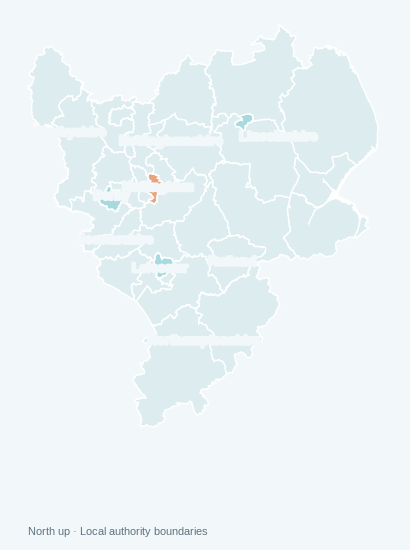
Compare all 35 areas: exact counts and education deprivation
| Council area | All LSOAs | Overall IMD decile 1 | Education domain decile 1 |
|---|---|---|---|
| Nottingham | 179 | 55 (30.7%) | 34 (19.0%) |
| Leicester | 200 | 40 (20.0%) | 70 (35.0%) |
| Lincoln | 60 | 12 (20.0%) | 17 (28.3%) |
| Derby | 152 | 28 (18.4%) | 31 (20.4%) |
| East Lindsey | 82 | 12 (14.6%) | 13 (15.9%) |
| Mansfield | 68 | 9 (13.2%) | 16 (23.5%) |
| Boston | 39 | 5 (12.8%) | 14 (35.9%) |
| Ashfield | 77 | 9 (11.7%) | 12 (15.6%) |
| Chesterfield | 69 | 8 (11.6%) | 5 (7.2%) |
| West Lindsey | 53 | 6 (11.3%) | 5 (9.4%) |
| Erewash | 73 | 6 (8.2%) | 9 (12.3%) |
| Bassetlaw | 69 | 5 (7.2%) | 15 (21.7%) |
| Bolsover | 50 | 3 (6.0%) | 10 (20.0%) |
| High Peak | 59 | 3 (5.1%) | 3 (5.1%) |
| North East Derbyshire | 64 | 3 (4.7%) | 4 (6.3%) |
| North Northamptonshire | 205 | 9 (4.4%) | 28 (13.7%) |
| Newark and Sherwood | 74 | 3 (4.1%) | 8 (10.8%) |
| Amber Valley | 79 | 3 (3.8%) | 8 (10.1%) |
| South Kesteven | 84 | 3 (3.6%) | 4 (4.8%) |
| Derbyshire Dales | 43 | 1 (2.3%) | 1 (2.3%) |
| West Northamptonshire | 238 | 5 (2.1%) | 14 (5.9%) |
| Charnwood | 102 | 2 (2.0%) | 2 (2.0%) |
| South Holland | 51 | 1 (2.0%) | 7 (13.7%) |
| North West Leicestershire | 60 | 1 (1.7%) | 3 (5.0%) |
| South Derbyshire | 62 | 1 (1.6%) | 2 (3.2%) |
| Gedling | 77 | 1 (1.3%) | 1 (1.3%) |
| Blaby | 60 | 0 (0.0%) | 0 (0.0%) |
| Broxtowe | 71 | 0 (0.0%) | 1 (1.4%) |
| Harborough | 52 | 0 (0.0%) | 0 (0.0%) |
| Hinckley and Bosworth | 68 | 0 (0.0%) | 0 (0.0%) |
| Melton | 30 | 0 (0.0%) | 2 (6.7%) |
| North Kesteven | 66 | 0 (0.0%) | 0 (0.0%) |
| Oadby and Wigston | 36 | 0 (0.0%) | 0 (0.0%) |
| Rushcliffe | 69 | 0 (0.0%) | 0 (0.0%) |
| Rutland | 26 | 0 (0.0%) | 0 (0.0%) |
Each measure uses its own national ranking. These are neighbourhood shares, not population poverty rates or assessments of individual learners. A zero does not mean an absence of disadvantage.
TA calculations from corrected MHCLG IoD2025 File 7: decile 1 neighbourhoods divided by all 2021 LSOAs in each authority. Regional denominator: 2,847 LSOAs. ONS May 2024 boundaries, generalised. Contains OS data and National Statistics data © Crown copyright and database right 2026.
EMCCA: established allocations and targeted commissioning
EMCCA’s adult skills geography contains 17 district or unitary areas across its four constituent councils. Current commissioning sits alongside established college and council provision. Its May 2026 decision rolled grant allocations forward and extended procured contracts into academic year 2026/27, subject to performance.
The current allocation annex records £49,793,310 of ASF and £3,016,590 of FCfJ across named providers. These are provider-allocation totals in that decision, not additional government funding to add to the single allocation. The schedule includes substantial delivery through Nottingham College, Derby College Group, Derbyshire County Council and West Nottinghamshire College.
Skills Bootcamps use more than one route. The July 2026 grant decision approved £1,168,439.52 across six grant providers and 19 programmes. A separate procured programme decision approved £2,275,255, with named winners across six lots. The tables later in this article distinguish those decisions and their provider rows.
The approved Bootcamp programme exceeds the Bootcamp component in the original government allocation because EMCCA can move funding within its single adult skills allocation. The local award decisions show how the wider settlement is being used; they are not separate funding to add to the government total.
The procurement record also reveals a practical barrier to entry. The Wave 7 competition, reference DN815523, used the Adult Skills and Learning DPS RM6348, established by Crown Commercial Service and now administered by the Government Commercial Agency (GCA). The report records 207 eligible suppliers, but five could not be invited because they were not registered on the required e-sourcing platform. A DPS appointment alone did not make every supplier reachable for the competition.
Provider implication: check the full chain before the next call-off: DPS membership, correct categories and geography, the buyer’s e-sourcing account, and monitored contact details. Then test how your offer complements existing provision and demonstrates real employer demand. No fresh open ASF competition was established at the review date.
Leicester, Leicestershire and Rutland: separate the city, county and programme
Leicester City Council and Leicestershire County Council are different buyers. Leicester City Council runs the evidenced Skills Bootcamps programme for Leicester and Leicestershire. The county council’s adult-learning service, the city’s adult education service and Rutland’s learning arrangements require separate monitoring.
The May 2026 Skills Bootcamps guidance offered £1.275m for delivery and 402 participants through a single-stage grant application submitted by email. The deadline was midnight on 12th June 2026. That round is closed. The programme’s general provider page still refers to Wave 6 and 2025/26, which makes the dated current-year guidance essential.
This is a clear reason to monitor programme pages as well as tender portals. A provider relying only on procurement alerts could miss an application route published through a council’s employment or skills service. Use the actual guidance to establish the year, eligible delivery area, process and closing date.
Leicester Adult Education Service also issued a 2026/27 ASF and FCfJ partner call of up to £1.2m, seeking up to ten providers. The call generally sought proposals of £50,000 to £300,000, with a 20% management fee. Its deadline was midnight on 18th September 2026, so this is a completed application window, not a current invitation.
That partner call focuses on Leicester residents. It does not establish a county-wide allocation, a Rutland opportunity or a new devolved authority. The money and the learner geography need to stay attached to the particular agreement.
Provider implication: maintain separate city, county and Rutland records. For each, record the adult-learning service, programme page, provider application route and current contact point. Ask about the next assessment or commissioning window before investing in a proposal against an old form.
Leicester shows why a promised alert is not a monitoring system. Leicester City Council told TA on 17th March 2026 that it would add us to its list and notify us when the Wave 7 call opened. The alert did not arrive. When TA followed up on 22nd June after checking the programme website, the deadline had passed. On 23rd June, the council apologised and confirmed that applications were closed. Its published guidance had required submissions by midnight on 12th June.
That communication failure matters: an interested organisation had asked in good time and still missed its chance to respond. Maintain checks of the Leicester Employment Hub programme page and grant guidance even when a buyer has promised an update. The opportunity you never saw explains why an alert list should support active monitoring rather than replace it.
Northamptonshire: adult learning and Bootcamps have different leads
North Northamptonshire and West Northamptonshire are the two unitary councils covering the county. Northamptonshire Adult Learning Service is led by North Northamptonshire Council and serves both areas. West Northamptonshire Council leads the separately evidenced Bootcamp programme. The two routes should not be merged into one assumed county-wide contract.
The adult-learning service’s policy dated 5th October 2026 covers ASF and FCfJ subcontracting and grants in 2026/27. It identifies a framework, open competitions and other approved routes, with a 15% management fee for delivery subcontracting. That policy explains how the service can commission partners; it does not by itself establish a live competition or an uncommitted allocation.
West Northamptonshire’s 2026/27 Bootcamp allocation is £1.5m including £400,000 construction. Its current course directories show an established provider footprint. A provider’s presence in that directory demonstrates advertised delivery, not a new award, a guaranteed future volume or an open supplier application.
The wider South Midlands economy matters for employer relationships and progression. However, its LSIP and employment programmes also cover Bedfordshire, Luton and Milton Keynes. A whole-programme budget or vacancy forecast cannot be attributed solely to the two Northamptonshire councils.
Provider implication: investigate the North Northamptonshire-led adult-learning route and the West Northamptonshire Bootcamp route separately. Match your proposed geography, learner recruitment and employer commitments to the specific agreement. Use the wider South Midlands plan to understand connections without overstating local funded demand.
A cabinet decision is not a reliable starting gun for supplier monitoring. When TA asked West Northamptonshire Council about the timetable on 16th March 2026, following its 10th March cabinet decision, the council confirmed that the Connect to Work (CtW) contract had already been awarded and Bootcamp grant applications were due on 6th April 2026. Providers waiting for a future tender notice could therefore have been looking at the wrong stage.
Monitor grant calls and programme pages alongside procurement notices. Ask whether the next step is admission, a grant application, a competition or an award. The £1.5 million annual allocation supports an established delivery programme; it does not establish that a new supplier application window is open.
Lincolnshire: a wider devolved system and a framework refresh
Lincolnshire County Council and its seven districts sit within Greater Lincolnshire Combined County Authority (GLCCA)’s adult skills system. The combined county authority also includes North Lincolnshire and North East Lincolnshire, outside the statistical region covered here. Whole Greater Lincolnshire funding and provider awards therefore need a wider-area label.
Lincolnshire County Council runs relevant procurement through PANACEA. The Adult Skills and Employment Programmes framework refresh, reference PL24/111, is open for applications. Existing providers retain their places and can apply for additional lots.
The three lots cover non-accredited provision, accredited skills, and other skills and employment-related activity. Issued buyer instructions set submissions for 30th November 2026, with appointments planned from 1st February 2027. Review the current opportunity note and confirm the exact cutoff and any amendments in PANACEA.
The advertised £87m including VAT is the estimated framework value across its scope. It is not Lincolnshire county’s annual adult skills allocation or a guaranteed sum for new entrants. Use the issued procurement documents and permitted clarification process to understand how admission will lead to call-offs, which geographical coverage is required and how specialist providers will be invited.
Current awards provide a useful competition map. The Greater Lincolnshire accredited Lot 2 notice names 17 providers for 2026/27. Lincolnshire County Council’s separate non-accredited Lot 1 notice has 14 contract entries across 13 suppliers. These are awarded delivery arrangements, separate from admission through the current refresh. A separate county accredited award names eight suppliers across nine contract entries. The provider directory retains those programme distinctions.
Provider implication: build the case around a locally evidenced need, such as food production, engineering, construction, care, logistics or workforce progression. Establish the learner catchment and practical facilities before claiming county-wide coverage. Use the framework refresh to test whether the lot and call-off design can support a viable specialist offer.
The councils and local services to keep in view
The directory covers all 35 district or unitary areas and identifies the county layer where it applies. It distinguishes regional funding responsibility from local adult learning, employment support, employer engagement and community access.
Not every council holds a devolved skills allocation or has a live procurement. Districts can still be important to a delivery proposition through local economic development, community relationships and referral networks. Check the contracting body for the particular programme rather than inferring it from a place name.
On 29th October 2026, government withdrew the July reorganisation decisions for Lincolnshire, North Lincolnshire and North East Lincolnshire; Derbyshire and Derby; Nottinghamshire and Nottingham; and Leicestershire, Leicester and Rutland. All proposals remain under consideration. Use the current councils for procurement and partnerships, and monitor final decisions before assuming a replacement buyer structure.
Buyer and delivery geography
Find the lead. Build the local delivery relationships.
Choose a shaded area or a commissioning geography below to see the programme lead and local council network.
Select a numbered area
Selected geography
Derby and Derbyshire
- Programme lead
- EMCCA: devolved adult skills and Bootcamps.
- Delivery and access
- Derby City Council and Derbyshire County Council are constituent authorities. Derbyshire Adult Community Education Service is a funded delivery partner. Districts connect local employers, communities and referrals.
- Local council network
- Amber Valley · Bolsover · Chesterfield · Derby · Derbyshire Dales · Erewash · High Peak · North East Derbyshire · South Derbyshire
Complete directory: 35 council areas
| Council area | Upper-tier area | Commissioning geography |
|---|---|---|
| Amber Valley | Derbyshire | Derby and Derbyshire |
| Ashfield | Nottinghamshire | Nottingham and Nottinghamshire |
| Bassetlaw | Nottinghamshire | Nottingham and Nottinghamshire |
| Blaby | Leicestershire | Leicester, Leicestershire and Rutland |
| Bolsover | Derbyshire | Derby and Derbyshire |
| Boston | Lincolnshire | Lincolnshire |
| Broxtowe | Nottinghamshire | Nottingham and Nottinghamshire |
| Charnwood | Leicestershire | Leicester, Leicestershire and Rutland |
| Chesterfield | Derbyshire | Derby and Derbyshire |
| Derby | Derby | Derby and Derbyshire |
| Derbyshire Dales | Derbyshire | Derby and Derbyshire |
| East Lindsey | Lincolnshire | Lincolnshire |
| Erewash | Derbyshire | Derby and Derbyshire |
| Gedling | Nottinghamshire | Nottingham and Nottinghamshire |
| Harborough | Leicestershire | Leicester, Leicestershire and Rutland |
| High Peak | Derbyshire | Derby and Derbyshire |
| Hinckley and Bosworth | Leicestershire | Leicester, Leicestershire and Rutland |
| Leicester | Leicester | Leicester, Leicestershire and Rutland |
| Lincoln | Lincolnshire | Lincolnshire |
| Mansfield | Nottinghamshire | Nottingham and Nottinghamshire |
| Melton | Leicestershire | Leicester, Leicestershire and Rutland |
| Newark and Sherwood | Nottinghamshire | Nottingham and Nottinghamshire |
| North East Derbyshire | Derbyshire | Derby and Derbyshire |
| North Kesteven | Lincolnshire | Lincolnshire |
| North Northamptonshire | North Northamptonshire | Northamptonshire |
| North West Leicestershire | Leicestershire | Leicester, Leicestershire and Rutland |
| Nottingham | Nottingham | Nottingham and Nottinghamshire |
| Oadby and Wigston | Leicestershire | Leicester, Leicestershire and Rutland |
| Rushcliffe | Nottinghamshire | Nottingham and Nottinghamshire |
| Rutland | Rutland | Leicester, Leicestershire and Rutland |
| South Derbyshire | Derbyshire | Derby and Derbyshire |
| South Holland | Lincolnshire | Lincolnshire |
| South Kesteven | Lincolnshire | Lincolnshire |
| West Lindsey | Lincolnshire | Lincolnshire |
| West Northamptonshire | West Northamptonshire | Northamptonshire |
District and borough boundaries follow ONS December 2024 geography. Programme leads are described separately from councils that help recruit, support and connect learners. Contains OS and National Statistics data © Crown copyright and database right 2026.
Specific local learning and employment roles
Derby
Unitary and EMCCA constituent council. Council adult learning and CtW delivery create local entry and referral relationships.
Nottingham
Unitary and EMCCA constituent council. Local adult learning, employment services and community access sit alongside regional skills commissioning.
Leicester
Unitary council and operator of the Leicester/Leicestershire Bootcamp grant route. Its separate ASF/FCfJ partner call focuses on city residents. Accountable body for LLR CtW.
Rutland
Unitary council with Adult Learning and Skills Service and a role in LLR CtW. Do not assume inclusion in the Leicester/Leicestershire Bootcamp grant.
North Northamptonshire
Lead council for Northamptonshire Adult Learning Service across both unitary areas; current ASF/FCfJ partner policy includes a 15% management fee for delivery subcontracting.
West Northamptonshire
Bootcamp programme lead and CtW commissioner. Shared adult learning is led by North Northamptonshire Council.
Who is already delivering, and what would you add?
Current provider allocations, awards and course listings answer different questions. An allocation identifies funded provision; an award records a contract; a framework appointment establishes access; and a course listing demonstrates an advertised offer. They do not establish provider quality, local market share or spare subcontracting capacity.
The current EMCCA allocation annex and Bootcamp decisions make its incumbent landscape visible. Greater Lincolnshire’s accredited awards and Lincolnshire County Council’s non-accredited awards show two different parts of that delivery system. Leicester and Northamptonshire also require attention to council services and advertised provision, with each source labelled below.
Use those records to identify overlap and a defensible contribution. That may be specialist equipment, an employer network, a neglected locality, a practical progression step or stronger access for a particular learner group. A long list of sectors is less persuasive than evidence of the gap your organisation can fill.
For a potential partnership, establish whether the agreement permits subcontracting, what approval is required, who owns recruitment and outcomes, and how the fee and payment terms affect delivery. An incumbent’s allocation is not evidence that it is seeking partners.
Provider evidence / explore the lists
Identify the existing offer before defining your contribution.
EMCCA · 43 ASF and FCfJ allocation rows · 2026/27
| Provider | Programme / route | Published allocation |
|---|---|---|
| ACADEMY TRANSFORMATION TRUST | ASF / Grant | £2,738,106 |
| BURTON AND SOUTH DERBYSHIRE COLLEGE | ASF / Grant | £315,367 |
| CHESTERFIELD COLLEGE | ASF / Grant | £1,805,986 |
| DERBY COLLEGE GROUP | ASF / Grant | £4,750,745 |
| DERBY CITY COUNCIL | ASF / Grant | £2,861,954 |
| DERBYSHIRE COUNTY COUNCIL | ASF / Grant | £4,516,125 |
| LINCOLN COLLEGE | ASF / Grant | £455,684 |
| NOTTINGHAM CITY COUNCIL | ASF / Grant | £540,075 |
| NOTTINGHAM COLLEGE | ASF / Grant | £16,018,319 |
| NOTTINGHAM TRENT UNIVERSITY | ASF / Grant | £19,875 |
| NOTTINGHAMSHIRE COUNTY COUNCIL | ASF / Grant | £2,930,867 |
| RNN GROUP | ASF / Grant | £1,166,647 |
| TEC PARTNERSHIP | ASF / Grant | £1,523,007 |
| UNIVERSITY OF DERBY | ASF / Grant | £311,015 |
| WEST NOTTINGHAMSHIRE COLLEGE | ASF / Grant | £4,425,106 |
| WORKERS EDUCATION ASSOCIATION | ASF / Grant | £1,007,597 |
| TAMESIDE COLLEGE | ASF / Grant | £50,000 |
| THE CONSTRUCTION SKILLS PEOPLE LTD | ASF / Procured | £650,000 |
| ORANGEBOX TRAINING SOLUTIONS UK LIMITED | ASF / Procured | £649,094 |
| MOMENTUM RECRUITMENT LIMITED | ASF / Procured | £650,000 |
| JUST IT TRAINING LIMITED | ASF / Procured | £618,040 |
| ACCESS TRAINING (EAST MIDLANDS) LTD | ASF / Procured | £616,372 |
| PATHWAY FIRST LIMITED | ASF / Procured | £648,652 |
| BACK 2 WORK COMPLETE TRAINING LIMITED | ASF / Procured | £524,677 |
| ACADEMY TRANSFORMATION TRUST | FCfJ / Grant | £1,073 |
| BURTON AND SOUTH DERBYSHIRE COLLEGE | FCfJ / Grant | £23,346 |
| CHESTERFIELD COLLEGE | FCfJ / Grant | £70,274 |
| DERBY COLLEGE GROUP | FCfJ / Grant | £224,108 |
| DERBY CITY COUNCIL | FCfJ / Grant | £16,708 |
| DERBYSHIRE COUNTY COUNCIL | FCfJ / Grant | £27,715 |
| LINCOLN COLLEGE | FCfJ / Grant | £3,279 |
| NOTTINGHAM COLLEGE | FCfJ / Grant | £237,535 |
| NOTTINGHAMSHIRE COUNTY COUNCIL | FCfJ / Grant | £23,318 |
| RNN GROUP | FCfJ / Grant | £21,286 |
| UNIVERSITY OF DERBY | FCfJ / Grant | £50,679 |
| WEST NOTTINGHAMSHIRE COLLEGE | FCfJ / Grant | £170,419 |
| THE CONSTRUCTION SKILLS PEOPLE LTD | FCfJ / Procured | £294,948 |
| MOMENTUM RECRUITMENT LIMITED | FCfJ / Procured | £400,000 |
| JUST IT TRAINING LIMITED | FCfJ / Procured | £252,027 |
| BACK 2 WORK COMPLETE TRAINING LIMITED | FCfJ / Procured | £286,124 |
| THINK EMPLOYMENT LTD | FCfJ / Procured | £204,240 |
| COMMUNITY TRAINING PORTAL LTD | FCfJ / Procured | £101,964 |
| LEARNING CURVE GROUP LTD | FCfJ / Procured | £607,547 |
Source: EMCCA’s May 2026 allocation annex. These rows total £49,793,310 ASF and £3,016,590 FCfJ, subject to performance. A provider may appear in both programmes; 43 rows does not mean 43 distinct providers. Allocations are not actual expenditure.
EMCCA · contracted Wave 7 Bootcamps · approved awards
| Provider | Lot / sector | Approved amount |
|---|---|---|
| Smart Gas Training and Assessment Centre Limited | Lot 1 / Construction and renewable | £397,500 |
| Talented Training Ltd | Lot 1 / Construction and renewable | £347,400 |
| Staff Power Training Ltd | Lot 1 / Construction and renewable | £330,355 |
| Tech Educators Limited | Lot 2 / Digital | £215,000 |
| Think Employment Ltd | Lot 2 / Digital | £85,000 |
| Think Employment Ltd | Lot 3 / Early Years and Education | £75,300 |
| Mastered Studios | Lot 3 / Early Years and Education | £24,700 |
| Maya Rail Technical Training and Consultancy | Lot 4 / Engineering | £271,700 |
| Momentum Recruitment Limited | Lot 4 / Engineering | £128,300 |
| Derby Business College Limited | Lot 5 / Leadership and Management | £112,500 |
| Mastered Studios | Lot 5 / Leadership and Management | £87,500 |
| Think Employment Ltd | Lot 6 / Transport | £186,725 |
| Momentum Recruitment Limited | Lot 6 / Transport | £13,275 |
Source: final July 2026 decision and award annex. Thirteen provider/lot rows total £2,275,255 across nine organisations and six lots. The earlier recommendation report contained two conflicting rows; the final approved values are used here. This competition is closed.
EMCCA · grant-funded Wave 7 Bootcamps · 19 programmes
| Provider | Programme | Approved grant |
|---|---|---|
| Chesterfield College | Sustainable construction | £60,231.60 |
| Chesterfield College | First line management | £33,264 |
| Chesterfield College | Teaching assistant | £60,035.84 |
| DACES (Derbyshire County Council) | Early years professional work ready | £41,750 |
| Lincoln College (Newark) | Emerging leaders | £99,973.44 |
| Lincoln College (Newark) | Reachigher forklift | £22,106.40 |
| Lincoln College (Newark) | Drive2Work HGV | £158,760 |
| Nottingham College | Green transport electric/hybrid hazard management | £59,500 |
| RNN Group | Air source heat pump design and heat loss | £61,952 |
| RNN Group | Drone construction operations | £96,445.44 |
| RNN Group | Air source heat pump installation and maintenance | £92,928 |
| RNN Group | Industrial fluid power and automation | £76,933.80 |
| West Nottinghamshire College | Advanced welding | £46,800 |
| West Nottinghamshire College | AI and change management | £14,322 |
| West Nottinghamshire College | Civil construction groundworks and rail | £141,780 |
| West Nottinghamshire College | Electrical test and inspection | £20,640 |
| West Nottinghamshire College | Engineering manufacturing | £17,800 |
| West Nottinghamshire College | Sustainable leadership | £16,456 |
| West Nottinghamshire College | Welding employment | £46,761 |
Source: July 2026 grant decision and programme annex. Six grant providers, 19 programmes and £1,168,439.52 in approved grants. These local programme decisions sit within the flexible adult skills allocation, not on top of it.
Leicester and Leicestershire · advertised Bootcamp providers
| Provider | Advertised specialism |
|---|---|
| GTR Training Services | Construction plant |
| Construct Training Services | Groundworks, road building and construction plant |
| Road to Logistics | Civils, groundworks, HGV and warehousing |
| Sysco Business Skills Academy | Drainage and technical skills |
| Fareport Training Organisation | Data analytics with AI |
| Future Connect Training and Recruitment | Data analytics and visualisation |
| Enterprise4All | AI Product Builder |
| Insite | HGV Category C/C+E and forklift |
| Momentum Recruitment | Warehousing, logistics and forklift |
Source: current council Employment Hub course directories, checked on 21st October 2026. Selected named examples show advertised provision. They do not establish a complete Wave 7 award list or individual contract values; check dated course information before assuming starts remain available.
West Northamptonshire · advertised Bootcamp providers
| Provider | Advertised provision |
|---|---|
| Moulton College | Groundworks; food production |
| STC Group | Retrofit/repair/refurbishment; groundwork |
| House Builder XL (HBXL) | Construction management pathway |
| Aspect Total Training | Scaffolding; listed venue Coventry, outside East Midlands |
| Northampton College | Green/retrofit; welding; construction/CSCS; scaffolding; ESOL for warehousing |
| Skills People Group | Civil engineering/groundworks; site supervision |
| SPS Training | Warehouse and logistics |
| Momentum Group | Warehousing, logistics and forklift |
| Insite Training | HGV C/C+E for employer-cofunded existing staff |
| BioGrads / BioGrad | Laboratory skills and biotechnology |
| Mastered Studios | Business and AI for freelancers and small businesses |
| Runway Training | Leadership and management; standalone council listing |
Source: West Northamptonshire Council’s current course directories and individual listings. These are advertised courses rather than a verified award schedule. One listed venue is outside the East Midlands; learner eligibility and the actual delivery location remain programme-specific.
Greater Lincolnshire · Accredited adult skills AY2026/27 · 17 suppliers
| Awarded supplier | Programme / area |
|---|---|
| Acorn Training | Greater Lincolnshire |
| Derby Business College | Greater Lincolnshire |
| DMR Training & Consultancy | Greater Lincolnshire |
| Hull College Group | Greater Lincolnshire |
| Learning Curve Group | Greater Lincolnshire |
| McGovern Assessments | Greater Lincolnshire |
| Momentum Recruitment | Greater Lincolnshire |
| Peter Smythe Transport Training | Greater Lincolnshire |
| Realise Learning and Employment | Greater Lincolnshire |
| Staff Power Training | Greater Lincolnshire |
| Steadfast Training | Greater Lincolnshire |
| Teach Vocation Group | Greater Lincolnshire |
| The Construction Skills People | Greater Lincolnshire |
| Think Employment | Greater Lincolnshire |
| Total Futures | Greater Lincolnshire |
| TRN (Train) | Greater Lincolnshire |
| Workpays | Greater Lincolnshire |
Source: official 2026/27 award notice. These are awarded call-offs, separate from admission through the current framework refresh. The Greater Lincolnshire list covers the whole CCA; the county lists are separate programme records. Exact individual award values are not reproduced because a complete primary dataset was not accessible.
Lincolnshire County Council · Lot1 non-accredited AY2026/27 · 13 suppliers
| Awarded supplier | Programme / area |
|---|---|
| 3CATS | Lot1 non-accredited AY2026/27 |
| The Abbey Access Centre | Lot1 non-accredited AY2026/27 |
| AKG (UK) Learning | Lot1 non-accredited AY2026/27 |
| Boston College | Lot1 non-accredited AY2026/27 |
| Community Learning in Partnership | Lot1 non-accredited AY2026/27 |
| East Lindsey ITEC / First College | Lot1 non-accredited AY2026/27 |
| Gainsborough Trinity Foundation | Lot1 non-accredited AY2026/27 |
| Lincoln College | Lot1 non-accredited AY2026/27 |
| Medex (Group) | Lot1 non-accredited AY2026/27 |
| Realise Learning and Employment | Lot1 non-accredited AY2026/27 |
| Riverside Access and Training Centre Gainsborough | Lot1 non-accredited AY2026/27 |
| Taylor ITEX CIC | Lot1 non-accredited AY2026/27 |
| Think Employment | Lot1 non-accredited AY2026/27 |
Source: official 2026/27 award notice. These are awarded call-offs, separate from admission through the current framework refresh. The Greater Lincolnshire list covers the whole CCA; the county lists are separate programme records. Exact individual award values are not reproduced because a complete primary dataset was not accessible.
Lincolnshire County Council · Lot2 accredited AY2026/27 · 8 suppliers
| Awarded supplier | Programme / area |
|---|---|
| 3CATS | Lot2 accredited AY2026/27 |
| The Abbey Access Centre | Lot2 accredited AY2026/27 |
| Community Learning in Partnership | Lot2 accredited AY2026/27 |
| East Lindsey ITEC / First College | Lot2 accredited AY2026/27 |
| Maya Rail Technical Training & Consultancy | Lot2 accredited AY2026/27 |
| Orangebox Training Solutions UK | Lot2 accredited AY2026/27 |
| I & F Limited / Skills4 | Lot2 accredited AY2026/27 |
| Skills-UK Education & Training | Lot2 accredited AY2026/27 |
Source: official 2026/27 award notice. These are awarded call-offs, separate from admission through the current framework refresh. The Greater Lincolnshire list covers the whole CCA; the county lists are separate programme records. Exact individual award values are not reproduced because a complete primary dataset was not accessible.
Local learning and employment networks · partnership context
| Area | Organisations / current role |
|---|---|
| Leicester, Leicestershire and Rutland | Leicester College: technical FE anchor. GoLearn and Rutland Adult Learning and Skills Service: local adult/community learning. Twin Employment and Training and Intuitive Thinking Skills: named CtW partners. |
| Derbyshire and Nottinghamshire | Nottingham College, Derby College Group, Chesterfield College and West Nottinghamshire College appear in current programme evidence. Derbyshire Adult Community Education Service combines local access with funded delivery. Reed, Asuria and councils have CtW roles. |
| Northamptonshire | Northampton College and Moulton College appear in the Bootcamp directories. Northamptonshire Adult Learning Service is the shared council route. Acorn Training holds the evidenced West Northamptonshire CtW contract. |
| Lincolnshire | CLIP’s CtW consortium includes Riverside Training, Abbey Access Training, Lincolnshire Action Trust, Green Synergy, YMCA Lincolnshire, Lincoln City Foundation, First College, Development Plus and Pelican Trust. |
Sources: current council, award and named-provider publications. These organisations can be competitors, delivery anchors or partners depending on the programme. The list is not a ranking or market-share estimate.
Employment programmes shape the learner pipeline
CtW provides supported employment alongside the learning system. Its accountability, delivery partners and contracts are separate from ASF and Bootcamps. These programmes can create important referral and employer relationships, but their budgets should not be added to course allocations as if they funded the same activity.
In the EMCCA area, the published £44.2m CtW programme for 2026 to 2030 names Reed in Partnership with Derby and Derbyshire councils, and Asuria for Nottingham and Nottinghamshire. Understand how the employment service identifies participants and supports a move into suitable work before proposing training as part of that pathway.
Leicester, Leicestershire and Rutland’s CtW programme has £17.2m over April 2025 to March 2030, with Leicester City Council as accountable body and the county and Rutland councils as partners. The city’s September 2026 announcement names Twin Employment and Training and Intuitive Thinking Skills among the delivery partners.
The South Midlands programme covers six councils and has a £32m programme total. West Northamptonshire’s stated local share is £6.1m. Neither figure is a Northamptonshire-wide annual training allocation. A current West Northamptonshire award names Acorn Training, with a signed contract value of £1,422,033 excluding VAT running to 31st March 2030; it is awarded work, not an open competition.
For Greater Lincolnshire, Lincolnshire County Council is the accountable body across all three constituent councils. National guidance gives a rounded £23.4m total programme grant and 6,000 starts. Those figures include the two northern councils outside this fact file and should not be presented as Lincolnshire county-only totals.
Within Lincolnshire county, CLIP reports nearly £4m for a consortium supporting more than 900 people over three years. Partners include Riverside Training, Abbey Access Training, Lincolnshire Action Trust, Green Synergy, YMCA Lincolnshire, Lincoln City Foundation, First College, Development Plus and Pelican Trust. This is a component of the wider programme, not additional money. It identifies a practical network for a provider with a specialist contribution to employment support.
Provider implication: connect learning to an actual progression route. Establish the employer role, referral partner, participant support and evidence needed for a sustained outcome. Training capacity and employment support need a clear division of responsibilities.
Prepare for local commissioning, and use engagement to shape it
The national contracting direction makes local relationships more important in the parts of the region that remain outside full ASF devolution. The DfE update of 30th September 2026 says current nationally procured ASF service contracts expire on 1st August 2027. It does not plan a national procurement for 2027/28; instead, it intends to expand Pathway to Devolution, transferring relevant funding to local authorities. Grant funding agreements are unaffected by that stated change.
That announcement is not a blanket invitation to bid to every council now. Track the actual local allocation, commissioning decision and provider-entry process. For an incoming provider, the task is to understand which authority will purchase the relevant provision and when its route becomes accessible.
Use pre-market engagement to improve the specification as well as your own bid decision. For Greater Lincolnshire, follow the completed engagement stage into the published procurement documents and use the permitted clarification process to test the delivery requirements.
- Which occupations and levels have current employer demand, and where is existing funded provision failing to meet it?
- Will call-offs separate geography, sector and learner need so that specialist providers can compete on a viable scope?
- Which application systems, categories and location filters will determine who receives invitations?
- What minimum volumes, mobilisation periods and practical facilities will be required?
- Who will secure referrals, work experience, interviews and employer release, and how will those commitments be verified?
- Which learner-support, travel, equipment and mobilisation costs are fundable, and when are payments earned and paid?
- How will engagement participants be notified of publication, clarifications and later call-offs?
The next moves to put in your regional plan
Focus on a route that is accessible to your organisation and a delivery gap that you can evidence. Established allocations, a closed partner call and a framework refresh moving beyond engagement require different actions.
Commissioning watchlist: 21st October 2026
An established programme calls for positioning; a closed round calls for preparation; a framework refresh calls for checking the current admission stage. Match your next action to the buyer’s actual stage.
| Area | Current position | Practical action |
|---|---|---|
| EMCCA | Current allocations and Wave 7 decisions; no fresh open ASF competition verified. | Check all required supplier platforms and categories before the next call-off. |
| Leicester and Leicestershire | Bootcamp grant round closed on 12th June 2026; city ASF/FCfJ partner call closed on 18th September 2026. | Monitor the city’s programme and adult-education pages for the next route; keep county and Rutland channels separate. |
| Northamptonshire | North-led shared adult learning and West-led Bootcamps have distinct routes. | Check current framework or competition instructions and the specific learner geography. |
| Lincolnshire / Greater Lincolnshire | Advertised engagement dates have passed; 9th November 2026 was the estimated tender-publication date. | Check PANACEA for issued documents, admission requirements and the application timetable. |
| Non-devolved ASF areas | National service-contract transition planned for 2027/28. | Track council commissioning decisions; do not assume a new national procurement. |
TA view: choose the buyer and the problem before the course
The East Midlands combines industrial specialisms, city skills markets, rural and coastal access challenges, and several different routes into funded delivery. EMCCA’s name can obscure that wider picture. The region needs a buyer map that follows the actual funding and a delivery model that follows the local learner and employer.
Choose an occupation, a catchment and a realistic entry route. Understand who already serves that market, prove the contribution your organisation can make and prepare the registrations and relationships before the next invitation. That gives a regional growth plan a practical basis.
Sources and scope
Research checked on 21st October 2026. Primary evidence includes national adult skills and Skills Bootcamps allocations; current authority decisions, provider schedules and award notices; council programme and subcontracting information; CtW publications; the available 2026 to 2029 LSIP material and the dated East Midlands draft identified in the article. Deprivation calculations use MHCLG’s English Indices of Deprivation 2025, corrected File 7, with 2024 local authority boundaries. The SSA mapping, calculated totals and provider implications are TA analysis. Source registers retain exact references, programme periods, geographical scope and identified evidence limits. No unverified current tender deadline is presented as an open opportunity.
Continue the thinking
England’s skills sectors
Compare the national picture across all 15 subject areas.
What makes local delivery credible?
Turn your chosen geography into a convincing delivery case.
Shape the opportunity before the tender
Use buyer engagement to test and strengthen your proposition.