
The East of England is a collection of connected labour markets rather than a single commissioning system. Cambridge’s science and technology economy, the Energy Coast, Greater Essex’s ports and industry, Hertfordshire’s specialist clusters and Bedfordshire’s logistics corridors require different delivery propositions.
This fact file connects current funding, employer priorities, buyer routes and the existing provider landscape. Its commercial purpose is to help a provider choose where to build capability, relationships and a realistic pipeline.
In this article
One region, five different routes into the market
The East of England combines a devolved adult skills system led by Cambridgeshire and Peterborough Combined Authority (CPCA) with county-led Bootcamps and nationally funded adult education elsewhere. Start with the learner’s postcode, the funding holder and the programme. A relationship with a county council does not automatically provide access to every funding stream operating there.
Five LSIP footprints explain employer demand: Cambridgeshire and Peterborough, Greater Essex, Hertfordshire, Norfolk and Suffolk, and the South Midlands. The last includes Bedford, Central Bedfordshire and Luton alongside Milton Keynes and both Northamptonshire councils. Those cross-boundary relationships matter for recruitment and employer partnerships, but their entire budgets cannot be assigned to this region.
Use existing councils as the practical directory. The 29th October 2026 update withdrew Hertfordshire’s July reorganisation decision. Essex, Norfolk, Suffolk and Cambridgeshire and Peterborough remain in the review, with no new decision announced. Track future structures alongside the body holding today’s grant or contract.
Funding geography / routes to market
Start with the commissioner, then define the catchment.
01 / Commissioning geography
Cambridgeshire and Peterborough
Route to understandMixed grants and contracts. GCA RM6348 plus Due North/ProContract for published procurement route. Check category and geographical eligibility before the next invitation. An October decision adds £499,425 to FY 2026/27 Bootcamps funding and plans an autumn procurement for spring 2027 starts; follow the published invitation and timetable.
02 / Commissioning geography
Norfolk and Suffolk
Route to understandJoint county Bootcamp delivery; Suffolk Sourcing for Suffolk-led tenders. Earlier Wave 7 competition terminated on 5th February 2026. Current programme has limited places; monitor commissioning separately from learner waiting lists.
03 / Commissioning geography
Greater Essex
Route to understandWave 8: provider market engagement by 16th December 2026, followed by selective sector RFQ invitations. The final buyer notice replaces the previously used RM6348 route for this programme. Delivery anticipated May or June 2027, subject to funding and resources.
04 / Commissioning geography
Hertfordshire
Route to understandAugust 2026 Skills Bootcamp framework procurement, following May engagement. Check the council procurement listing and current framework position before planning an entry route.
05 / Commissioning geography
Bedfordshire and Luton
Route to understandBESA Bootcamps and separate council adult learning relationships. Follow each council’s commissioning record and South Midlands employment programme delivery teams.
Read the allocation alongside the route
Cambridgeshire and Peterborough’s published 2026/27 academic-year adult skills single allocation is £14,557,578. Adding its separately identified £143,419 Free Courses for Jobs (FCfJ) engineering allocation gives £14,700,997. This combines the published single-allocation total with the additional engineering line; it is not the amount available in a new tender.
Elsewhere, the 2026/27 financial-year Bootcamp maxima are £1.6 million for Essex, £1.9 million for Hertfordshire and £1.5 million each for Suffolk and Central Bedfordshire. Construction is included within each allocation. These grants sit alongside national Adult Skills Fund (ASF) provision and employment support, so there is no defensible single regional pot created by simply adding every published figure.
For non-devolved ASF, the current national rules cover 1st August 2026 to 31st July 2027. Providers need the relevant funding agreement or an authorised delivery partnership. LSIP alignment strengthens the case for provision, but does not itself secure a contract. Apprenticeships have a separate employer-led funding route; district regeneration projects and employment programmes require their own commissioning checks.
CPCA: Calculated total: published single allocation plus additional engineeringAcademic year 2026/27 · Devolved ASF, Bootcamps, FCfJ and additional FCfJ engineering£14,700,997
| Component | Amount | Period / scope |
|---|---|---|
| ASF core | £11,980,465 | AY 2026/27 |
| Skills Bootcamps | £1,500,000 | AY 2026/27 |
| FCfJ excluding engineering | £1,077,114 | AY 2026/27 |
| Published single-allocation total | £14,557,578 | AY 2026/27 |
| Additional FCfJ engineering | £143,419 | AY 2026/27 |
August 2026 grant determination. The published single total is £1 below the sum of its displayed components; headline uses that published total plus engineering. The single total already includes the first three lines. Separately, the October decision records £1,500,000 original Bootcamps funding plus £499,425 additional funding for financial year 2026/27: calculated programme funding £1,999,425. This financial-year programme figure is shown separately from the academic-year headline; the two figures should not be added together.
Essex County Council: Maximum grant allocationFinancial year 2026/27 · Greater Essex Bootcamps, including Southend-on-Sea and Thurrock£1,600,000
| Component | Amount | Period / scope |
|---|---|---|
| Skills Bootcamps | £1,600,000 | FY 2026/27 |
| Construction within the total | £400,000 | Included, not additional |
National Skills Bootcamps allocation table, updated 1st June 2026.
Hertfordshire County Council: Maximum grant allocationFinancial year 2026/27 · Hertfordshire Bootcamps£1,900,000
| Component | Amount | Period / scope |
|---|---|---|
| Skills Bootcamps | £1,900,000 | FY 2026/27 |
| Construction within the total | £500,000 | Included, not additional |
National Skills Bootcamps allocation table, updated 1st June 2026.
Suffolk County Council: Maximum grant allocationFinancial year 2026/27 · Joint Norfolk and Suffolk Bootcamp delivery£1,500,000
| Component | Amount | Period / scope |
|---|---|---|
| Skills Bootcamps | £1,500,000 | FY 2026/27 |
| Construction within the total | £400,000 | Included, not additional |
National Skills Bootcamps allocation table, updated 1st June 2026.
Central Bedfordshire Council: Maximum grant allocationFinancial year 2026/27 · Bootcamps benefiting Central Bedfordshire and Bedford Borough£1,500,000
| Component | Amount | Period / scope |
|---|---|---|
| Skills Bootcamps | £1,500,000 | FY 2026/27 |
| Construction within the total | £400,000 | Included, not additional |
National Skills Bootcamps allocation table, updated 1st June 2026.
Greater Essex: CtW: Separate employment programme fundingMulti-year programme · Essex, Southend-on-Sea and Thurrock£30.7 million
| Component | Amount | Period / scope |
|---|---|---|
| CtW programme | £30.7 million | Programme, not annual ASF |
January 2026 mobilisation announcement confirms three delivery partners. Not a new training tender.
South Midlands: CtW: Cross-regional programme fundingMulti-year programme · Six councils, including three outside the East of England£32 million
| Component | Amount | Period / scope |
|---|---|---|
| Whole South Midlands programme | £32 million | Not an East of England subtotal |
October 2025 launch: Bedford, Central Bedfordshire, Luton, Milton Keynes, North Northamptonshire and West Northamptonshire.
The strongest offer connects technical skills with progression
Across the five plans, digital adoption, leadership, work-readiness and progression sit alongside sector shortages. These are curriculum design requirements, rather than reasons to offer the same generic course everywhere. An AI course for food manufacturing supervisors should solve a different workplace problem from digital training for a care team or a creative microbusiness.
The SSA graphic is TA’s translation of the plans into curriculum areas. Start with the actual occupation, entry requirement and progression route, then choose the qualification or non-accredited intervention. The distinction matters particularly in construction and logistics, where employers may need a licence or demonstrated workplace competence as well as a certificate.
Local Skills Improvement Plans / delivery implications
Translate the sector priority into an occupational offer.
Cambridgeshire and Peterborough
Employer representative body: Cambridgeshire Chamber of Commerce
Published 2026 to 2029 plan
Local priorities: Advanced manufacturing and materials · Agri-food and technology · Digital technology · Life sciences · Defence · Energy and clean technology
Build technician and supervisory progression around employers; reach the Fens and Peterborough through a locally workable recruitment model.
Explore occupations, capabilities and delivery implications
| Priority | What this means for provision |
|---|---|
| SSA 4: Engineering and Manufacturing TechnologiesAdvanced manufacturing and materials | Automation, quality improvement, supply-chain capability and flexible technical upskilling. |
| SSA 3: Agriculture, Horticulture and Animal CareSSA 4: Engineering and Manufacturing TechnologiesSSA 7: Retail and Commercial EnterpriseAgri-food and technology | Food safety, digital production, data use and supervisor capability across the food supply chain. |
| SSA 6: Digital TechnologyDigital technology | TA delivery implication: Use the area’s existing emphasis on automation, quality and data to define practical digital projects. Distinguish user competence in production and food businesses from specialist systems, software or data roles. |
| SSA 2: Science and MathematicsSSA 4: Engineering and Manufacturing TechnologiesLife sciences | TA delivery implication: Test laboratory, quality, regulatory and data requirements with the relevant employer. Build a practical technician or specialist progression route with access to the right facilities; a science cluster does not establish an entry-level course opportunity on its own. |
| SSA 4: Engineering and Manufacturing TechnologiesDefence | TA delivery implication: Establish which supply-chain role needs training and which standards or security conditions apply. Use the profile’s flexible technical-upskilling approach to convert relevant manufacturing experience into evidenced capability. |
| SSA 4: Engineering and Manufacturing TechnologiesSSA 5: Construction, Planning and the Built EnvironmentEnergy and clean technology | TA delivery implication: Start with the actual engineering, installation or maintenance task. Connect flexible technical upskilling to employers’ equipment and quality requirements rather than treating clean technology as a stand-alone awareness topic. |
Greater Essex
Employer representative body: Essex Chambers of Commerce
Approved 2026 to 2029 plan
Local priorities: Construction and clean energy · Manufacturing and aviation · Digital · Creative industries · Health and care · Transport and logistics
Convert infrastructure and sector growth into named employer requirements and accessible entry-to-progression pathways.
Explore occupations, capabilities and delivery implications
| Priority | What this means for provision |
|---|---|
| SSA 4: Engineering and Manufacturing TechnologiesSSA 5: Construction, Planning and the Built EnvironmentConstruction and clean energy | TA delivery implication: Translate infrastructure activity into a named trade, installation or supervisory role. Combine employer-backed practical experience with modular learning that smaller firms can accommodate. |
| SSA 4: Engineering and Manufacturing TechnologiesManufacturing and aviation | TA delivery implication: Distinguish manufacturing fundamentals from aviation-specific standards and credentials. Build an entry-to-progression route around employer tasks, with training release patterns that work for SMEs. |
| SSA 6: Digital TechnologyDigital | TA delivery implication: Move from applied AI awareness to practical workplace tasks and assessment. Identify whether the employer needs everyday digital confidence or a specialist role, and make the progression route explicit. |
| SSA 9: Arts, Media and PublishingCreative industries | TA delivery implication: Use employer briefs and portfolios to connect production skills with commercial work. Include client, project and small-business capability, delivered flexibly around the realities of creative employment. |
| SSA 1: Health, Public Services and CareHealth and care | TA delivery implication: Connect work readiness to practical care competence and an employer-supported next step. Test shift patterns, supervision and digital practice before assuming that recruitment alone will solve the workforce need. |
| SSA 4: Engineering and Manufacturing TechnologiesSSA 7: Retail and Commercial EnterpriseTransport and logistics | TA delivery implication: Specify driving, warehouse, operations or planning requirements separately. Connect licences and practical competence to employer-supported progression, with modular release for smaller firms. |
| SME workforce development | Practical, modular leadership for managers balancing training with business operations. |
| Across sectors | Work-readiness, applied AI adoption and employer-supported progression from entry-level learning. |
Hertfordshire
Employer representative body: Hertfordshire Chamber of Commerce
Approved 2026 to 2029 plan
Local priorities: Health and care · Construction and green skills · Education and childcare · Professional services · Life sciences · Creative and digital industries
Offer flexible technical progression alongside recruitment and inclusion, rather than relying on the county’s high-skill reputation.
Explore occupations, capabilities and delivery implications
| Priority | What this means for provision |
|---|---|
| SSA 1: Health, Public Services and CareHealth and care | TA delivery implication: Connect care recruitment with supervised practice and progression through relevant technical levels. Add digital confidence and work readiness where they enable the occupational task rather than as detached course content. |
| SSA 5: Construction, Planning and the Built EnvironmentConstruction and green skills | TA delivery implication: Build a Level 3 to 5 progression route around the specific trade, retrofit or supervisory role. Test the employer’s credentials and equipment requirements, while keeping short upskilling usable for SMEs. |
| SSA 1: Health, Public Services and CareSSA 13: Education and TrainingEducation and childcare | TA delivery implication: distinguish early-years practice from teaching and learning-support roles. Build supervised practice, safeguarding and inclusive support into the pathway, with progression that fits the employer’s staffing and release arrangements. |
| SSA 15: Business, Administration and LawProfessional services | TA delivery implication: Identify the administration, compliance, analysis or management role and its next technical level. Combine short digital or AI modules with practical client and business tasks suitable for SME staff. |
| SSA 2: Science and MathematicsSSA 4: Engineering and Manufacturing TechnologiesLife sciences | TA delivery implication: Use the profile’s Level 3 to 5 progression emphasis to test technician pathways into laboratory, quality and data roles. Secure practical facilities and employer participation before positioning a course as a route into the sector. |
| SSA 6: Digital TechnologySSA 9: Arts, Media and PublishingCreative and digital industries | TA delivery implication: separate specialist digital roles from creative production that uses digital tools. Build live briefs, portfolios and client delivery into creative learning; test technical depth, troubleshooting and systems practice for software or data pathways. |
| Technical occupations | Level 3 to 5 pathways with clearer progression into higher technical roles. |
| SMEs and foundational services | Short courses, digital and AI capability, work-readiness and accessible employer engagement. |
Norfolk and Suffolk
Employer representative body: Norfolk Chambers of Commerce
Published 2026 to 2029 plan
Local priorities: Clean energy · Agri-tech and life sciences · Digital and ICT · Advanced manufacturing · Health and care
Connect entry opportunities to technical progression and make the training system easier for rural employers to navigate.
Explore occupations, capabilities and delivery implications
| Priority | What this means for provision |
|---|---|
| SSA 4: Engineering and Manufacturing TechnologiesSSA 5: Construction, Planning and the Built EnvironmentClean energy | TA delivery implication: Connect engineering and technician pathways to actual installation, operation or maintenance requirements. Plan rural access and employer release alongside technical depth; a net-zero label does not identify the correct occupational level. |
| SSA 2: Science and MathematicsSSA 3: Agriculture, Horticulture and Animal CareSSA 4: Engineering and Manufacturing TechnologiesAgri-tech and life sciences | TA delivery implication: Separate agricultural production and technology from scientific laboratory routes. In agrifood, connect technical and data competence to the profile’s Level 4 to 6 leadership emphasis; validate facilities and regulatory requirements independently for life-science roles. |
| SSA 6: Digital TechnologyDigital and ICT | TA delivery implication: distinguish everyday workplace digital confidence from specialist software, data, cyber or infrastructure capability. Assess learners through practical tasks and employer projects, with a clear next step beyond introductory awareness training. |
| SSA 4: Engineering and Manufacturing TechnologiesAdvanced manufacturing | TA delivery implication: Combine technician development with digital adoption and practical production competence. Where the opportunity is progression rather than entry, test sector-specific Level 4 to 6 management development with employers. |
| SSA 1: Health, Public Services and CareHealth and care | TA delivery implication: connect care recruitment to practical competence, digital recordkeeping and progression into senior or supervisory roles. Design training around shifts and employer support so that completion can translate into sustained work. |
| Energy and manufacturing | Engineering and technician pathways, digital adoption and net-zero capabilities. |
| Leadership | Sector-specific Level 4 to 6 management development, particularly in agrifood and manufacturing. |
South Midlands: Bedfordshire coverage
Employer representative body: Northamptonshire Chamber of Commerce, incorporating Milton Keynes Chamber
Approved 2026 to 2029 plan; six-authority footprint
Local priorities: Construction and retrofit · Health and care · Logistics · Engineering and manufacturing · Digital · Food and hospitality
Use the shared employer economy while keeping Bedford, Central Bedfordshire and Luton funding relationships distinct.
Explore occupations, capabilities and delivery implications
| Priority | What this means for provision |
|---|---|
| SSA 5: Construction, Planning and the Built EnvironmentConstruction and retrofit | TA delivery implication: Connect practical trade and retrofit competence to the licences and standards employers require. Provide a clear Level 3 to 5 progression route, with travel and access support suited to the Bedfordshire catchment. |
| SSA 1: Health, Public Services and CareHealth and care | TA delivery implication: connect care recruitment to practical competence, digital recordkeeping and progression into senior or supervisory roles. Design training around shifts and employer support so that completion can translate into sustained work. |
| SSA 4: Engineering and Manufacturing TechnologiesSSA 7: Retail and Commercial EnterpriseLogistics | TA delivery implication: Align driving, warehouse and operations training with practical assessment and required licences. Connect entry to planning or supervisory progression, while addressing English-language, travel and digital barriers to participation. |
| SSA 4: Engineering and Manufacturing TechnologiesEngineering and manufacturing | TA delivery implication: connect production and maintenance fundamentals to technician and supervisory progression. Use relevant machinery, inspection and troubleshooting tasks, with employer input on automation, quality and the practical experience required for competent work. |
| SSA 6: Digital TechnologyDigital | TA delivery implication: distinguish everyday workplace digital confidence from specialist software, data, cyber or infrastructure capability. Assess learners through practical tasks and employer projects, with a clear next step beyond introductory awareness training. |
| SSA 7: Retail and Commercial EnterpriseFood and hospitality | TA delivery implication: connect safe day-to-day operations and customer service with supervisory progression. Align practical training and release patterns with shifts and seasonality, and test whether the main gap is recruitment, retention or the step into management. |
| Construction and logistics | Align practical competence and licences with employer requirements, alongside qualification progression. |
| Technical and inclusive pathways | Expand Level 3 to 5 routes and address transport, English-language, health and digital barriers. |
LSIP evidence to curriculum
A sector label becomes useful when it changes the course.
Cambridgeshire and Peterborough; Energy Coast; Essex; South Midlands
Engineering, manufacturing and energy
4.1 Engineering · 4.2 Manufacturing technologies
Build progression into technician and supervisory work, with the digital and quality skills employers need on the job.
Housing, retrofit and infrastructure across all five footprints
Construction and the built environment
5.2 Building and construction · 5.3 Urban, rural and regional planning
Pair entry and trade skills with practical competence, employer access and a clear route towards site supervision.
Specialist technology clusters and SMEs across the region
Digital capability
6.1 Digital technology (practitioners) · 6.2 Digital technology (users)
Teach digital skills through the workplace task, from AI adoption to reliable data use and technical support.
County-wide foundational employment and inclusive progression
Health, care and childcare
1.2 Nursing, and subjects and vocations allied to medicine · 1.3 Health and social care · 1.5 Child development and well being
Combine occupational preparation with retention, supervision and the support learners need to stay in work.
Fens; Norfolk and Suffolk; ports; Bedfordshire distribution corridors
Agrifood and logistics
3.1 Agriculture · 4.3 Transportation operations and maintenance
Connect food production and movement with safety, digital systems and the licences required by employers.
SMEs, first-line managers and adults returning to employment
Leadership and access to work
15.3 Business management · 14.2 Preparation for work
Make management development sector-specific and connect employability support to a real occupational destination.
TA crosswalk to Ofqual Sector Subject Areas. The qualification’s assigned SSA and the programme’s eligibility rules remain the classification reference.
Design around the distance between growth and access
Cambridge’s research economy does not describe the whole region. The Cambridgeshire and Peterborough LSIP identifies a persistent north-south divide, participation barriers in Peterborough and the Fens, and insufficient local job demand in Fenland. A training course alone cannot resolve a weak local vacancy base. Employer recruitment, travel and realistic job destinations must be designed together.
Rural Norfolk and Suffolk, coastal communities and dispersed Bedfordshire employers create different access problems from urban Luton or the Thames corridor. The LSIPs repeatedly identify transport, digital exclusion, health, confidence and English-language barriers. Use the neighbourhood deprivation graphic to choose outreach locations, then test the actual learner journey: travel time, shift patterns, caring responsibilities and access to a suitable device.
A credible proposal should name the referral partner, explain the support available before enrolment and show how learners reach an employer afterwards. Community venues and short local sessions can widen entry; specialist facilities and higher technical progression may require a separate travel and partnership model.
English Indices of Deprivation 2025
Local disadvantage changes the delivery model.
3.9% of the region’s neighbourhoods are in England’s most deprived tenth: 145 of 3,758 LSOAs. The concentration differs substantially between council areas.
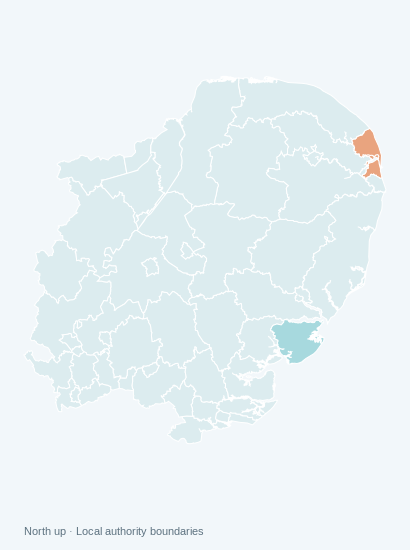
Compare all 45 council areas: exact counts and education deprivation
| Council area | All LSOAs | Overall IMD decile 1 | Education domain decile 1 |
|---|---|---|---|
| Great Yarmouth | 60 | 15 (25.0%) | 16 (26.7%) |
| Tendring | 89 | 18 (20.2%) | 31 (34.8%) |
| Luton | 125 | 17 (13.6%) | 13 (10.4%) |
| Peterborough | 121 | 16 (13.2%) | 35 (28.9%) |
| Ipswich | 85 | 11 (12.9%) | 26 (30.6%) |
| Norwich | 85 | 10 (11.8%) | 23 (27.1%) |
| Southend-on-Sea | 108 | 12 (11.1%) | 9 (8.3%) |
| Fenland | 56 | 5 (8.9%) | 14 (25.0%) |
| Basildon | 112 | 9 (8.0%) | 13 (11.6%) |
| East Suffolk | 145 | 11 (7.6%) | 17 (11.7%) |
| King's Lynn and West Norfolk | 92 | 5 (5.4%) | 13 (14.1%) |
| Bedford | 117 | 5 (4.3%) | 10 (8.5%) |
| Thurrock | 100 | 3 (3.0%) | 4 (4.0%) |
| Rochford | 53 | 1 (1.9%) | 1 (1.9%) |
| Castle Point | 57 | 1 (1.8%) | 7 (12.3%) |
| Mid Suffolk | 57 | 1 (1.8%) | 1 (1.8%) |
| Colchester | 117 | 2 (1.7%) | 8 (6.8%) |
| Harlow | 58 | 1 (1.7%) | 0 (0.0%) |
| Hertsmere | 63 | 1 (1.6%) | 0 (0.0%) |
| Breckland | 80 | 1 (1.3%) | 10 (12.5%) |
| Babergh | 55 | 0 (0.0%) | 3 (5.5%) |
| Braintree | 88 | 0 (0.0%) | 1 (1.1%) |
| Brentwood | 48 | 0 (0.0%) | 0 (0.0%) |
| Broadland | 85 | 0 (0.0%) | 0 (0.0%) |
| Broxbourne | 58 | 0 (0.0%) | 1 (1.7%) |
| Cambridge | 78 | 0 (0.0%) | 1 (1.3%) |
| Central Bedfordshire | 175 | 0 (0.0%) | 5 (2.9%) |
| Chelmsford | 113 | 0 (0.0%) | 1 (0.9%) |
| Dacorum | 96 | 0 (0.0%) | 4 (4.2%) |
| East Cambridgeshire | 51 | 0 (0.0%) | 0 (0.0%) |
| East Hertfordshire | 90 | 0 (0.0%) | 1 (1.1%) |
| Epping Forest | 78 | 0 (0.0%) | 0 (0.0%) |
| Huntingdonshire | 111 | 0 (0.0%) | 3 (2.7%) |
| Maldon | 41 | 0 (0.0%) | 0 (0.0%) |
| North Hertfordshire | 82 | 0 (0.0%) | 0 (0.0%) |
| North Norfolk | 62 | 0 (0.0%) | 1 (1.6%) |
| South Cambridgeshire | 99 | 0 (0.0%) | 0 (0.0%) |
| South Norfolk | 88 | 0 (0.0%) | 0 (0.0%) |
| St Albans | 88 | 0 (0.0%) | 0 (0.0%) |
| Stevenage | 54 | 0 (0.0%) | 0 (0.0%) |
| Three Rivers | 55 | 0 (0.0%) | 0 (0.0%) |
| Uttlesford | 49 | 0 (0.0%) | 0 (0.0%) |
| Watford | 58 | 0 (0.0%) | 0 (0.0%) |
| Welwyn Hatfield | 69 | 0 (0.0%) | 0 (0.0%) |
| West Suffolk | 107 | 0 (0.0%) | 7 (6.5%) |
Each measure uses its own national ranking. These are neighbourhood shares, not population poverty rates or assessments of individual learners. A zero does not mean an absence of disadvantage.
TA calculations from corrected MHCLG IoD2025 File 7 and ONS 2024 authority geography. 3,758 neighbourhoods (2021 LSOAs) in this region. Contains OS data and National Statistics data © Crown copyright and database right 2026.
Cambridgeshire and Peterborough: join the delivery system before chasing volume
The Combined Authority approved its revised 2025 to 2028 commissioning strategy on 23rd September 2026. It retains a mix of grant agreements and contracts for services, with an intention ordinarily to use contracts lasting up to three years where funding conditions permit. This favours a coherent delivery proposition with demonstrable progression and employer relationships.
A decision published on 12th October 2026 accepts an additional £499,425 of Skills Bootcamps funding for financial year 2026/27. Alongside the £1.5 million original programme funding identified in that decision, this gives a calculated £1,999,425. The decision planned a competitive procurement in autumn 2026 for programmes starting in spring 2027. Providers should prepare an employer-backed offer aligned to local skills priorities and follow CPCA’s procurement notices for the invitation and timetable.
The published procurement route for ASF, FCfJ and Bootcamps uses the Government Commercial Agency (GCA), formerly Crown Commercial Service (CCS), Adult Skills and Learning DPS, RM6348, alongside Due North/ProContract. Appointment, the relevant categories and geographic coverage matter when suppliers are selected for an invitation. Registration is a preparation step, rather than evidence that a competition is currently open.
The LSIP connects advanced manufacturing, agri-food, digital, life sciences, defence and clean energy. Its useful detail is the overlap: manufacturers need automation and quality improvement; food businesses need food safety, digital production and supply-chain capability; both compete for engineering and technical talent. Flexible modules and technician progression can address needs which a broad sector label misses.
Norfolk and Suffolk: energy demand needs an accessible technical pipeline
The joint county Bootcamp programme is offering 400 learner places between April 2026 and March 2027. Its current page warns that funding is very limited and directs learners towards provider waiting lists. That is a delivery-capacity signal: a course directory is useful intelligence about existing provision, not an invitation for a new supplier to bid. An earlier Wave 7 procurement was terminated on 5th February 2026; current delivery should be tracked separately from that ended competition.
The 2026 to 2029 LSIP prioritises employer access to training, stronger FE-to-HE pathways, net-zero and technical skills, digital capability and sector-specific leadership. Energy infrastructure creates a case for technicians and engineering progression. Agrifood and manufacturing also need practical digital adoption, while Level 4 to 6 leadership should reflect the operating context of the employer.
An entrant should distinguish major-project skills from foundational demand in care, food, hospitality and logistics. The best prospect may be a supporting occupation or a progression gap within an existing provider’s offer. For Suffolk-led procurement, monitor Suffolk Sourcing and the council’s tender pages, alongside notices and the relevant programme team.
Suffolk’s ASF commissioning has continued separately. The council awarded Realise Futures CIC a £4,970,778 contract, including VAT, for Suffolk Adult Learning Service from 1st August 2026 to 31st July 2027, with an optional further year. The direct award maintains existing provision during the anticipated devolution transition. It is not a replacement award for the cancelled Bootcamps competition. Track the adult learning contract and the next Bootcamp commissioning decision as separate routes with different entry points and timescales.
The Department for Education’s 4th November 2026 update plans Norfolk and Suffolk’s ASF transfer for academic year 2027/28, subject to the necessary devolution and implementation arrangements. Engage with the emerging strategic authority while following current commissioning routes.
For Wave 8, the councils’ November provider forum anticipates extensions and variations to existing Bootcamp contracts, with possible new direct awards subject to funding and procurement requirements. Final allocations remain conditional. Providers should prepare capacity and employer evidence for programme discussions and confirm the route before committing bid resources.
Greater Essex: translate major projects into specific employer commitments
Greater Essex includes Essex, Southend-on-Sea and Thurrock. Essex’s Wave 7 award notice covers that wider geography and sectors spanning construction, manufacturing and aviation, creative industries, digital, health and care, professional services and logistics. The award-stage evidence should inform future positioning; it should not be presented as a current open call.
Wave 8 changes the entry route. Essex’s final buyer notice of 16th November 2026 moves away from its previous RM6348 route. The provider survey closes on 16th December, after which the council plans selective invitations to sector-specific RFQs. Delivery is anticipated from May or June 2027, subject to funding and resources. Complete the engagement stage and follow the council’s instructions for the Wave 8 opportunity.
The LSIP identifies opportunities around clean energy, ports, airport activity, housing and infrastructure. Its employer evidence also asks for practical essentials: work-readiness, modular management development, AI adoption and clearer progression. Anchor the training proposal in an employer’s actual recruitment or productivity problem. A large infrastructure announcement is only the start of the demand test.
Greater Essex’s £30.7 million Connect to Work (CtW) programme is separate employment-support funding. Shaw Trust, Essex Cares Limited and Essex Partnership University NHS Foundation Trust are confirmed delivery partners. For a training provider, these relationships may be valuable for referrals and specialist support. They do not turn the whole programme value into an available training contract.
Essex County Council gave formal consent to a Greater Essex Mayoral Strategic Authority on 19th October 2026. The proposed authority would cover Essex, Southend-on-Sea and Thurrock, with powers over strategic matters including skills, transport and growth. Establishment still depends on the required local consents and legislation. Prepare for a changing commissioner while following current council and programme routes; the strategic tier would sit alongside councils delivering local services.
For ASF, the Department for Education’s 4th November 2026 update sets a later transition: current Greater Essex commissioning arrangements will continue in academic year 2027/28, with responsibility expected to transfer in 2028/29. Build your pipeline around that timetable and the current programme owner.
Engagement attendance did not secure visibility. In correspondence with TA on 27th April 2026, Essex County Council explained that time pressure had led it to use an expedited CCS DPS route under PCR2015 and acknowledged a gap in notifying market engagement participants. Secure admission to the buyer’s actual route and monitor it directly. A promised engagement update should not become your only source of opportunity intelligence. Read The opportunity you never saw.
Hertfordshire: strong growth sectors still need middle-level technical skills
Hertfordshire’s LSIP distinguishes core workforce pressures, growth sectors and sectors which build transferable work-readiness. Health and care, construction, education and childcare, and professional services sit alongside life sciences, creative industries, advanced manufacturing, digital and clean energy. The immediate commissioning case must explain which kind of demand the offer addresses.
The plan identifies shortages at Levels 3 to 5 and asks for shorter, flexible provision that SMEs can access. A laboratory or screen-sector brand may attract attention, but employers still need technicians, supervisors, digital competence and reliable progression. Build the route from entry-level preparation to occupational competence, with clear points for employer involvement.
Hertfordshire County Council published a Skills Bootcamp framework tender in August 2026, following market engagement in May. Track the framework’s latest status and supplier arrangements through the council’s procurement listing before committing bid resources. Its £1.9 million annual Bootcamp allocation is a different measure from any framework’s potential lifetime value.
Hertfordshire’s framework shows why readiness starts before the tender. Its application requires separate case studies on employer-led design and learner progression, and provider-owned quality assurance and Ofsted readiness, before the scored award assessment. Employer support must be evidenced at framework stage where relied upon. The council allows neighbouring-area employer evidence where it supports genuine opportunities for Hertfordshire residents, but applicants must still explain their impact in the county. Build that evidence early. See Win the groundwork before the tender lands.
Bedfordshire and Luton: think across the South Midlands boundary
Central Bedfordshire’s £1.5 million Bootcamp allocation supports the Bedfordshire Employment and Skills Academy offer benefiting Central Bedfordshire and Bedford Borough. The council identifies digital, construction and green skills, transport and logistics, and early years. Luton has its own council and adult learning relationships; inclusion in the same LSIP does not make it part of every neighbouring grant.
The South Midlands plan calls for more Level 3 to 5 technical provision, better alignment with licences to practise, and entry routes into construction, health and care, logistics and engineering. In Bedfordshire, design employer engagement around actual workplaces and shift patterns. A course location that looks central on a map may still be impractical for rural learners or staff working rotating shifts.
The £32 million South Midlands CtW programme covers six councils, including Bedford, Central Bedfordshire and Luton. Its whole-programme figure also includes Milton Keynes and both Northamptonshire authorities. Use local delivery teams to understand referrals and employment support, rather than treating that cross-regional total as a Bedfordshire training budget.
Keep the commissioner and the local delivery partner distinct
The Combined Authority is the devolved adult skills commissioner for Cambridgeshire and Peterborough. County and unitary councils elsewhere combine different roles: Bootcamp grant holder, adult learning provider, employment programme partner and economic development lead. Districts can provide employer intelligence, community access and locally commissioned projects. Record the programme owner, current procurement route, contract cycle and referral partners for each authority.
Buyer and delivery geography
Find the lead. Build the local delivery relationships.
Choose a shaded area or a commissioning geography below to see the programme lead and local council network.
Select a numbered area
Selected geography
Cambridgeshire and Peterborough
- Programme lead
- CPCA: devolved ASF and Bootcamps.
- Delivery and access
- Combined Authority controls devolved adult skills; councils and districts provide delivery, referral and local economic relationships.
- Local council network
- Cambridge · East Cambridgeshire · Fenland · Huntingdonshire · Peterborough · South Cambridgeshire
Complete directory: 45 council areas
| Council area | Upper-tier area | Commissioning geography |
|---|---|---|
| Babergh | Suffolk | Norfolk and Suffolk |
| Basildon | Essex | Greater Essex |
| Bedford | Bedford | Bedfordshire and Luton |
| Braintree | Essex | Greater Essex |
| Breckland | Norfolk | Norfolk and Suffolk |
| Brentwood | Essex | Greater Essex |
| Broadland | Norfolk | Norfolk and Suffolk |
| Broxbourne | Hertfordshire | Hertfordshire |
| Cambridge | Cambridgeshire | Cambridgeshire and Peterborough |
| Castle Point | Essex | Greater Essex |
| Central Bedfordshire | Central Bedfordshire | Bedfordshire and Luton |
| Chelmsford | Essex | Greater Essex |
| Colchester | Essex | Greater Essex |
| Dacorum | Hertfordshire | Hertfordshire |
| East Cambridgeshire | Cambridgeshire | Cambridgeshire and Peterborough |
| East Hertfordshire | Hertfordshire | Hertfordshire |
| East Suffolk | Suffolk | Norfolk and Suffolk |
| Epping Forest | Essex | Greater Essex |
| Fenland | Cambridgeshire | Cambridgeshire and Peterborough |
| Great Yarmouth | Norfolk | Norfolk and Suffolk |
| Harlow | Essex | Greater Essex |
| Hertsmere | Hertfordshire | Hertfordshire |
| Huntingdonshire | Cambridgeshire | Cambridgeshire and Peterborough |
| Ipswich | Suffolk | Norfolk and Suffolk |
| King's Lynn and West Norfolk | Norfolk | Norfolk and Suffolk |
| Luton | Luton | Bedfordshire and Luton |
| Maldon | Essex | Greater Essex |
| Mid Suffolk | Suffolk | Norfolk and Suffolk |
| North Hertfordshire | Hertfordshire | Hertfordshire |
| North Norfolk | Norfolk | Norfolk and Suffolk |
| Norwich | Norfolk | Norfolk and Suffolk |
| Peterborough | Peterborough | Cambridgeshire and Peterborough |
| Rochford | Essex | Greater Essex |
| South Cambridgeshire | Cambridgeshire | Cambridgeshire and Peterborough |
| South Norfolk | Norfolk | Norfolk and Suffolk |
| Southend-on-Sea | Southend-on-Sea | Greater Essex |
| St Albans | Hertfordshire | Hertfordshire |
| Stevenage | Hertfordshire | Hertfordshire |
| Tendring | Essex | Greater Essex |
| Three Rivers | Hertfordshire | Hertfordshire |
| Thurrock | Thurrock | Greater Essex |
| Uttlesford | Essex | Greater Essex |
| Watford | Hertfordshire | Hertfordshire |
| Welwyn Hatfield | Hertfordshire | Hertfordshire |
| West Suffolk | Suffolk | Norfolk and Suffolk |
District and borough boundaries follow ONS December 2024 geography. Programme leads are described separately from councils that help recruit, support and connect learners. Contains OS and National Statistics data © Crown copyright and database right 2026.
Compete against the provision already visible
The tables distinguish provider directories, course listings, confirmed employment-service partners and LSIP institutions. Use them to test where you add value. An established college may offer specialist facilities and employer access; an independent provider may bring flexible recruitment and delivery. A useful partnership fills a specific gap, such as community outreach, additional vacancies, specialist teaching or progression.
CPCA published adult skills provider network
| Provider | Role / evidence |
|---|---|
| Cambridge Regional College; Inspire Education Group | Colleges listed by the Combined Authority. |
| College of West Anglia; West Suffolk College; Bedford College | Colleges in the published network, including cross-boundary provision. |
| Cambridgeshire Skills; City College Peterborough | Council adult learning providers. |
| Steadfast Training; Learning Curve Group; Seetec; WEA | Examples from the published provider network. |
Current CPCA directory reviewed in October 2026; presence is not a statement of a new 2026/27 award value.
Norfolk and Suffolk current digital Bootcamp listings
| Provider | Role / evidence |
|---|---|
| LEEP Talent | Level 3 IT Technician course listed. |
| Mastered Studios Ltd | Business for Creatives at Levels 3 and 5 listed. |
| Tech Educators | Level 4 Digital Innovators, Level 3 AI literacy and Level 5 digital transformation listings. |
Suffolk County Council course directory. Listings show provision; the programme warns that 2026/27 funding is limited.
Greater Essex CtW delivery partners
| Provider | Role / evidence |
|---|---|
| Shaw Trust | Confirmed programme delivery partner. |
| Essex Cares Limited | Confirmed supported-employment partner. |
| Essex Partnership University NHS Foundation Trust | Confirmed health and employment-support partner. |
January 2026 mobilisation announcement confirms these partners. This is employment-support delivery, not a Bootcamp award list.
Institutions to include in the partnership and competition map
| Provider | Role / evidence |
|---|---|
| Hertford Regional College; North Herts College; West Herts College Group; Oaklands College | Participated in Hertfordshire LSIP development. |
| Colchester Institute | Greater Essex LSIP identifies its clean-energy technical role. |
| The Bedford College Group; Barnfield College | South Midlands LSIP identifies these institutions within the local technical education landscape. |
Evidence is institutional participation and capability described in current LSIPs, not a quantified market-share ranking.
Turn the regional picture into a focused development plan
Select a manageable commissioning footprint and build the evidence before the next competition. The question is which employer problem, learner group and funding route your organisation can serve credibly.
- Separate CPCA’s devolved contracts from county Bootcamp grants and national ASF. Check residency and delivery requirements for each proposed cohort.
- For CPCA, review RM6348 categories and Due North registration; for other buyers, follow the actual programme and procurement notices rather than assuming a common regional portal.
- Choose one occupational pathway and secure employer evidence on vacancies, entry requirements, practical assessment and progression.
- Map referral partners against the deprivation and access picture. Cost travel, outreach, learner support and employer engagement into delivery.
- Use current provider listings and awards to identify a precise partnership gap, then monitor the next commissioning or contract-review point.
TA’s view: the opportunity lies in connecting systems
The East of England offers a broad market, but its demand is highly specific. High-value clusters need technical progression; foundational sectors need recruitment and retention; excluded communities need accessible routes into real jobs. Providers that connect those needs to the correct funding holder and delivery partnership will have a stronger proposition than those pursuing the region as one undifferentiated opportunity.
Sources and scope
Evidence checked on 21st October 2026. Uses current 2026 to 2029 LSIPs, national allocation tables and buyer programme information. Allocations, programme funding and provider listings have different meanings. No county-wide ASF total has been inferred for non-devolved areas. Procurement status must be checked against the latest buyer record before acting; no live tender is asserted here. The 21st October update also incorporates dated TA correspondence and buyer-issued procurement material where identified in the article; individual contacts and client identities are omitted.
Continue the thinking
England’s skills sectors
Compare the national picture across all 15 subject areas.
What makes local delivery credible?
Turn your chosen geography into a convincing delivery case.
Shape the opportunity before the tender
Use buyer engagement to test and strengthen your proposition.