
The North East offers a substantial adult skills market, but entering it takes more than matching a course to a priority sector. Funding is split between two regional authorities. Councils also commission provision, established providers hold delivery agreements, and some of the most visible opportunities have already closed.
This fact file covers England’s statistical North East: the seven councils within the North East Mayoral Strategic Authority and the five within Tees Valley. Read it as a guide to where to focus, whom to understand and what to resolve before committing delivery capacity.
The central commercial judgement: connect a specific employer or resident need with an accessible commissioning route. A strong regional case becomes useful when you can show who will recruit, who will deliver, who will pay and what happens after training.
In this article
One region, two skills systems
The North East Mayoral Strategic Authority, which adopted that public name on 18th May 2026, covers County Durham, Gateshead, Newcastle upon Tyne, North Tyneside, Northumberland, South Tyneside and Sunderland. Its funding and procurement documents also use North East Combined Authority (NECA). Those names refer to the same seven-council geography in this report.
Tees Valley Combined Authority (TVCA), covers Darlington, Hartlepool, Middlesbrough, Redcar and Cleveland, and Stockton-on-Tees. It has its own adult skills allocation, commissioning process and Local Skills Improvement Plan. Neither authority’s provider list defines the geographical boundary: a college based in Tees Valley can also hold North East funding.
For devolved provision, test the learner’s residence and the programme’s eligibility rules. For employer-led provision, also establish the employer, workplace and outcome requirements. A provider’s head office postcode alone will not answer those questions.
Funding geography
Build your route around the commissioning system.
Seven councils
North East MSA
Regional grant and procured delivery, with additional council routes in Sunderland and South Tyneside.
Tender platform: Open
Five councils
Tees Valley
Four lots in the latest competition, alongside established grant provision and council services.
Tender platform: Delta eSourcing
Financial year 2026/27. North East is the calculated sum of four adult skills settlement components. Tees Valley is the published single adult skills total before the separate engineering package. These are allocation scales, not open tender balances.
Who holds the money, and how much?
The figures below separate government allocations from procurement estimates. Financial years run from April to March; academic years run from August to July. That distinction matters when comparing a settlement with a delivery agreement.
For the North East authority, four adult skills components in the published integrated settlement total £79,580,106 for financial year 2026/27. This is a TA calculation from the listed Adult Skills Fund (ASF), Bootcamps and construction uplift lines. The equivalent totals are £80,489,289 for 2027/28 and £80,965,528 for 2028/29. Free Courses for Jobs (FCfJ) is already included in its ASF line.
TVCA’s published single adult skills allocation is £35,552,817 for financial year 2026/27, or £36,020,368 for academic year 2026/27, before its separately stated engineering package. Adding that package gives calculated totals of £35,781,630 and £36,386,468 respectively. The financial-year comparison is useful for scale; the academic-year figure is more useful when reviewing delivery plans.
These sums fund a mixture of established grant provision and commissioned services. They do not show the uncommitted balance available to a new provider. The procurement figures later in this report describe parts of these funding systems and must not be added to them as extra money.
Adult skills funding: financial year 2026/27
Published government allocation components. Amounts are pounds sterling, not tender values.
North East: calculated subtotalFinancial year 2026/27 · Sum of the four lines above; excludes employment support and capital.£79,580,106
| Authority / component | 2026/27 allocation | How to read it |
|---|---|---|
| ASF, including FCfJ | £68,407,762 | Core adult skills component within the integrated settlement. |
| ASF construction uplift | £962,099 | Additional construction skills component. |
| Skills Bootcamps | £7,783,856 | Bootcamps component, brought into the regional programme. |
| Bootcamps construction package | £2,426,389 | Additional construction component. |
| calculated subtotal | £79,580,106 | Sum of the four lines above; excludes employment support and capital. |
Tees Valley: calculated totalFinancial year 2026/27 · Single allocation plus additional engineering£35,781,630
| Authority / component | 2026/27 allocation | How to read it |
|---|---|---|
| ASF | £30,329,579 | Component of its single adult skills allocation. |
| Skills Bootcamps | £2,686,756 | Part of the same allocation. |
| FCfJ, excluding engineering | £2,536,482 | Part of the same allocation. |
| published subtotal | £35,552,817 | Published total before the separate engineering package. |
| additional FCfJ engineering | £228,813 | Separate Annex B allocation; add only once. |
Sources: the North East integrated settlement funding table and the 2026/27 devolved adult skills grant determination. Settlement figures remain subject to the stated government review arrangements. Provider allocations and actual spending are separate measures.
What skills does the region actually need?
Two current plans provide the starting point: the North East LSIP 2026 to 2029, led by the North East Automotive Alliance, and the Tees Valley LSIP 2026 to 2029, led by the North East Chamber of Commerce. They are employer demand evidence for shaping an offer. They are not lists of automatic funding entitlements.
The North East plan identifies eight priority sectors and asks for stronger collaboration, digital and AI capability, more Level 3 to Level 8 technical skills, greater SME participation and better foundation and employability pathways. Tees Valley identifies six priority sectors, with particular attention to practical experience, multiskilling and industrial transition.
The distinction is particularly important in Tees Valley. Its LSIP describes contraction and uncertainty in chemical and process industries alongside skills gaps, making conversion into adjacent industries a more credible proposition than a blanket growth claim. In digital and creative work, sufficient entry-level applicants can coexist with a shortage of experienced staff and practical commercial skills.
That creates two connected markets: helping people reach an entry point, and helping existing workers acquire deeper or adjacent skills. A generic introductory course will not resolve a shortage of experienced technicians, supervisors or commercially effective digital specialists. Conversely, a high-level technical offer will miss residents who first need basic skills, confidence and sustained support.
The graphic translates sector priorities into useful curriculum questions and relevant Sector Subject Areas, or SSAs. This is TA’s crosswalk using Ofqual’s subject classification. Check the actual qualification’s assigned SSA, approved learning aim, learner eligibility and local funding rules before costing delivery.
LSIP priorities to curriculum
Turn the sector label into a teachable, employable skill.
Both LSIPs
Advanced manufacturing
Automation, maintenance, welding and production capability.
4.1 Engineering · 4.2 Manufacturing technologies
Show equipment access and practical assessment. Build a route from operative to technician or supervisor.
Both LSIPs
Energy and industrial transition
Offshore and clean energy, electrical systems and experienced technical workers.
4.1 Engineering · 4.2 Manufacturing technologies
Connect conversion training to named roles and contractors. Test the demand for new entrants separately from experienced staff.
Both LSIPs
Life sciences, biomanufacturing and process
Process competence, laboratory practice, quality systems and transition skills.
2.1 Science · 4.1 Engineering · 4.2 Manufacturing technologies
Combine practical capability with compliance. In Tees Valley, target transferable skills from changing process industries.
Both LSIPs
Construction
Trade skills, work readiness, digital construction and supervision.
5.2 Building and construction
Secure genuine site experience and an employer route. Assess experienced-worker progression as well as entry cohorts.
Both LSIPs
Digital, technology and AI
Applied digital skills, experienced specialists and effective use of AI.
6.1 Digital technology (practitioners) · 6.2 Digital technology (users)
Separate specialist technical training from workplace digital literacy. Use live tasks to evidence practical competence.
Both LSIPs
Creative industries and content
Production capability, digital tools and commercial readiness.
9.1 Performing arts · 9.2 Crafts, creative arts and design · 9.3 Media and communication
Build employer briefs, portfolios and production experience into the offer, with a realistic route to paid work.
North East LSIP
Defence, security and space
Advanced technical and scientific capability.
2.1 Science · 4.1 Engineering · 6.1 Digital technology (practitioners)
Define the occupation and required technical depth. Engage the relevant supply chain before investing in specialist delivery.
North East LSIP
Adult social care
A resilient workforce and accessible occupational pathways.
1.3 Health and social care
Join recruitment, practical preparation and employer support. Test retention and progression alongside initial starts.
English, maths, digital confidence and preparation for work can connect residents to technical pathways. Relevant areas include SSA 14.1 Foundations for learning and life and 14.2 Preparation for work. Test the actual learning aim and local programme rules.
TA curriculum crosswalk. Tees Valley combines digital and creative in one of its six sectors, and separates biomanufacturing/life sciences from chemical/process. The North East plan has eight priority sectors. Qualification classifications and funding eligibility must be checked at learning-aim level.
Where inclusion must shape the delivery model
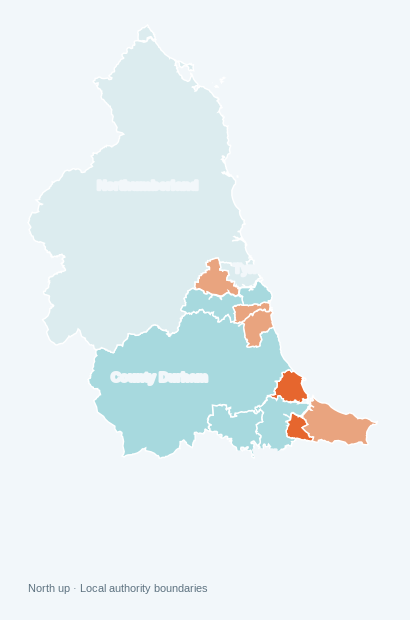
Regional averages hide very different recruitment and support conditions. In the English Indices of Deprivation 2025, 50.0% of Middlesbrough’s neighbourhoods fall within England’s most deprived 10%, followed by 42.1% in Hartlepool. The equivalent proportions are 27.6% in Sunderland and 26.1% in Newcastle upon Tyne.
These figures measure the share of small areas, known as Lower-layer Super Output Areas or LSOAs, in a national deprivation band. They are not the percentage of residents living in poverty. The education, skills and training domain is a separate measure: Newcastle has 28.3% of neighbourhoods in its most deprived national tenth, while South Tyneside has 2.9%. Overall deprivation and education deprivation therefore point to different aspects of need.
Use place evidence to design the learner journey. Test recruitment through trusted community organisations, the cost and timing of travel, digital access, caring commitments, health needs and the support required to stay on programme. Cost these activities and confirm which the agreement will fund.
Northumberland’s 11.0% headline should not lead to a uniform low-support model. A dispersed catchment requires separate travel and access checks. Within urban authorities, test the actual neighbourhood and referral catchment too. The local authority map is a first screen, not a substitute for venue-level planning.
English Indices of Deprivation 2025
The route into training must work for the place.
View exact counts and the education, skills and training measure
| Authority | All LSOAs | IMD decile 1 | Education decile 1 |
|---|---|---|---|
| Middlesbrough | 90 | 45 (50.0%) | 40 (44.4%) |
| Hartlepool | 57 | 24 (42.1%) | 14 (24.6%) |
| Sunderland | 185 | 51 (27.6%) | 43 (23.2%) |
| Newcastle upon Tyne | 180 | 47 (26.1%) | 51 (28.3%) |
| Redcar and Cleveland | 88 | 22 (25.0%) | 12 (13.6%) |
| South Tyneside | 103 | 22 (21.4%) | 3 (2.9%) |
| Darlington | 66 | 13 (19.7%) | 8 (12.1%) |
| Stockton-on-Tees | 124 | 24 (19.4%) | 17 (13.7%) |
| Gateshead | 126 | 24 (19.0%) | 23 (18.3%) |
| County Durham | 330 | 56 (17.0%) | 36 (10.9%) |
| Northumberland | 200 | 22 (11.0%) | 19 (9.5%) |
| North Tyneside | 133 | 11 (8.3%) | 5 (3.8%) |
Both columns use the most deprived national tenth for their respective index or domain. Neither is a population poverty rate or a measure of an individual learner’s needs.
TA calculations from MHCLG File 7, IoD2025: neighbourhoods (2021 LSOAs) in decile 1 divided by all LSOAs in each authority. Total regional denominator: 1,682 LSOAs. Boundary source: ONS, May 2024, generalised and clipped. Contains OS data © Crown copyright and database right 2026; contains National Statistics data © Crown copyright and database right 2026.
North East: follow the new Skills Programme
From 2026/27, the authority brings ASF, FCfJ and Skills Bootcamps together under the North East Skills Programme. Its three strands are Skills Foundation, Skills Activation and Skills for Work. In broad terms, the pathway moves from essential skills and confidence towards technical learning, employment and progression.
The direct procurement, issued under NECA, closed on 18th May 2026 and has been awarded. Its advertised estimate was £80m across the potential three-year procurement term, with an initial academic-year agreement and extension options. That procurement estimate is different from the roughly £80m annual regional funding scale shown earlier.
The latest contract-details update was published on 16th September 2026. The authority’s 2026/27 provider workbooks, linked from its Skills Programmes page updated on 18th September 2026, identify grant and procured delivery. No currently open admission round was established for this authority-level competition at the research date.
The practical task now is to identify the strand and delivery gap you can address, understand the existing provider base, and prepare for future commissioning or a permitted delivery partnership. The authority advertises competitive opportunities through Open; track its programme pages and Find a Tender alongside that platform.
Read the payment model before agreeing volumes. The 2026/27 rules distinguish grant payments against an agreed monthly profile in arrears from procured payments based on actual earnings in arrears. Outcome reporting and valid evidence affect payment. Build employer engagement, learner support, data collection and claim timing into the cost model.
Local credibility is visible in the award pattern. In TA’s review of the first 20 announced Adult Skills Programme awards, recorded on 12th August 2026, 19 suppliers already supplied NECA, all 20 operated from facilities within the area, and 16 were headquartered there. This was an early snapshot, not the complete current roster shown later in this fact file. Established delivery, employer relationships and local recruitment routes were prominent; a headquarters elsewhere was not an absolute barrier.
A satisfactory first answer may still end the bid. NECA’s Create Talent competition closing in January 2026 required at least 8/10 for the first quality question. The same threshold appears in the May 2026 Adult Skills Programme documents reviewed, including Skills Activation: Sector Focussed and ICT. A lower score stopped further evaluation. The sector-focused question tested expertise, consultation, complementarity with regional provision, employer relationships and the proposed offer. Resolve the strength of that evidence before investing in the rest of the response. Strong generic policies cannot compensate for failing the gateway. See What would make local delivery in your next region credible?.
Tees Valley: a £21m competition with four distinct offers
TVCA’s adult skills competition TVCA-PROC-0911 was issued through Delta eSourcing and replaced the withdrawn TVCA-PROC-0745 procurement. Stage 1 closed on 25th September 2026. The buyer’s Clarification Register V20, dated 2nd November 2026, set the invited Stage 2 submission deadline at 12 noon on 12th November 2026 (GMT), with questions due by 3pm on 4th November 2026. Those dates have passed. Invited bidders should follow any subsequent instructions issued through Delta.
The notice estimates up to £21m excluding VAT across the three academic years named in the procurement. The original notice planned award on 29th January 2027, delivery from 22nd February 2027 to 31st July 2029, and a possible extension to 31st July 2030. Those are procurement estimates and planned dates, not confirmed awards or a promise of three full years of delivery.
The buyer’s 2nd November clarification requires a Delivery Plan based on a full academic year. The agreed annual Year 1 allocation can be earned during the shortened period from 22nd February to 31st July 2027, with payment based on eligible actual delivery. Unused funding is neither paid nor carried forward. Build learner volumes around what can be delivered within that period. The four lots expose the buyer’s choices. It wants accessible legal entitlements alongside pathways into work and employer-led Bootcamps. In the published evaluation, quality carries 80% and social value 20%. A credible response therefore needs to explain recruitment, practical delivery and progression as well as curriculum.
For providers outside this competition, monitor award information, future notices and the scope for permitted partnerships once successful suppliers are known. The Bootcamps lot is already included in the £21m estimate. It is not an additional £9m fund to add to the annual allocation.
The earlier TVCA-PROC-0745 competition was withdrawn on 28th May 2026. TVCA cited changed circumstances and a review of the specification against grant-funded delivery plans and the developing LSIP. The withdrawal followed a legal claim brought by Learning Curve Group and two subsidiaries, reported by FE Week, but the public evidence does not establish that the claim caused the cancellation. Treat the replacement as a fresh opportunity: its scope, timetable and evaluation requirements can differ from the original bid.
TVCA-PROC-0911: what the buyer set out to buy
The Stage 2 deadline recorded in the buyer’s 2nd November register has passed. All lot estimates below exclude VAT and together total £21m.
| Lot | Estimated value | Delivery proposition |
|---|---|---|
| 1. English, maths and digital entitlements | £1.5m | Entry Level to Level 2 provision that complements grant-funded delivery. |
| 2. First full Level 2 and Level 3 entitlements | £3m | Eligible qualifications linked to further learning, work and progression. |
| 3. Pathways to employment | £7.5m | Employment and sector skills for unemployed adults aged 19+ seeking work. English, maths and digital within a pathway require a separate Lot 1 request. |
| 4. Employer-led Skills Bootcamps | £9m | Co-designed training tied to evidenced recruitment, upskilling and other specified employer outcomes. |
Bootcamps headings include the six LSIP sectors plus the foundational economy, business start-up and scale-up, and building smarter businesses. Procurement headings and LSIP sector headings are not identical.
The twelve councils: buyers, delivery bodies and referral partners
The regional authority is only part of the commissioning picture. Councils can hold adult skills grants, procure delivery, operate employment services and connect providers with residents. Treat each council’s role separately rather than assuming that every council runs its own open Bootcamps tender.
Sunderland City Council has a separate Adult Skills Programme Flexible Framework, OPEN20261311. Its advertised aggregate estimate is £6,165,000 excluding VAT. The initial admission deadline was 17th July 2026. The latest contract-details notice records terms from 1st September 2026 to 31st July 2029 and 50 distinct suppliers across the three strand lots.
Sunderland’s framework provides for reopening according to its procurement timetable; admission is not continuous. The next reopening date was not established from the public notices. Stage 1 membership and Stage 2 funded call-offs are separate decisions. The published terms prohibit onward subcontracting by appointed suppliers, which matters when considering a partnership route.
Sunderland’s competition also illustrates the importance of operational reach. TA’s review of the initial round highlighted competitors with established Sunderland or wider North East delivery networks. A new entrant should test its recruitment, venues and employer access against those networks, while keeping framework admission separate from a funded call-off.
South Tyneside Council’s Post 16 Education and Training DPS, DN725797, has an advertised end and participation deadline of 31st July 2027. Its original categories cover study programmes, adult education, FCfJ and Bootcamps. The old register contains conflicting dates and the council’s current procurement guidance points to Open. Confirm the current admission channel and status with the council before investing in an application.
For council procurement, monitor Open for Durham, Gateshead, Newcastle and Northumberland, as well as Sunderland and South Tyneside. North Tyneside’s guidance still refers to NEPO and legacy arrangements, so follow the access point stated in each current notice. Across the five Tees Valley boroughs, TVCA’s direct adult skills route is Delta; Hartlepool’s regional Connect to Work (CtW) procurement uses Open.
The directory below also identifies CtW delivery. IPS means Individual Placement and Support; SEQF is the Supported Employment Quality Framework. These models require specialist employment support, employer engagement and sustained in-work support. They are not interchangeable with a classroom training programme.
Buyer and delivery geography
Find the lead. Build the local delivery relationships.
Choose a shaded area or a commissioning geography below to see the programme lead and local council network.
Select a numbered area
Selected geography
North East
- Programme lead
- NECA: devolved adult skills; Open procurement.
- Delivery and access
- Seven constituent councils deliver adult learning, employment support and local referrals. Sunderland has a separate framework; South Tyneside has its own post-16 DPS.
- Local council network
- County Durham · Gateshead · Newcastle upon Tyne · North Tyneside · Northumberland · South Tyneside · Sunderland
Complete directory: 12 council areas
| Council area | Upper-tier area | Commissioning geography |
|---|---|---|
| County Durham | County Durham | North East |
| Darlington | Darlington | Tees Valley |
| Gateshead | Gateshead | North East |
| Hartlepool | Hartlepool | Tees Valley |
| Middlesbrough | Middlesbrough | Tees Valley |
| Newcastle upon Tyne | Newcastle upon Tyne | North East |
| North Tyneside | North Tyneside | North East |
| Northumberland | Northumberland | North East |
| Redcar and Cleveland | Redcar and Cleveland | Tees Valley |
| South Tyneside | South Tyneside | North East |
| Stockton-on-Tees | Stockton-on-Tees | Tees Valley |
| Sunderland | Sunderland | North East |
District and borough boundaries follow ONS December 2024 geography. Programme leads are described separately from councils that help recruit, support and connect learners. Contains OS and National Statistics data © Crown copyright and database right 2026.
Specific local learning and employment roles
County Durham
Durham Learn / council grant provider listed for 2026/27. CtW IPS lead: Triage Central.
Gateshead
Council grant provider listed for 2026/27; distinguish it from Gateshead College. CtW IPS lead: Triage Central.
Newcastle upon Tyne
Newcastle City Learning grant provider listed for 2026/27. CtW IPS lead: Groundwork North East and Cumbria.
North Tyneside
Council grant provider listed for 2026/27. CtW IPS lead: Groundwork North East and Cumbria.
Northumberland
Council grant provider listed for 2026/27. CtW IPS lead: Northumberland County Council.
South Tyneside
Council grant provider plus the separate post-16 DPS described above. CtW IPS lead: Northern Rights.
Sunderland
Council grant provider plus its separate three-strand framework. CtW IPS lead: Triage Central.
Darlington
Council Adult Learning is in the historical TVCA allocation list. CtW IPS lead: Waythrough: 9th October 2026 award notice; its estimated start was 1st November 2026. Confirm current mobilisation with the lead provider.
Hartlepool
Council Adult Learning is in the historical list; council leads regional Connect to Work procurement. CtW IPS lead: Let’s Connect (Eng) Ltd.
Middlesbrough
Council Adult Learning is in the historical TVCA allocation list. CtW IPS lead: Waythrough: 9th October 2026 award notice; its estimated start was 1st November 2026. Confirm current mobilisation with the lead provider.
Redcar and Cleveland
Council Adult Learning is in the historical TVCA allocation list. CtW IPS lead: Waythrough: 9th October 2026 award notice; its estimated start was 1st November 2026. Confirm current mobilisation with the lead provider.
Stockton-on-Tees
Council Adult Learning is in the historical list; council also supports Youth Guarantee delivery. CtW IPS lead: Waythrough: 9th October 2026 award notice; its estimated start was 1st November 2026. Confirm current mobilisation with the lead provider.
Employment, apprenticeships and wider investment
Adult skills is one part of the market. Employment support can create referral and progression relationships, while employer-led apprenticeships can provide a route into longer occupational training. Keep each programme’s budget, outcomes and access rules separate.
The North East integrated settlement includes £11,434,454 for CtW in financial year 2026/27. The wider regional programme is described as up to £50m to 31st March 2030. Its IPS lots have already been awarded. The annual allocation, programme headline and individual contract values overlap, so they should never be added together.
Tees Valley’s agreed CtW grant for the programme through 31st March 2030 is £17.6m, with 5,000 planned starts; both figures are rounded in DWP’s published table. Hartlepool leads procurement. Waythrough holds SEQF delivery across all five boroughs; Let’s Connect holds Hartlepool IPS. The four-borough IPS award notice published on 9th October 2026 recorded £2,769,200 including VAT for Waythrough and an estimated term from 1st November 2026 to 31st March 2028, extendable to 31st March 2030. These are the dates in that award notice; confirm the current mobilisation timetable with the lead provider when assessing delivery partnerships.
TVCA also announced £5m for the Youth Guarantee’s second year, 2026/27, delivered with Stockton-on-Tees and the other local authorities. Employer placements and local delivery relationships are relevant entry points. The programme announcement is not evidence of a new open provider tender.
A further £9.4m apprenticeship brokerage programme, announced on 2nd October 2026, aims to support 1,500 additional starts. This is a useful signal for providers with SME relationships and progression routes for young people. Its announcement does not establish the funding period or supplier procurement timetable. Those are the next questions to resolve.
Separate regional announcements from the national funding routes for apprenticeships and mainstream 16 to 19 provision. A devolved adult skills agreement does not confer access to those markets. Check the current provider requirements, employer funding route and programme rules before presenting a combined offer.
The North East settlement also lists industry placements and FE capital funding, including Technical Excellence Colleges. Those investments may strengthen the facilities and relationships available to regional partners. Capital investment is not training-delivery revenue. Similarly, TVCA’s current UKSPF page shows its People and Skills calls as closed; older transition-year allocations should not be marketed as live opportunities.
Who is already delivering?
Start with programme-specific evidence. The North East authority’s published 2026/27 workbooks list 20 grant-provider rows and 25 procured-provider rows for academic year 2026/27. Gateshead College, New College Durham and NCG appear under both routes. The lists identify provision and approved strands; they do not disclose market shares or funding won by each provider.
Competition varies by offer. The procured list names Gateshead College, New College Durham, RE:GEN Academy and TRN (Train) for Skills for Work construction. Gateshead College and Leep Talent are listed for tech, digital and AI. In Activation health and social care, listed providers include Alpha Care Agency, Learning Curve Group, TRN (Train) and Winnovation.
Those names help frame a useful question: what can your organisation add that the existing offer does not already cover? Test a particular employer group, specialist capability, delivery timetable, neighbourhood reach or progression relationship. Evidence of a gap matters more than the fact that the sector appears in a growth plan.
In Tees Valley, the current public provider tools still link to 2025/26 allocations. Those historic figures show substantial established delivery by Middlesbrough College, the Education Training Collective, Hartlepool College and Darlington College, alongside council services and independent providers. They are shown below with their original year. A complete 2026/27 allocation roster and the future PROC-0911 awardees were not established at the review date.
Check group structures and cross-border delivery when assessing competition. A local campus, a legal contracting entity and a national group may refer to the same organisation. Also distinguish prime contractors, grant providers, subcontractors and framework members: each relationship tells you something different about access to funded work.
Provider evidence / explore the lists
Compare organisations by programme and year.
Expand each directory. The North East lists show approved strands; the Tees Valley list shows historical allocations, which can help identify established delivery relationships.
North East grant providers · 2026/27 · 20 rows
| Provider | Approved strands |
|---|---|
| Bishop Auckland College | Skills Foundation; Skills Activation; Skills for Work |
| Darlington College | Skills Foundation; Skills Activation |
| Derwentside College | Skills Foundation; Skills Activation |
| Durham Council | Skills Foundation; Skills Activation; Skills for Work |
| East Durham College | Skills Foundation; Skills Activation; Skills for Work |
| Sunderland College (EPNE) | Skills Foundation; Skills Activation; Skills for Work |
| The Education Training Collective (ETC) | Skills Activation |
| Gateshead College | Skills Foundation; Skills Activation |
| Gateshead Council | Skills Foundation; Skills Activation |
| Hartlepool College | Skills Foundation; Skills Activation |
| Middlesbrough College | Skills Activation; Skills for Work |
| Newcastle College (NCG) | Skills Foundation; Skills Activation |
| New College Durham | Skills Foundation; Skills Activation; Skills for Work |
| Newcastle City Learning | Skills Foundation; Skills Activation |
| North Tyneside Council | Skills Foundation; Skills Activation |
| Northumberland Council | Skills Foundation; Skills Activation |
| South Tyneside Council | Skills Foundation; Skills Activation |
| Sunderland Council | Skills Foundation; Skills Activation; Skills for Work |
| Tyne Coast College | Skills Foundation; Skills Activation |
| Workers' Educational Association (WEA) | Skills Foundation; Skills Activation |
Source: authority workbooks linked from the Skills Programmes page, updated 18th September 2026. Names and strand flags follow those lists. Their sector labels, including “ICT”, are retained as published.
North East procured providers · 2026/27 · 25 rows
| Provider | Approved strands | Published sector flags |
|---|---|---|
| Aim 2 Learn | Skills Activation | Activation: ICT |
| Alpha Care Agency | Skills Activation | Activation: Health & Social Care |
| Back to Work Training | Skills Activation; Skills for Work | Activation: ICT; Work: Foundational Economy |
| B-Skill | Skills Foundation | Skills Foundation |
| Castleview Group Training | Skills for Work | Work: Advanced Manufacturing |
| Gateshead College | Skills for Work | Work: Advanced Manufacturing; Work: Foundational Economy; Work: Green Jobs; Work: Construction; Work: Tech, Digital & AI |
| GEM Partnership | Skills Activation; Skills for Work | Activation: Sector Focused; Work: Advanced Manufacturing |
| Health and Safety Training | Skills Activation | Activation: Sector Focused |
| Learning Curve Group | Skills Activation; Skills for Work | Activation: Health & Social Care; Work: Foundational Economy |
| Leep Talent | Skills for Work | Work: Tech, Digital & AI |
| Logistics Skills and Consultancy | Skills for Work | Work: Foundational Economy |
| Momentum Recruitment | Skills Activation | Activation: Sector Focused |
| New College Durham | Skills for Work | Work: Foundational Economy; Work: Green Jobs; Work: Construction |
| Optimum Skills | Skills Activation | Activation: Sector Focused; Activation: Visitor Economy |
| Penshaw View Training | Skills Activation | Activation: Visitor Economy |
| RE:GEN Academy | Skills for Work | Work: Construction |
| Realise Learning and Employment | Skills Activation | Activation: Sector Focused |
| Release Potential | Skills Activation | Activation: Sector Focused |
| Sportscape Training | Skills Foundation; Skills for Work | Skills Foundation; Work: Foundational Economy |
| The Corporation of NCG | Skills Foundation; Skills for Work | Skills Foundation; Work: Foundational Economy |
| Think Employment | Skills Activation | Activation: Child Development |
| TLG Business Services | Skills Activation | Activation: Sector Focused; Activation: Visitor Economy |
| TRN (Train) | Skills Activation; Skills for Work | Activation: Health & Social Care; Work: Construction |
| Winnovation | Skills Activation | Activation: Sector Focused; Activation: Health & Social Care; Activation: Child Development |
| Zenith Training | Skills for Work | Work: Foundational Economy |
Source: authority workbooks linked from the Skills Programmes page, updated 18th September 2026. Names and strand flags follow those lists. Their sector labels, including “ICT”, are retained as published.
Tees Valley published allocations · historical 2025/26 · 29 providers
These are the last published allocations found, for the previous academic year. They do not establish 2026/27 funding or the winners of PROC-0911.
| Provider | ASF 2025/26 | FCfJ 2025/26 |
|---|---|---|
| Back 2 Work Complete Training | £0 | £166,370 |
| Baltic Training Services | £399,894 | £0 |
| B-Skill Ltd | £455,350 | £0 |
| Darlington Borough Council Adult Learning | £610,092 | £18,454 |
| Darlington College | £2,196,423 | £139,494 |
| Derwentside College | £328,310 | £0 |
| Digital Telecoms Network Academy | £485,100 | £0 |
| Enterprise Made Simple | £514,410 | £213,701 |
| Hartlepool Borough Council Adult Learning | £1,050,441 | £36,641 |
| Hartlepool College of FE | £3,039,801 | £180,792 |
| ITEC NE Ltd | £330,125 | £0 |
| Learning Curve Group | £1,378,434 | £130,461 |
| Middlesbrough Borough Council Adult Learning | £1,752,494 | £0 |
| Middlesbrough College | £6,124,440 | £226,898 |
| New College Durham | £805,189 | £281,546 |
| Orangebox Training Solutions Ltd | £1,081,130 | £0 |
| TVCT - Prior Pursglove Sixth Form College | £419,055 | £33,478 |
| Realise Learning and Employment Limited | £307,607 | £131,834 |
| Redcar and Cleveland Borough Council Adult Learning | £1,107,873 | £0 |
| Stockton On Tees Borough Council Adult Learning | £1,815,609 | £69,499 |
| Sunderland College | £301,094 | £0 |
| The Education Training Collective (ETC) | £4,506,031 | £165,959 |
| The Northern School of Art | £42,206 | £0 |
| Think Employment Ltd | £40,256 | £144,617 |
| Tradetechs Northern | £731,580 | £172,107 |
| Triage Central Ltd | £1,518,458 | £38,610 |
| TRN (Train) Ltd | £0 | £153,901 |
| University Centre Quayside | £673,987 | £0 |
| Vision Training (North East) Limited | £159,780 | £196,092 |
Source: TVCA published 2025/26 allocation table. Values are allocations, not actual expenditure. Individual rows are reproduced; no total is calculated from the source’s inconsistent FCfJ total.
Turn the evidence into a regional offer
A useful offer joins three things: an evidenced need, a deliverable pathway and a route the buyer can use. For example, a construction proposition might combine a local recruitment partner, entry checks, practical training and named employers who can provide real work experience. A process-industry proposition might start with experienced workers and assess which additional competences they need to move into an adjacent role.
Use the LSIP to open the conversation, then test the specifics with employers and commissioners. Ask which roles need new entrants, which need experienced workers and when demand is expected. Establish the machinery, site access, licences, placements and tutor expertise required. A large project announcement is a reason to investigate demand, not a forecast of learner starts.
Shape the next specification during pre-market engagement. Bring evidence about the practical effects of lot design, cohort size, travel, employer commitments, payment milestones and mobilisation time. Offer a workable alternative where the proposed model could exclude the learners or employers the buyer wants to reach.
- Which specific gaps remain after current grant and contracted provision, and what evidence will the buyer use to prioritise them?
- Will the next commissioning round separate foundation learning, technical progression and supported employment, or buy a connected pathway?
- Which employer commitments must be secured before award, and what happens if recruitment or a major project slips?
- Can delivery cover outreach, travel, additional support and post-course progression, and how will those activities be paid?
- When will frameworks reopen, how will new entrants be assessed, and which partnership or subcontracting arrangements are permitted?
End the research with a small number of costed propositions and a clear decision on each: develop for the next direct competition, pursue an authorised partnership, or wait for a defined access point. Match the scale of investment to the strength of the evidence and the work actually accessible.
What should providers watch next?
Maintain a buyer-level watchlist. The authority website explains programme changes, the procurement platform carries tender documents, statutory notices show formal stages, and provider lists reveal the delivery base. Checking all four gives a more useful picture than relying on a tender alert alone.
The next evidence that could change your decision
Status checked on 21st October 2026. Planned dates and future access points need rechecking before action.
| Watch item | Known position | What to establish |
|---|---|---|
| North East Skills Programme | 2026/27 delivery lists published; direct competition awarded. | Revised funding rules, new provider/course lists and any future commissioning notice on Open. |
| Sunderland flexible framework | Initial round awarded; future reopening provided for. | The next date in the procurement timetable and the requirements for admission and funded call-offs. |
| South Tyneside DPS | Advertised term and participation deadline: 31st July 2027. | Current application channel, admission status and any replacement arrangement. |
| TVCA-PROC-0911 | The recorded Stage 2 deadline of 12 noon on 12th November 2026 has passed; the original notice planned award for 29th January 2027. | Successful providers, confirmed start dates, contract scope and permitted supply-chain roles. |
| Tees Valley apprenticeship brokerage | £9.4m programme announced on 2nd October 2026. | Delivery period, provider access and how employer referrals will be allocated. |
| LSIP and local growth delivery | 2026 to 2029 LSIPs now in place. | Sector partnership activity, employer demand changes and the timing of real recruitment. |
TA view: choose a place, a problem and a route
The North East’s opportunity is substantial, but uneven. There is demand for technical depth and industrial transition alongside a pressing need to help residents enter, remain in and progress through work. The strongest provider propositions connect those two sides with credible employers and local delivery relationships.
Choose the council areas and occupational problems where your organisation can make a clear contribution. Understand the incumbents, secure the necessary delivery relationships and identify the next usable commissioning route. That is how regional intelligence becomes a decision about where to invest.
Sources and scope
Research checked on 21st October 2026; TVCA Stage 2 timetable and Year 1 funding updated on 3rd November using Clarification Register V20, answers 65, 66 and 70 dated 2nd November 2026. Elapsed-deadline wording updated on 13th November 2026; later invitation-only amendments remain subject to the buyer’s Delta instructions. Primary sources: North East and Tees Valley LSIPs 2026 to 2029; the North East integrated settlement table; DWP 2026/27 adult skills grant determinations and CtW guidance; both authorities’ programme, provider and growth-plan publications; North East procurement notices including 087879-2026; Sunderland notice 083926-2026; South Tyneside notice 017260-2024; TVCA-PROC-0911 on Delta; and Hartlepool’s August and October 2026 CtW notices. Deprivation calculations use MHCLG’s English Indices of Deprivation 2025, File 7, with 2024 local authority boundaries. SSAs use Ofqual’s published classification. Provider rosters retain their stated academic years. TA’s curriculum mapping, calculations and commercial implications are identified as analysis. Full research references are retained in the editorial evidence record.
Continue the thinking
England’s skills sectors
Compare the national picture across all 15 subject areas.
What makes local delivery credible?
Turn your chosen geography into a convincing delivery case.
Shape the opportunity before the tender
Use buyer engagement to test and strengthen your proposition.