
There is no single South East adult skills market. Surrey and Buckinghamshire now have devolved Adult Skills Fund (ASF) allocations; other areas retain national provider funding alongside local programmes. Ten separately identified Skills Bootcamp grant areas sit across the region, while Milton Keynes belongs to a wider South Midlands skills geography. A regional sales strategy therefore needs several buyer strategies underneath it.
The opportunity is equally varied: laboratory and engineering technicians around Oxfordshire, digital infrastructure in Berkshire, screen production in Buckinghamshire, maritime industries around the Solent, and care, construction and visitor economy skills across coastal and rural communities. High-value industries create demand, but providers still need to show which employers will recruit, which residents can participate and which funding route supports that journey.
In this article
Start with the commissioning geography
Eight 2026 to 2029 LSIP footprints are relevant: Buckinghamshire; Oxfordshire; Thames Valley Berkshire; Surrey; Hampshire and the Solent; Kent and Medway; Sussex and Brighton; and the South East Midlands plan covering Milton Keynes alongside areas in two other English regions. LSIP boundaries describe employer needs. They do not, by themselves, identify the organisation that can award a contract.
Buckinghamshire Council and Surrey County Council are the immediate devolved ASF buyers. West Sussex, East Sussex and Brighton & Hove are preparing shared commissioning arrangements through a pathway to devolution pilot. Elsewhere, national ASF agreements with individual providers remain important alongside council adult learning and separately commissioned programmes. Treat proposed governance changes and existing funding responsibilities as different pieces of intelligence.
Funding geography / routes to market
Start with the commissioner, then define the catchment.
01 / Commissioning geography
Buckinghamshire
Route to understandDevolved ASF delivery network and Skills Bootcamp programme. Council provider and procurement pages are the starting points; the visible ASF provider list is delivery evidence, not an open invitation.
02 / Commissioning geography
Milton Keynes
Route to understandCommunity Learning MK adult education and employment-support services; check council opportunities and college partnerships. Verify Milton Keynes eligibility in any wider South Midlands programme.
03 / Commissioning geography
Oxfordshire
Route to understandWave 7 procurement sought 11 lots; published round closed on 13th March 2026. Follow Enterprise Oxfordshire Skills procurement updates and subsequent notices, distinguishing course enrolment from provider competition.
04 / Commissioning geography
Berkshire
Route to understandWokingham is the government-listed Bootcamp lead; the Hub manages Berkshire delivery. Use its programme team and current course catalogue to identify provision and future requirements.
05 / Commissioning geography
Surrey
Route to understandBusiness Surrey competitive grant pages cover ASF and Bootcamps. Both reviewed application forms are closed. The Wave 7 July round addressed engineering, care and digital adoption.
06 / Commissioning geography
Hampshire
Route to understandProsperity Hampshire Skills Bootcamps and council procurement updates. October funding uplift is confirmed; a new open supplier competition was not established from that announcement.
07 / Commissioning geography
Solent
Route to understandSkills Bootcamp framework used targeted reopening in March 2026 for five lots. Monitor Portsmouth notices and Solent Growth Partnership for further lot access and programme demand.
08 / Commissioning geography
Kent and Medway
Route to understandMonitor Kent Business Portal/Delta and the council’s Skills Bootcamps programme notices. Check the relevant lot, learner catchment and supplier eligibility. Kent leads the shared Bootcamp programme; Medway retains separate adult-learning and local delivery roles.
09 / Commissioning geography
West Sussex
Route to understandExisting Adult Skills and Learning framework applications through Atamis. September update says shared replacement launch is delayed; suppliers will need to reapply.
10 / Commissioning geography
East Sussex
Route to understandCareers East Sussex programme and provider information; future shared Sussex framework is a separate commissioning development. Current Bootcamp delivery already has named providers.
11 / Commissioning geography
Brighton & Hove
Route to understandCouncil adult education and Bootcamp programme pages remain relevant alongside the proposed shared Sussex commissioning route. Its £1.5 million Bootcamp line is separate from neighbouring counties.
Separate the money you can pursue from the money you can describe
The table separates academic-year ASF allocations from financial-year Bootcamp grants. Buckinghamshire’s three published academic-year ASF, Free Courses for Jobs (FCfJ) and additional engineering lines total £6,252,995; Surrey’s total £12,183,285. These are authority allocations, not an advertised contract value or an uncommitted balance. Their Bootcamp grants sit separately.
Hampshire illustrates why a national allocation table is only a starting point. Its published 2026/27 Bootcamp baseline is £2.6 million, but the council announced more than £1 million of additional government funding on 16th October 2026. The announcement did not provide an exact revised total. Providers should establish how extra capacity will be commissioned rather than assume that an uplift creates an open competition.
For areas without devolved ASF, the relevant opportunity may sit within a college or council’s existing national allocation. A local partnership can therefore matter as much as a direct tender. Do not add provider allocations, council grants, framework ceilings and employment programme budgets into a single addressable-market figure.
Buckinghamshire Council: ASF and Level 3 offer: Calculated subtotal of three published allocation linesAcademic year 2026/27 · Resident-based devolved ASF, FCfJ and additional engineering funding£6,252,995
| Component | Amount | Period / scope |
|---|---|---|
| ASF core | £5,728,454 | Academic year 2026/27 |
| FCfJ | £454,596 | Academic year 2026/27 |
| Additional engineering | £69,945 | Academic year 2026/27 |
Government grant determinations updated 20th August 2026. Financial-year payments overlap these allocations and are not added. Bootcamps shown separately.
Surrey County Council: ASF and Level 3 offer: Calculated subtotal of three published allocation linesAcademic year 2026/27 · Resident-based devolved ASF, FCfJ and additional engineering funding£12,183,285
| Component | Amount | Period / scope |
|---|---|---|
| ASF core | £11,160,357 | Academic year 2026/27 |
| FCfJ | £887,050 | Academic year 2026/27 |
| Additional engineering | £135,878 | Academic year 2026/27 |
Government grant determinations updated 20th August 2026. Financial-year payments overlap these allocations and are not added. Bootcamps shown separately.
Brighton & Hove City Council: Skills Bootcamps: Published Bootcamp allocationFinancial year 2026/27 · Named local Bootcamp grant area£1,500,000
| Component | Amount | Period / scope |
|---|---|---|
| Construction element | £400,000 | Included within allocation |
| Other allocation balance | £1,100,000 | Calculated difference |
National published grant allocation. Construction is included in the headline; the remaining balance is calculated.
Buckinghamshire Council: Skills Bootcamps: Published Bootcamp allocationFinancial year 2026/27 · Named local Bootcamp grant area£1,500,000
| Component | Amount | Period / scope |
|---|---|---|
| Construction element | £400,000 | Included within allocation |
| Other allocation balance | £1,100,000 | Calculated difference |
National published grant allocation. Construction is included in the headline; the remaining balance is calculated.
East Sussex County Council: Skills Bootcamps: Published Bootcamp allocationFinancial year 2026/27 · Named local Bootcamp grant area£1,500,000
| Component | Amount | Period / scope |
|---|---|---|
| Construction element | £400,000 | Included within allocation |
| Other allocation balance | £1,100,000 | Calculated difference |
National published grant allocation. Construction is included in the headline; the remaining balance is calculated.
Hampshire County Council: Skills Bootcamps: Published Bootcamp allocation baselineFinancial year 2026/27 · Named local Bootcamp grant area£2,600,000
| Component | Amount | Period / scope |
|---|---|---|
| Construction element | £600,000 | Included within allocation |
| Other allocation balance | £2,000,000 | Calculated difference |
National published grant allocation. Construction is included in the headline; the remaining balance is calculated. More than £1 million additional funding announced on 16th October 2026; exact revised total not stated, so this is the national baseline.
Kent County Council: Skills Bootcamps: Published Bootcamp allocationFinancial year 2026/27 · Named local Bootcamp grant area£1,500,000
| Component | Amount | Period / scope |
|---|---|---|
| Construction element | £400,000 | Included within allocation |
| Other allocation balance | £1,100,000 | Calculated difference |
National published grant allocation. Construction is included in the headline; the remaining balance is calculated.
Oxfordshire County Council: Skills Bootcamps: Published Bootcamp allocationFinancial year 2026/27 · Named local Bootcamp grant area£1,500,000
| Component | Amount | Period / scope |
|---|---|---|
| Construction element | £400,000 | Included within allocation |
| Other allocation balance | £1,100,000 | Calculated difference |
National published grant allocation. Construction is included in the headline; the remaining balance is calculated.
Portsmouth City Council: Solent: Skills Bootcamps: Published Bootcamp allocationFinancial year 2026/27 · Named local Bootcamp grant area£1,500,000
| Component | Amount | Period / scope |
|---|---|---|
| Construction element | £400,000 | Included within allocation |
| Other allocation balance | £1,100,000 | Calculated difference |
National published grant allocation. Construction is included in the headline; the remaining balance is calculated.
Surrey County Council: Skills Bootcamps: Published Bootcamp allocationFinancial year 2026/27 · Named local Bootcamp grant area£1,500,000
| Component | Amount | Period / scope |
|---|---|---|
| Construction element | £400,000 | Included within allocation |
| Other allocation balance | £1,100,000 | Calculated difference |
National published grant allocation. Construction is included in the headline; the remaining balance is calculated.
Wokingham Council: Thames Valley Berkshire: Skills Bootcamps: Published Bootcamp allocationFinancial year 2026/27 · Named local Bootcamp grant area£1,800,000
| Component | Amount | Period / scope |
|---|---|---|
| Construction element | £400,000 | Included within allocation |
| Other allocation balance | £1,400,000 | Calculated difference |
National published grant allocation. Construction is included in the headline; the remaining balance is calculated.
West Sussex County Council: Skills Bootcamps: Published Bootcamp allocationFinancial year 2026/27 · Named local Bootcamp grant area£1,500,000
| Component | Amount | Period / scope |
|---|---|---|
| Construction element | £400,000 | Included within allocation |
| Other allocation balance | £1,100,000 | Calculated difference |
National published grant allocation. Construction is included in the headline; the remaining balance is calculated.
Milton Keynes: No separate local Bootcamp allocation identified in the reviewed national table2026/27 · Milton Keynes-specific fundingAmount not established
| Component | Amount | Period / scope |
|---|---|---|
| Adult learning and local programme routes | Check commissioning documents | Programme-specific period |
Wider South Midlands allocations are not attributed to Milton Keynes without an evidenced local share.
Convert the LSIP into an occupational proposition
The recurring gap is applied competence between entry-level learning and experienced specialist work. Employers need technicians, supervisors and people who can use digital systems in real working conditions. A generic course in a fashionable subject will struggle to distinguish itself from provision already available.
Use the sector and SSA cards as a starting map. Then specify the occupation, starting level, equipment, employer involvement and progression destination. For an engineering offer, that could mean a practical technician pathway with quality assurance and automation tasks. For construction, distinguish new entrants from qualified tradespeople adding retrofit or low-carbon installation competence.
Local Skills Improvement Plans / delivery implications
Translate the sector priority into an occupational offer.
Buckinghamshire
Employer representative body: Buckinghamshire Business First
2026 to 2029 plan
Local priorities: Construction · Digital · Engineering · Film and television · Health and social care
Combine Level 1 and 2 entry routes with technical progression and flexible workforce upskilling.
Explore occupations, capabilities and delivery implications
| Priority | What this means for provision |
|---|---|
| SSA 5: Construction, Planning and the Built EnvironmentConstruction | Plant operators, civil engineering and quantity surveying needs sit alongside trades and site work readiness. |
| SSA 6: Digital TechnologyDigital | TA delivery implication: Make AI literacy and workplace digital confidence practical through real tasks. Distinguish this cross-sector need from specialist software, data or cyber roles before choosing entry requirements and qualification level. |
| SSA 4: Engineering and Manufacturing TechnologiesEngineering | TA delivery implication: Connect Level 1 and 2 entry to practical technical progression, with relevant equipment and employer assessment. Embed work readiness and digital tools so that learners can contribute in the workplace. |
| SSA 9: Arts, Media and PublishingFilm and television | TA delivery implication: Build production and technical skills through industry briefs, portfolios and access to equipment. Combine progression with the project, communication and commercial capability needed in a small-business and freelance environment. |
| SSA 1: Health, Public Services and CareHealth and social care | TA delivery implication: connect care recruitment to practical competence, digital recordkeeping and progression into senior or supervisory roles. Design training around shifts and employer support so that completion can translate into sustained work. |
| Cross-sector | AI literacy, work readiness and SME leadership sit alongside sector expertise. |
Milton Keynes within South East Midlands
Employer representative body: Northamptonshire Chamber of Commerce, including Milton Keynes Chamber
2026 to 2029 plan
Local priorities: Construction and retrofit · Engineering and manufacturing · Digital and AI · Health and care · Logistics · Food and hospitality
Use the shared plan while checking which employers, projects and programmes are actually accessible from Milton Keynes.
Explore occupations, capabilities and delivery implications
| Priority | What this means for provision |
|---|---|
| SSA 5: Construction, Planning and the Built EnvironmentConstruction and retrofit | TA delivery implication: connect core trade competence to site experience and progression into supervision. For retrofit and low-carbon work, validate the installation, assessment or coordination role and the credentials employers require before adding a green module. |
| SSA 4: Engineering and Manufacturing TechnologiesEngineering and manufacturing | TA delivery implication: connect production and maintenance fundamentals to technician and supervisory progression. Use relevant machinery, inspection and troubleshooting tasks, with employer input on automation, quality and the practical experience required for competent work. |
| SSA 6: Digital TechnologyDigital and AI | TA delivery implication: distinguish everyday workplace digital confidence from specialist software, data, cyber or infrastructure capability. Assess learners through practical tasks and employer projects, with a clear next step beyond introductory awareness training. |
| SSA 1: Health, Public Services and CareHealth and care | TA delivery implication: connect care recruitment to practical competence, digital recordkeeping and progression into senior or supervisory roles. Design training around shifts and employer support so that completion can translate into sustained work. |
| SSA 4: Engineering and Manufacturing TechnologiesSSA 7: Retail and Commercial EnterpriseLogistics | TA delivery implication: identify whether employers need driving, warehousing, operations or supply-chain coordination. Match licences and practical assessment to that role, then develop progression into team leadership, planning and safe use of digital operating systems. |
| SSA 7: Retail and Commercial EnterpriseFood and hospitality | TA delivery implication: connect safe day-to-day operations and customer service with supervisory progression. Align practical training and release patterns with shifts and seasonality, and test whether the main gap is recruitment, retention or the step into management. |
| Technical progression | Trades, technicians and supervisors need applied competence and routes beyond entry level. |
| Inclusion | Work experience and supported pathways matter for SEND learners, returners and people facing disadvantage. |
Oxfordshire
Employer representative body: Thames Valley Chamber of Commerce
2026 to 2029 plan
Local priorities: Health and life sciences · Technology and innovation · Creative industries · Defence and security · Critical services · Construction and green infrastructure
Translate innovation investment into technician and operational pathways, including Levels 3 to 5.
Explore occupations, capabilities and delivery implications
| Priority | What this means for provision |
|---|---|
| SSA 1: Health, Public Services and CareSSA 2: Science and MathematicsHealth and life sciences | TA delivery implication: Keep care and clinical pathways distinct from laboratory and bioprocess technician provision. The existing profile highlights automation, quality systems and workplace experience for science roles; use those requirements to define the practical Level 3 to 5 offer. |
| SSA 2: Science and MathematicsSSA 4: Engineering and Manufacturing TechnologiesSSA 6: Digital TechnologyTechnology and innovation | TA delivery implication: Translate innovation investment into practical technician and operational duties. Combine equipment, systems and data competence with workplace experience, rather than assuming a general technology introduction will meet specialist demand. |
| SSA 9: Arts, Media and PublishingCreative industries | TA delivery implication: use practical production briefs and portfolios to connect learning with paid work. Combine technical tools with project, pricing and client-management capability, and make delivery workable for freelancers and small creative businesses. |
| SSA 4: Engineering and Manufacturing TechnologiesSSA 6: Digital TechnologyDefence and security | TA delivery implication: identify the technical role and supply-chain standards before designing training. Equipment access, quality assurance and relevant practical experience matter; establish security, certification and onboarding requirements with employers rather than assuming a general defence course will suffice. |
| Critical services | TA delivery implication: identify the particular service and occupation before specifying provision. Test operational competence, digital systems, workforce retention and progression with the relevant employer; the heading itself does not identify a single qualification route. |
| SSA 5: Construction, Planning and the Built EnvironmentConstruction and green infrastructure | TA delivery implication: connect core trade competence to site experience and progression into supervision. For retrofit and low-carbon work, validate the installation, assessment or coordination role and the credentials employers require before adding a green module. |
| SSA 2: Science and MathematicsSSA 4: Engineering and Manufacturing TechnologiesLife sciences | Laboratory and bioprocess technicians need automation, quality systems and workplace experience. |
| SSA 4: Engineering and Manufacturing TechnologiesEngineering | Energy systems, commissioning and maintenance capabilities support facilities moving towards operation. |
Thames Valley Berkshire
Employer representative body: Thames Valley Chamber of Commerce
2026 to 2029 plan
Local priorities: Digital technology and datacentres · Creative industries · Health and life sciences · Defence and advanced manufacturing · Critical services · Construction and green infrastructure
Bridge the gap between introductory digital training and applied mid-level technical competence.
Explore occupations, capabilities and delivery implications
| Priority | What this means for provision |
|---|---|
| SSA 6: Digital TechnologyDigital technology and datacentres | Data engineering, cyber security, cloud infrastructure and practical systems experience. |
| SSA 9: Arts, Media and PublishingCreative industries | Production technicians, post-production and virtual production require industry exposure and commercial skills. |
| SSA 1: Health, Public Services and CareSSA 2: Science and MathematicsHealth and life sciences | TA delivery implication: separate direct care pathways from laboratory, medical-technology and scientific roles. Match each route to its practical setting, regulatory requirements, digital systems and employer-supported progression rather than treating the combined heading as one course market. |
| SSA 4: Engineering and Manufacturing TechnologiesDefence and advanced manufacturing | TA delivery implication: identify the technical role and supply-chain standards before designing training. Equipment access, quality assurance and relevant practical experience matter; establish security, certification and onboarding requirements with employers rather than assuming a general defence course will suffice. |
| Critical services | TA delivery implication: identify the particular service and occupation before specifying provision. Test operational competence, digital systems, workforce retention and progression with the relevant employer; the heading itself does not identify a single qualification route. |
| SSA 5: Construction, Planning and the Built EnvironmentConstruction and green infrastructure | TA delivery implication: connect core trade competence to site experience and progression into supervision. For retrofit and low-carbon work, validate the installation, assessment or coordination role and the credentials employers require before adding a green module. |
Surrey
Employer representative body: Surrey Chambers of Commerce
2026 to 2029 plan
Local priorities: Manufacturing and engineering · Construction and green transition · Health and social care · Digital adoption and AI
Make workforce training usable by SMEs with limited time and capacity to release staff.
Explore occupations, capabilities and delivery implications
| Priority | What this means for provision |
|---|---|
| SSA 4: Engineering and Manufacturing TechnologiesManufacturing and engineering | TA delivery implication: Make technical training usable for SMEs by anchoring it in equipment, quality and troubleshooting tasks. Add communication and problem solving to the assessment, with release patterns employers can sustain. |
| SSA 5: Construction, Planning and the Built EnvironmentConstruction and green transition | TA delivery implication: Build low-carbon and retrofit competence around the actual trade or site role. Use flexible modules and employer tasks to accommodate SME capacity, with practical work readiness alongside technical learning. |
| SSA 1: Health, Public Services and CareHealth and social care | TA delivery implication: Connect practical care competence with digital recording, communication and teamwork. Make release arrangements and workplace reinforcement part of the offer so smaller employers can use the training. |
| SSA 6: Digital TechnologyDigital adoption and AI | Workplace-embedded learning in AI, data and cyber confidence, with responsible use and practical business applications. |
| Work readiness | Communication, teamwork, problem solving and generic digital competence support technical recruitment. |
Hampshire and the Solent
Employer representative body: Hampshire Chamber of Commerce
2026 to 2029 plan
Local priorities: Advanced manufacturing · Creative and digital · Health and life sciences · Marine and maritime · Defence and aerospace · Green industries · Construction · Rural industries and logistics
Use specialist industry relationships to connect technical training with live workplaces across a varied geography.
Explore occupations, capabilities and delivery implications
| Priority | What this means for provision |
|---|---|
| SSA 4: Engineering and Manufacturing TechnologiesAdvanced manufacturing | TA delivery implication: connect production and maintenance fundamentals to technician and supervisory progression. Use relevant machinery, inspection and troubleshooting tasks, with employer input on automation, quality and the practical experience required for competent work. |
| SSA 6: Digital TechnologySSA 9: Arts, Media and PublishingCreative and digital | TA delivery implication: separate specialist digital roles from creative production that uses digital tools. Build live briefs, portfolios and client delivery into creative learning; test technical depth, troubleshooting and systems practice for software or data pathways. |
| SSA 1: Health, Public Services and CareSSA 2: Science and MathematicsHealth and life sciences | TA delivery implication: separate direct care pathways from laboratory, medical-technology and scientific roles. Match each route to its practical setting, regulatory requirements, digital systems and employer-supported progression rather than treating the combined heading as one course market. |
| SSA 4: Engineering and Manufacturing TechnologiesMarine and maritime | TA delivery implication: Match technical workforce development to the equipment, digital systems and decarbonisation changes in the relevant marine employer. Keep engineering, onboard operations and shore-based logistics requirements distinct. |
| SSA 4: Engineering and Manufacturing TechnologiesDefence and aerospace | TA delivery implication: identify the technical role and supply-chain standards before designing training. Equipment access, quality assurance and relevant practical experience matter; establish security, certification and onboarding requirements with employers rather than assuming a general defence course will suffice. |
| SSA 4: Engineering and Manufacturing TechnologiesSSA 5: Construction, Planning and the Built EnvironmentGreen industries | TA delivery implication: define whether the gap is engineering, installation, maintenance, retrofit or project delivery. Build on existing technical competence and validate equipment, safety and workplace requirements with employers before recruiting a new-entry cohort. |
| SSA 5: Construction, Planning and the Built EnvironmentConstruction | Site supervision, skilled trades, digital site systems, retrofit and low-carbon heating. |
| SSA 3: Agriculture, Horticulture and Animal CareSSA 4: Engineering and Manufacturing TechnologiesSSA 7: Retail and Commercial EnterpriseRural industries and logistics | TA delivery implication: separate land-based production from transport and distribution roles. Match practical equipment, safety and seasonal delivery requirements to each employer, with progression into supervision and supply-chain coordination. |
| Marine and engineering | Technical workforce development must reflect changing equipment, digital systems and decarbonisation. |
Kent and Medway
Employer representative body: Kent Invicta Chamber of Commerce
2026 to 2029 plan
Local priorities: Adult social care · Construction · Creative industries · Food, horticulture and viticulture · Manufacturing and engineering · Visitor economy
Build distinct occupational offers for productive sectors and the services sustaining local communities.
Explore occupations, capabilities and delivery implications
| Priority | What this means for provision |
|---|---|
| SSA 1: Health, Public Services and CareAdult social care | Contextualised English and maths, recordkeeping, digital care and dementia skills, taught around shift patterns. |
| SSA 5: Construction, Planning and the Built EnvironmentConstruction | TA delivery implication: connect core trade competence to site experience and progression into supervision. For retrofit and low-carbon work, validate the installation, assessment or coordination role and the credentials employers require before adding a green module. |
| SSA 9: Arts, Media and PublishingCreative industries | TA delivery implication: use practical production briefs and portfolios to connect learning with paid work. Combine technical tools with project, pricing and client-management capability, and make delivery workable for freelancers and small creative businesses. |
| SSA 3: Agriculture, Horticulture and Animal CareSSA 4: Engineering and Manufacturing TechnologiesSSA 7: Retail and Commercial EnterpriseSSA 9: Arts, Media and PublishingFood, horticulture and viticulture | Machinery, automation and climate-control maintenance support modern horticulture and food production. |
| SSA 4: Engineering and Manufacturing TechnologiesManufacturing and engineering | TA delivery implication: Use the profile’s machinery, automation and maintenance emphasis to test technical roles in local production businesses. Assess practical competence on relevant systems and define progression into troubleshooting or supervision. |
| SSA 7: Retail and Commercial EnterpriseSSA 8: Leisure, Travel and TourismVisitor economy | TA delivery implication: connect safe day-to-day operations and customer service with supervisory progression. Align practical training and release patterns with shifts and seasonality, and test whether the main gap is recruitment, retention or the step into management. |
Sussex and Brighton
Employer representative body: Sussex Chamber of Commerce
2026 to 2029 plan
Local priorities: Construction · Creative and cultural · Digital · Engineering and advanced manufacturing · Health, care and life sciences · Visitor economy · Land-based industries · Professional services
Address technician and mid-level shortages alongside clearer entry and progression pathways.
Explore occupations, capabilities and delivery implications
| Priority | What this means for provision |
|---|---|
| SSA 5: Construction, Planning and the Built EnvironmentConstruction | TA delivery implication: connect core trade competence to site experience and progression into supervision. For retrofit and low-carbon work, validate the installation, assessment or coordination role and the credentials employers require before adding a green module. |
| SSA 9: Arts, Media and PublishingCreative and cultural | TA delivery implication: use practical production briefs and portfolios to connect learning with paid work. Combine technical tools with project, pricing and client-management capability, and make delivery workable for freelancers and small creative businesses. |
| SSA 6: Digital TechnologyDigital | TA delivery implication: distinguish everyday workplace digital confidence from specialist software, data, cyber or infrastructure capability. Assess learners through practical tasks and employer projects, with a clear next step beyond introductory awareness training. |
| SSA 4: Engineering and Manufacturing TechnologiesEngineering and advanced manufacturing | TA delivery implication: connect production and maintenance fundamentals to technician and supervisory progression. Use relevant machinery, inspection and troubleshooting tasks, with employer input on automation, quality and the practical experience required for competent work. |
| SSA 1: Health, Public Services and CareSSA 2: Science and MathematicsHealth, care and life sciences | TA delivery implication: separate direct care pathways from laboratory, medical-technology and scientific roles. Match each route to its practical setting, regulatory requirements, digital systems and employer-supported progression rather than treating the combined heading as one course market. |
| SSA 7: Retail and Commercial EnterpriseSSA 8: Leisure, Travel and TourismVisitor economy | TA delivery implication: connect safe day-to-day operations and customer service with supervisory progression. Align practical training and release patterns with shifts and seasonality, and test whether the main gap is recruitment, retention or the step into management. |
| SSA 3: Agriculture, Horticulture and Animal CareLand-based industries | TA delivery implication: combine safe practical production with equipment, digital and business capability. Test seasonal release patterns and access to relevant machinery, then connect entry routes to technical or supervisory progression in local farming and food businesses. |
| SSA 15: Business, Administration and LawProfessional services | TA delivery implication: define the accounting, administration, compliance, analysis or management role. Combine applied digital tools with professional judgement and client or team responsibilities; use workplace tasks to show progression beyond routine transactions. |
| Technical capability | Equipment, quality systems and troubleshooting skills are central to workplace performance. |
| Digital and green transition | Embed technology and sustainability in existing occupations, supported by flexible learning for small employers. |
LSIP evidence to curriculum
A sector label becomes useful when it changes the course.
Oxfordshire, Berkshire, Surrey, Hampshire and the Solent
Technical capability
2.1 Science · 4.1 Engineering · 4.2 Manufacturing technologies
Turn scientific and engineering growth into applied technician pathways with equipment, quality systems and employer validation.
All eight LSIP footprints
Construction and transition
5.1 · 5.2 Building and construction
Separate access to site from upskilling established trades in retrofit, building services and low-carbon installation.
Berkshire, Buckinghamshire, Surrey, Oxfordshire and Sussex
Digital and creative production
6.1 Digital technology (practitioners) · 6.2 Digital technology (users) · 9.3 Media and communication
Define the workflow learners will improve, from cloud systems to production tasks, and build a practical portfolio.
Across the South East
Care and community pathways
1.3 Health and social care · 1.5 Child development and well being · 14.1 Foundations for learning and life · 14.2 Preparation for work
Connect foundational learning and support with the occupational confidence needed to enter and progress in care.
Kent and Medway, Sussex, Hampshire and Milton Keynes
Land, logistics and visitor economy
3.1 Agriculture · 3.2 Horticulture and forestry · 4.3 Transportation operations and maintenance · 7.4 Hospitality and catering · 8.2 Travel and tourism
Use specific employer demand to shape practical pathways around rural access, shift patterns and seasonal work.
TA crosswalk to Ofqual Sector Subject Areas. The qualification’s assigned SSA and the programme’s eligibility rules remain the classification reference.
Prosperity does not remove the participation problem
Regional averages conceal the distance between successful employers and residents who can reach their vacancies. Coastal communities, disadvantaged urban neighbourhoods and rural settlements need different recruitment and support arrangements. The deprivation graphic should help identify a catchment for investigation, followed by local referral evidence and employer demand.
Build delivery around travel time, shift patterns, caring responsibilities, confidence, English and maths, and access to equipment. In an expensive labour market, a successful interview is insufficient if the job cannot support the learner’s travel and living costs. Test the complete journey from referral to sustained employment before promising a cohort.
English Indices of Deprivation 2025
Local disadvantage changes the delivery model.
3.3% of the region’s neighbourhoods are in England’s most deprived tenth: 185 of 5,571 LSOAs. The concentration differs substantially between council areas.
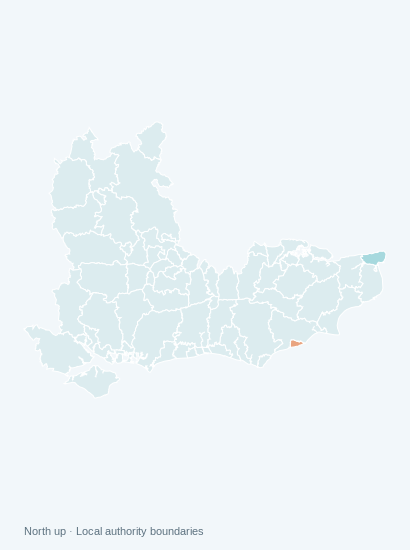
Compare all 64 council areas: exact counts and education deprivation
| Council area | All LSOAs | Overall IMD decile 1 | Education domain decile 1 |
|---|---|---|---|
| Hastings | 53 | 18 (34.0%) | 10 (18.9%) |
| Thanet | 86 | 16 (18.6%) | 17 (19.8%) |
| Swale | 90 | 13 (14.4%) | 23 (25.6%) |
| Eastbourne | 60 | 8 (13.3%) | 8 (13.3%) |
| Portsmouth | 125 | 15 (12.0%) | 21 (16.8%) |
| Southampton | 152 | 18 (11.8%) | 25 (16.4%) |
| Dover | 69 | 8 (11.6%) | 11 (15.9%) |
| Havant | 79 | 9 (11.4%) | 20 (25.3%) |
| Gravesham | 65 | 6 (9.2%) | 4 (6.2%) |
| Gosport | 56 | 5 (8.9%) | 10 (17.9%) |
| Medway | 169 | 15 (8.9%) | 13 (7.7%) |
| Brighton and Hove | 165 | 13 (7.9%) | 18 (10.9%) |
| Folkestone and Hythe | 67 | 5 (7.5%) | 7 (10.4%) |
| Rother | 58 | 3 (5.2%) | 4 (6.9%) |
| Arun | 99 | 5 (5.1%) | 7 (7.1%) |
| Milton Keynes | 166 | 8 (4.8%) | 12 (7.2%) |
| Canterbury | 92 | 4 (4.3%) | 8 (8.7%) |
| Ashford | 81 | 3 (3.7%) | 6 (7.4%) |
| Isle of Wight | 89 | 3 (3.4%) | 3 (3.4%) |
| Maidstone | 99 | 3 (3.0%) | 4 (4.0%) |
| Oxford | 84 | 2 (2.4%) | 12 (14.3%) |
| New Forest | 114 | 2 (1.8%) | 2 (1.8%) |
| Crawley | 67 | 1 (1.5%) | 2 (3.0%) |
| Dartford | 67 | 1 (1.5%) | 0 (0.0%) |
| Sevenoaks | 75 | 1 (1.3%) | 2 (2.7%) |
| Adur | 42 | 0 (0.0%) | 1 (2.4%) |
| Basingstoke and Deane | 115 | 0 (0.0%) | 3 (2.6%) |
| Bracknell Forest | 82 | 0 (0.0%) | 0 (0.0%) |
| Buckinghamshire | 334 | 0 (0.0%) | 11 (3.3%) |
| Cherwell | 102 | 0 (0.0%) | 7 (6.9%) |
| Chichester | 75 | 0 (0.0%) | 2 (2.7%) |
| East Hampshire | 74 | 0 (0.0%) | 2 (2.7%) |
| Eastleigh | 82 | 0 (0.0%) | 1 (1.2%) |
| Elmbridge | 82 | 0 (0.0%) | 0 (0.0%) |
| Epsom and Ewell | 46 | 0 (0.0%) | 0 (0.0%) |
| Fareham | 73 | 0 (0.0%) | 1 (1.4%) |
| Guildford | 84 | 0 (0.0%) | 1 (1.2%) |
| Hart | 59 | 0 (0.0%) | 0 (0.0%) |
| Horsham | 89 | 0 (0.0%) | 0 (0.0%) |
| Lewes | 62 | 0 (0.0%) | 1 (1.6%) |
| Mid Sussex | 92 | 0 (0.0%) | 0 (0.0%) |
| Mole Valley | 54 | 0 (0.0%) | 1 (1.9%) |
| Reading | 100 | 0 (0.0%) | 8 (8.0%) |
| Reigate and Banstead | 90 | 0 (0.0%) | 0 (0.0%) |
| Runnymede | 52 | 0 (0.0%) | 1 (1.9%) |
| Rushmoor | 60 | 0 (0.0%) | 5 (8.3%) |
| Slough | 84 | 0 (0.0%) | 0 (0.0%) |
| South Oxfordshire | 93 | 0 (0.0%) | 0 (0.0%) |
| Spelthorne | 61 | 0 (0.0%) | 0 (0.0%) |
| Surrey Heath | 55 | 0 (0.0%) | 1 (1.8%) |
| Tandridge | 51 | 0 (0.0%) | 1 (2.0%) |
| Test Valley | 81 | 0 (0.0%) | 3 (3.7%) |
| Tonbridge and Malling | 78 | 0 (0.0%) | 1 (1.3%) |
| Tunbridge Wells | 69 | 0 (0.0%) | 2 (2.9%) |
| Vale of White Horse | 81 | 0 (0.0%) | 1 (1.2%) |
| Waverley | 82 | 0 (0.0%) | 0 (0.0%) |
| Wealden | 99 | 0 (0.0%) | 3 (3.0%) |
| West Berkshire | 99 | 0 (0.0%) | 2 (2.0%) |
| West Oxfordshire | 68 | 0 (0.0%) | 1 (1.5%) |
| Winchester | 72 | 0 (0.0%) | 2 (2.8%) |
| Windsor and Maidenhead | 89 | 0 (0.0%) | 0 (0.0%) |
| Woking | 62 | 0 (0.0%) | 0 (0.0%) |
| Wokingham | 103 | 0 (0.0%) | 0 (0.0%) |
| Worthing | 68 | 0 (0.0%) | 1 (1.5%) |
Each measure uses its own national ranking. These are neighbourhood shares, not population poverty rates or assessments of individual learners. A zero does not mean an absence of disadvantage.
TA calculations from corrected MHCLG IoD2025 File 7 and ONS 2024 authority geography. 5,571 neighbourhoods (2021 LSOAs) in this region. Contains OS data and National Statistics data © Crown copyright and database right 2026.
Oxfordshire, Berkshire and Buckinghamshire: three neighbouring propositions
Oxfordshire’s LSIP connects scientific growth to laboratory, bioprocess, engineering and operational roles, including Levels 3 to 5 demand as facilities move towards operation. Providers need access to workplaces and specialist equipment, not simply an association with the county’s research reputation. Enterprise Oxfordshire’s Wave 7 procurement sought 11 lots, including digital, care, logistics and construction; the published March round is closed.
Berkshire’s six priority clusters include digital technology and datacentres, creative production, life sciences, defence and advanced manufacturing, critical services, and construction and green infrastructure. Wokingham Council is the named Bootcamp lead, while the Skills and Business Hub manages delivery. The county-wide programme should not be mistaken for a Wokingham-only learner market.
Buckinghamshire combines a new devolved ASF system with an established mix of college and independent provision. Its LSIP gives particular weight to construction, digital, engineering, film and television, and health and social care. A new entrant should explain the uncovered occupation or learner group it can reach, then show how that offer connects entry-level learning to technical progression.
Surrey: place-based outcomes alongside digital and technical growth
Surrey’s ASF competitive grant process assessed strategic alignment, lasting impact, place-based impact and deliverability. The application form is closed. Its Wave 7 Bootcamp application page also confirms closure after the July round, which targeted manufacturing and engineering, health and social care, and adoption of digital technologies. Monitoring the programme page matters because the route includes competitive grants.
The LSIP makes a useful distinction between specialist digital skills and the ability of ordinary businesses to adopt technology. Flexible, workplace-based learning that improves a specific process can be more persuasive than a broad AI awareness offer. The same plan highlights employers’ limited time to release staff: delivery design is part of the value proposition.
Hampshire and the Solent: one LSIP, separate Bootcamp buyers
Hampshire County Council and Portsmouth City Council’s Solent programme have separate national grant lines. The Hampshire and Solent LSIP spans Hampshire, Portsmouth, Southampton and the Isle of Wight, but this does not make every programme interchangeable. Confirm the actual learner and employer eligibility geography before building a delivery footprint.
Portsmouth reopened selected framework lots during 2026, including solar construction, entry to site, welding, facilities management and AI business transformation. That is evidence of targeted gaps within an established buying route. Hampshire’s October funding uplift strengthens the case for a current conversation about capacity and demand; the programme highlights digital, construction, care, education and horticulture.
Kent, Medway and Sussex: watch the specific route and lot
Kent’s 2026 reopening of the agri-food Bootcamp lot carried an estimated funding envelope of up to £82,000 excluding VAT. That was one lot, not the council’s whole £1.5 million grant. The August competition is closed. For a specialist provider, the useful signal is the buyer’s need to reopen a defined part of provision through Kent Business Portal.
Sussex requires three parallel relationships: East Sussex, West Sussex and Brighton & Hove each have their own Bootcamp allocation. West Sussex’s September update describes a planned shared Adult Skills and Learning Framework for 2026 to 2034, with launch delayed. Existing suppliers will have to apply again. Providers should prepare for that transition while checking each council’s current programmes and requirements.
East Sussex’s current wave already includes AI, analytics and introductory engineering alongside land-based, care and other programmes. The Sussex LSIP’s emphasis on technician and mid-level shortages suggests a stronger opportunity in progression and practical competence than in simply duplicating introductory courses.
Milton Keynes belongs in the regional picture
Milton Keynes is in the South East statistical region but shares an LSIP with Bedfordshire and Northamptonshire. Wider South Midlands investment and programmes must be checked for actual Milton Keynes coverage. A neighbouring authority’s grant is not a Milton Keynes allocation.
Community Learning MK provides adult education and employment support, while Milton Keynes College is a significant delivery organisation and also appears on Buckinghamshire’s ASF provider list. This is a practical reminder that provider operating areas cross council boundaries. Build the proposition around learner residence and delivery eligibility rather than the location of the provider’s head office.
Connect training with employment support
Connect to Work (CtW) is a locally commissioned supported-employment programme for disabled people, people with health conditions and people facing specified complex barriers. In Oxfordshire, the county council works with Oxfordshire Employment and Enterprise Oxfordshire. A training provider’s contribution may be an occupational progression pathway or an employer relationship within that system.
This is not interchangeable with a course-purchasing budget. Establish the local delivery partner, referral criteria and sequencing before proposing joint work. Across the region, adult learning services, Jobcentre Plus, colleges and community organisations can help reach learners who will not respond to a conventional course advertisement.
Who holds the budget, and who helps delivery?
The directory distinguishes upper-tier and unitary buyers from district and borough partners. District councils can be valuable for regeneration, community venues, employer engagement and local referrals, even where they do not control ASF. Berkshire’s six unitary councils and the separate city authorities around Hampshire and Sussex need explicit attention.
Use current contracting-body names when monitoring opportunities. Reorganisation proposals, strategic-authority development and skills-funding transfers follow different timetables. An emerging regional institution should not displace an existing council from the prospect list until responsibility for the relevant programme has actually moved.
The 29th October 2026 update gives provisional support to two councils for East Sussex and Brighton and Hove, and three for Oxfordshire with boundary changes. These remain subject to representations, final decisions and Parliamentary approval. Kent and Medway’s July decision was withdrawn; Hampshire and West Sussex remain under review. Surrey’s April 2027 change remains outside that review. The further representation period for East Sussex and Brighton and Hove, and Oxfordshire runs from 23rd November to 14th December 2026. Final decisions remain outstanding.
Buyer and delivery geography
Find the lead. Build the local delivery relationships.
Choose a shaded area or a commissioning geography below to see the programme lead and local council network.
Select a numbered area
Selected geography
Buckinghamshire
- Programme lead
- Buckinghamshire Council: devolved ASF and Bootcamps.
- Delivery and access
- Unitary authority and devolved ASF buyer; Milton Keynes is separate.
- Local council network
- Buckinghamshire
Complete directory: 64 council areas
| Council area | Upper-tier area | Commissioning geography |
|---|---|---|
| Adur | West Sussex | Sussex and Brighton |
| Arun | West Sussex | Sussex and Brighton |
| Ashford | Kent | Kent and Medway |
| Basingstoke and Deane | Hampshire | Hampshire and the Solent |
| Bracknell Forest | Bracknell Forest | Berkshire |
| Brighton and Hove | Brighton and Hove | Sussex and Brighton |
| Buckinghamshire | Buckinghamshire | Buckinghamshire |
| Canterbury | Kent | Kent and Medway |
| Cherwell | Oxfordshire | Oxfordshire |
| Chichester | West Sussex | Sussex and Brighton |
| Crawley | West Sussex | Sussex and Brighton |
| Dartford | Kent | Kent and Medway |
| Dover | Kent | Kent and Medway |
| East Hampshire | Hampshire | Hampshire and the Solent |
| Eastbourne | East Sussex | Sussex and Brighton |
| Eastleigh | Hampshire | Hampshire and the Solent |
| Elmbridge | Surrey | Surrey |
| Epsom and Ewell | Surrey | Surrey |
| Fareham | Hampshire | Hampshire and the Solent |
| Folkestone and Hythe | Kent | Kent and Medway |
| Gosport | Hampshire | Hampshire and the Solent |
| Gravesham | Kent | Kent and Medway |
| Guildford | Surrey | Surrey |
| Hart | Hampshire | Hampshire and the Solent |
| Hastings | East Sussex | Sussex and Brighton |
| Havant | Hampshire | Hampshire and the Solent |
| Horsham | West Sussex | Sussex and Brighton |
| Isle of Wight | Isle of Wight | Hampshire and the Solent |
| Lewes | East Sussex | Sussex and Brighton |
| Maidstone | Kent | Kent and Medway |
| Medway | Medway | Kent and Medway |
| Mid Sussex | West Sussex | Sussex and Brighton |
| Milton Keynes | Milton Keynes | Milton Keynes |
| Mole Valley | Surrey | Surrey |
| New Forest | Hampshire | Hampshire and the Solent |
| Oxford | Oxfordshire | Oxfordshire |
| Portsmouth | Portsmouth | Hampshire and the Solent |
| Reading | Reading | Berkshire |
| Reigate and Banstead | Surrey | Surrey |
| Rother | East Sussex | Sussex and Brighton |
| Runnymede | Surrey | Surrey |
| Rushmoor | Hampshire | Hampshire and the Solent |
| Sevenoaks | Kent | Kent and Medway |
| Slough | Slough | Berkshire |
| South Oxfordshire | Oxfordshire | Oxfordshire |
| Southampton | Southampton | Hampshire and the Solent |
| Spelthorne | Surrey | Surrey |
| Surrey Heath | Surrey | Surrey |
| Swale | Kent | Kent and Medway |
| Tandridge | Surrey | Surrey |
| Test Valley | Hampshire | Hampshire and the Solent |
| Thanet | Kent | Kent and Medway |
| Tonbridge and Malling | Kent | Kent and Medway |
| Tunbridge Wells | Kent | Kent and Medway |
| Vale of White Horse | Oxfordshire | Oxfordshire |
| Waverley | Surrey | Surrey |
| Wealden | East Sussex | Sussex and Brighton |
| West Berkshire | West Berkshire | Berkshire |
| West Oxfordshire | Oxfordshire | Oxfordshire |
| Winchester | Hampshire | Hampshire and the Solent |
| Windsor and Maidenhead | Windsor and Maidenhead | Berkshire |
| Woking | Surrey | Surrey |
| Wokingham | Wokingham | Berkshire |
| Worthing | West Sussex | Sussex and Brighton |
District and borough boundaries follow ONS December 2024 geography. Programme leads are described separately from councils that help recruit, support and connect learners. Contains OS and National Statistics data © Crown copyright and database right 2026.
Read the provider landscape as evidence of market access
The tables identify organisations named in current council delivery information and programme evidence. Buckinghamshire’s list spans colleges, council adult learning and independent providers. East Sussex also has a mixed delivery network. A competitor can be a potential partner where your specialist employer access, facilities or learner reach fills a different part of the pathway.
Compare actual occupations, delivery locations, entry requirements and employer relationships. A course directory establishes visible provision; it does not establish contract share or spare capacity. Prioritise a demonstrable gap over a claim that the area lacks providers.
Buckinghamshire ASF: current council delivery directory
| Provider | Role / evidence |
|---|---|
| Buckinghamshire Adult Learning | Council adult learning provision |
| Buckinghamshire College Group; Windsor Forest Colleges Group; Milton Keynes College; Capital City College | Colleges named in the council’s ASF directory |
| AKG (UK) Learning; JBC Skills Training; Burleigh College | Independent providers named in the same directory |
| Professional Training Solutions; Staff Power Group | Additional named ASF delivery organisations |
Council course-access directory checked on 21st October 2026. Names establish visible delivery, not allocation size.
East Sussex Bootcamps: Wave 7 delivery announced in July 2026
| Provider | Role / evidence |
|---|---|
| East Sussex County Council; East Sussex College Group; Plumpton College | Council and college delivery partners |
| Brighton & Hove Education Academy; Brighter Horizons Training & Development | Named training partners |
| TechNative Digital; Creative Process Digital; Insite; Skills Provider | Named specialist providers in the council’s programme announcement |
East Sussex County Council announcement of 9th July 2026 names these nine delivery organisations; contract shares are not provided.
Berkshire: programme examples, not a full supplier register
| Provider | Role / evidence |
|---|---|
| Newbury College | Hub case study describes practical engineering training for AWE graduates |
| Realise Training | Hub’s May 2026 case study describes early years Bootcamp delivery |
| The Growth Academy | Hub programme evidence describes business and sales Bootcamps |
Evidence consists of published programme examples and case studies. These are not asserted as new 2026/27 contract awards.
Five questions to answer before investing
- Which authority or funded provider can buy the specific programme, and is the route currently open, closed or being replaced?
- Which occupation and starting level does the latest LSIP identify, and which employers will help design and validate delivery?
- What can you add to the existing provider network: specialist equipment, progression, employer access or a credible learner catchment?
- Can learners reach the training and the eventual job, including practical support around travel, caring and health?
- Is the budget an annual allocation, a programme envelope or a contract opportunity, and how much is actually available to new delivery?
TA’s view
The South East opportunity is not simply its economic scale. It is the mismatch between sophisticated employer demand and uneven access to the skills needed to meet it. Choose a small number of commissioning areas, develop a specific occupational proposition and demonstrate the local delivery relationships behind it. That is a more credible expansion strategy than presenting the whole region as one market.
Sources and scope
Evidence checked on 21st October 2026. Funding rows distinguish academic-year ASF from financial-year Bootcamp grants; construction is already included in each Bootcamp headline. Hampshire’s later uplift is separately identified. Milton Keynes-specific programme funding was not established. Provider examples are programme evidence, not a complete market-share ranking. Procurement status is the last publicly evidenced position; planned routes are not presented as open competitions. The 21st October update also incorporates dated TA correspondence and buyer-issued procurement material where identified in the article; individual contacts and client identities are omitted.
Continue the thinking
England’s skills sectors
Compare the national picture across all 15 subject areas.
What makes local delivery credible?
Turn your chosen geography into a convincing delivery case.
Shape the opportunity before the tender
Use buyer engagement to test and strengthen your proposition.