
Where should a training provider focus in Yorkshire and the Humber? Start with the buyer and the local problem. The region contains large established adult skills systems, newly devolved budgets and an industrial labour market around the Humber that crosses the statistical regional boundary.
This fact file brings the current funding position, LSIP evidence, deprivation, council roles and provider landscape into one report. Its purpose is to help providers decide where they can make a credible contribution, which route they need to access and what to investigate before committing capacity.
In this article
One region. Five commissioning systems.
Yorkshire and the Humber contains 15 metropolitan or unitary council areas. West Yorkshire has five; South Yorkshire has four; York and North Yorkshire has two; Hull and East Yorkshire has two; and North Lincolnshire and North East Lincolnshire complete the region. These are the places covered in this fact file.
The statistical region and the funding map do not line up neatly. The two northern Lincolnshire councils sit within Greater Lincolnshire’s adult skills system, alongside Lincolnshire County Council in the East Midlands. A provider targeting Grimsby or Scunthorpe therefore needs to follow Greater Lincolnshire’s decisions and Lincolnshire’s procurement activity.
West Yorkshire and South Yorkshire operate through integrated settlements. York and North Yorkshire has had devolved adult skills responsibility since August 2025. Hull and East Yorkshire, and Greater Lincolnshire, entered their first devolved Adult Skills Fund (ASF) academic year in August 2026. Each has its own provider arrangements, priorities and access points.
The right starting point is the learner’s residence, the programme and the commissioner. Provider location alone does not establish a funding entitlement. Current allocations include cross-border providers, while some contracts use location filters to decide who receives invitations. Map eligibility and access separately from your delivery footprint.
Funding geography / routes to market
Follow the commissioner, even when the regional boundary changes.
5 council areas
West Yorkshire
01 / Route to understandEstablished grant base; targeted programmes and an Adult Skills DPS with invitation filters.
4 council areas
South Yorkshire
02 / Route to understandGrant and procured delivery; Wave 7 Bootcamps already awarded through an existing framework.
2 council areas
York and North Yorkshire
03 / Route to understandThree provider routes; evidenced ASF procurement uses GCA RM6348 and location filters.
2 council areas
Hull and East Yorkshire
04 / Route to understandNew devolved system with first-year contracts awarded; Hull City Council runs ASF procurement.
2 council areas within a wider funding system
Northern Lincolnshire
05 / Route to understandFollow GLCCA and Lincolnshire County Council. Framework refresh: check the current admission stage.
Rounded figures use different stated periods and must not be added. The first two combine four integrated settlement lines; the other three include Bootcamps, FCfJ and the separate engineering allocation. Greater Lincolnshire’s figure also covers Lincolnshire county. Exact funding lines appear below.
Who controls the money, and how much?
West Yorkshire’s four adult skills settlement lines total £74,443,139 for financial year 2026/27. South Yorkshire’s equivalent total is £44,779,204. These TA calculations combine ASF including Free Courses for Jobs (FCfJ), the ASF construction uplift, Skills Bootcamps and the separate Bootcamps construction component.
For the other three systems, the national grant determination gives both financial-year and academic-year allocations. The academic-year view covers 1st August 2026 to 31st July 2027. Its single adult skills allocation already includes core ASF, FCfJ and Bootcamps. Adding a separate Bootcamp allocation to that total would double-count it.
Including the additional engineering allocation, TA’s totals from the published academic-year allocations are £13,801,066 for York and North Yorkshire, £19,502,584 for Hull and East Yorkshire, and £21,494,359 for the whole Greater Lincolnshire area. The Greater Lincolnshire amount cannot be attributed solely to North Lincolnshire and North East Lincolnshire.
Financial-year and academic-year figures overlap. They are different views of funding, not additional pots. Nor does an allocation show the uncommitted balance available to a new supplier. Existing grants, contracts, programme changes and local flexibilities determine the actual commissioning opportunity.
The table keeps those distinctions visible. Employment support, capital investment and apprenticeships are considered separately. There is deliberately no combined regional total built from incompatible periods or funding geographies.
West Yorkshire’s £70.69 million ASF figure is a single financial year’s regional revenue allocation, including FCfJ: 1st April 2026 to 31st March 2027. It supports an established system of college, council and contracted delivery, rather than an unallocated tender pot. The separate construction and Bootcamp lines bring the four-component subtotal to £74.44 million. Academic-year provider allocations describe delivery within that system and should not be added to it.
Adult skills funding: retain the period and geography
Government allocations show the scale of each system. The next accessible contract depends on how the authority commissions delivery.
West Yorkshire: calculated subtotalFinancial year 2026/27 · Four adult skills settlement lines£74,443,139
| Authority / component | Amount | Period and scope |
|---|---|---|
| ASF including FCfJ | £70,686,274 | Financial year 2026/27: 1st April 2026 to 31st March 2027; regional revenue allocation, including grant and contracted delivery |
| ASF construction uplift | £994,144 | Financial year 2026/27 |
| Bootcamps | £2,106,181 | Financial year 2026/27 |
| Bootcamps construction | £656,540 | Financial year 2026/27 |
| calculated subtotal | £74,443,139 | Four adult skills settlement lines |
South Yorkshire: calculated subtotalFinancial year 2026/27 · Four adult skills settlement lines£44,779,204
| Authority / component | Amount | Period and scope |
|---|---|---|
| ASF including FCfJ | £42,678,960 | Financial year 2026/27 |
| ASF construction uplift | £600,244 | Financial year 2026/27 |
| Bootcamps | £1,143,536 | Financial year 2026/27 |
| Bootcamps construction | £356,464 | Financial year 2026/27 |
| calculated subtotal | £44,779,204 | Four adult skills settlement lines |
York and North Yorkshire: calculated totalAcademic year 2026/27 · Published single allocation plus engineering£13,801,066
| Authority / component | Amount | Period and scope |
|---|---|---|
| single adult skills allocation | £13,672,999 | Academic year 2026/27; includes £2,013,112 Bootcamps |
| additional engineering | £128,067 | Academic year 2026/27; separate Annex B amount |
| calculated total | £13,801,066 | Published single allocation plus engineering |
Hull and East Yorkshire: calculated totalAcademic year 2026/27 · Published single allocation plus engineering£19,502,584
| Authority / component | Amount | Period and scope |
|---|---|---|
| single adult skills allocation | £19,310,015 | Academic year 2026/27; includes £2,287,505 Bootcamps |
| additional engineering | £192,569 | Academic year 2026/27; separate Annex B amount |
| calculated total | £19,502,584 | Published single allocation plus engineering |
Greater Lincolnshire: calculated totalAcademic year 2026/27 · Whole CCA, including Lincolnshire County Council£21,494,359
| Authority / component | Amount | Period and scope |
|---|---|---|
| single adult skills allocation | £21,269,625 | Academic year 2026/27; whole CCA, includes £1,616,315 Bootcamps |
| additional engineering | £224,734 | Academic year 2026/27; whole CCA |
| calculated total | £21,494,359 | Whole CCA, including Lincolnshire County Council |
Sources: West Yorkshire and South Yorkshire integrated settlement tables; national 2026/27 single adult skills grant determination, Annexes A and B. Calculated totals use the published allocation totals. Financial year means 1st April 2026 to 31st March 2027. These are allocations, not procurement ceilings, awards or actual expenditure.
What does the local economy need providers to solve?
The current LSIPs cover 2026 to 2029. Four cover areas wholly within this fact file; the Greater Lincolnshire plan supplies the relevant south-Humber evidence. Read the plans at occupation and capability level. A sector appearing in an LSIP is a starting point for market engagement, not a commitment to purchase every course in that sector.
West Yorkshire’s manufacturing evidence illustrates the distinction. Broadly stable employment can still generate substantial training demand as routine work gives way to technical, digital and engineering capability. The opportunity may be progression and conversion of the existing workforce, particularly at Levels 3 to 5.
South Yorkshire separates four growth sectors from emerging and foundational activity. Advanced manufacturing, clean energy, life sciences and defence are growth priorities; construction, health and care, and retail and hospitality remain important to the everyday economy. A growth-sector strategy does not remove demand for foundation learning or frontline workforce development.
Hull and East Yorkshire distinguishes growth drivers, growth potential and growth-enabling sectors. On the south bank, Greater Lincolnshire identifies industrial, port, seafood, chemical, energy and logistics needs. It specifically highlights laboratory science, metallurgy and materials provision in North Lincolnshire in relation to British Steel.
A vacancy count is not a curriculum specification. Ask whether employers need more applicants, competent new entrants, experienced technicians, a supervisory step or help adopting new technology. The strongest proposal identifies the missing capability and demonstrates how learners will gain the practical experience to use it.
The current 2026 to 2029 LSIPs
Read the occupational problem beneath the sector heading.
West Yorkshire
Employer representative body: West and North Yorkshire Chamber of Commerce
Local priorities: Advanced Manufacturing and Engineering · Creative and Cultural Industries · Digital and Technology · Financial and Professional Services · Green Economy · HealthTech and Life Sciences
Construction is additionally supported as an enabling sector for housing, infrastructure and decarbonisation; it is not one of the six named growth-sector headings.
A provider should test whether it can move people up the technical ladder or help an existing workforce adapt. Employment growth alone understates the opportunity in manufacturing and professional services: the work is changing even where total headcount grows little.
Explore occupations, levels and delivery implications
| Priority | Evidence and delivery implications |
|---|---|
| SSA 4: Engineering and Manufacturing TechnologiesAdvanced Manufacturing and Engineering | Levels 3 to 5 engineering, machining, maintenance and first-line supervision; technical progression as automation changes routine work. |
| SSA 9: Arts, Media and PublishingCreative and Cultural Industries | Digital production, project coordination, client delivery and commercial skills; flexible routes for freelancers and small businesses. |
| SSA 6: Digital TechnologyDigital and Technology | Software, data, cyber, IT support and applied AI, alongside communication and leadership. Essential digital exclusion persists. |
| SSA 15: Business, Administration and LawFinancial and Professional Services | Finance, compliance, analysis and client judgement as routine transactions automate; higher professional progression and digital upskilling. |
| SSA 4: Engineering and Manufacturing TechnologiesSSA 5: Construction, Planning and the Built EnvironmentGreen Economy | Electrical and plumbing competence, solar PV, low-carbon heating and whole-house retrofit; job-ready technical capability and specialist tutors. |
| SSA 1: Health, Public Services and CareSSA 2: Science and MathematicsSSA 4: Engineering and Manufacturing TechnologiesSSA 6: Digital TechnologyHealthTech and Life Sciences | Laboratory skills, scientific data, digital health and regulation; interdisciplinary science and technology pathways. |
| SSA 5: Construction, Planning and the Built EnvironmentConstruction | Core trades, site safety and supervision, alongside retrofit installation, assessment and coordination. Specialist tutors and apprenticeship participation constrain supply. |
Useful anchors in the plan: Kirklees College and Calderdale College; Leeds College of Building; HealthTech Investment Zone, universities and NHS assets.
South Yorkshire
Employer representative body: Doncaster Chamber of Commerce
Local priorities: Advanced manufacturing · Clean energy · Life sciences · Defence
Emerging: digital and aviation. Foundational: construction, health and care, retail and hospitality.
The sharpest question is not how many people can enrol, but how many will become productive in a real workplace. Defence makes this explicit: an experience and standards gap needs employer-backed practice, conversion and progression, while manufacturing still needs core trade skills as it adopts automation.
Explore occupations, levels and delivery implications
| Priority | Evidence and delivery implications |
|---|---|
| SSA 4: Engineering and Manufacturing TechnologiesAdvanced manufacturing | Machining, welding, fabrication, moulding and shop-floor fundamentals; supervisor succession and digital readiness. |
| SSA 4: Engineering and Manufacturing TechnologiesSSA 5: Construction, Planning and the Built EnvironmentClean energy | Engineering, construction, retrofit and infrastructure capability; experienced trades and mid-career conversion alongside new technology. |
| SSA 2: Science and MathematicsSSA 4: Engineering and Manufacturing TechnologiesLife sciences | Science, quality, regulation and digital capability; workplace readiness and commercialisation alongside academic attainment. |
| SSA 4: Engineering and Manufacturing TechnologiesDefence | Level 3 machining, maintenance, mechatronics and welding. The shortage is production-ready experience and standards knowledge, despite available applicants. |
| Digital and deep tech | Applied AI, automation, data interpretation and collaborative problem-solving through real business projects. |
| Aviation | Engineering, certification and specialist experience; align provision with verified recruitment and operational timelines. |
| Construction, care and access to work | Construction and retrofit support development; care, flexible work and integrated employment support help residents participate. |
Useful anchors in the plan: Advanced Manufacturing Research Centre (AMRC); Advanced Wellbeing Research Centre and Olympic Legacy Park; Digital Media Centre.
York and North Yorkshire
Employer representative body: West and North Yorkshire Chamber of Commerce
Local priorities: Clean Energy, Green Economy and Carbon Negative Technical Skills · Construction · Creative Industries · Health and Social Care (including Engineering Biology and Life Sciences) · Land-based Skills (including Food and Farming Innovation) · Manufacturing and Engineering (including Rail Innovation and Secure Technologies)
The Local Growth Plan competitive advantages are Food & Farming Innovation; Engineering Biology and Life Sciences; Clean Energy; Rail Innovation & Secure Technologies; Creative Industries. The LSIP broadens these into six delivery chapters.
This is a two-part skills market: essential Level 2 to 3 workforce renewal sits alongside specialist Level 6 to 7 innovation. A regional offer needs reachable rural provision and real progression between levels, not a single city-centre course catalogue.
Explore occupations, levels and delivery implications
| Priority | Evidence and delivery implications |
|---|---|
| SSA 4: Engineering and Manufacturing TechnologiesSSA 5: Construction, Planning and the Built EnvironmentClean Energy, Green Economy and Carbon Negative Technical Skills | Level 2 to 3 trades, retrofit, diagnostics and quality assurance; progression into controls, systems integration and project delivery. |
| SSA 5: Construction, Planning and the Built EnvironmentConstruction | Level 2 to 3 trades, retrofit, diagnostics and quality assurance; progression into controls, systems integration and project delivery. |
| SSA 9: Arts, Media and PublishingCreative Industries | Practical production, digital tools, live briefs and freelance business skills; flexible delivery around client work. |
| SSA 1: Health, Public Services and CareSSA 2: Science and MathematicsSSA 4: Engineering and Manufacturing TechnologiesHealth and Social Care (including Engineering Biology and Life Sciences) | Level 2 to 3 care recruitment and retention, including rural and coastal communities; progression to senior care and supervision. A distinct Level 6 to 7 market: laboratory automation, bioinformatics, regulation, data and commercialisation. |
| SSA 3: Agriculture, Horticulture and Animal CareSSA 4: Engineering and Manufacturing TechnologiesSSA 7: Retail and Commercial EnterpriseLand-based Skills (including Food and Farming Innovation) | Level 2 to 3 farm and food competence, safety, traceability, sensors and precision agriculture; seasonal and mobile delivery. |
| SSA 4: Engineering and Manufacturing TechnologiesManufacturing and Engineering (including Rail Innovation and Secure Technologies) | Renew machining, welding, maintenance and inspection skills; progress towards automation, rail systems and higher apprenticeships. |
Useful anchors in the plan: York, Scarborough, Selby, Skipton and Harrogate; Rail innovation and secure technologies; Universities and specialist research employers.
Hull and East Yorkshire
Employer representative body: Hull and Humber Chamber of Commerce
Local priorities: Agri-food and Agri-tech · Energy · Manufacturing · Ports and Logistics
Growth potential: Digital & Technologies; Professional & Business Services; Financial Services; Creative Industries; Construction; Culture & the Visitor Economy. Growth enabling: Health & Social Care; Education & Skills Provision; Retail & Wholesale; Public Administration & Public Services; Utilities & Other Local Services; Transport outside ports & maritime logistics; Real Estate.
The same industrial growth story contains very different entry points: operational logistics and food roles, skilled engineering trades, and higher-level energy professionals. Match the learner cohort and progression route to the actual occupation; a single green-jobs narrative hides that difference.
Explore occupations, levels and delivery implications
| Priority | Evidence and delivery implications |
|---|---|
| SSA 3: Agriculture, Horticulture and Animal CareSSA 4: Engineering and Manufacturing TechnologiesSSA 7: Retail and Commercial EnterpriseAgri-food and Agri-tech | Food and process operatives, maintenance, welding, warehousing and production management; progression into robotics and data-driven production. |
| SSA 4: Engineering and Manufacturing TechnologiesSSA 5: Construction, Planning and the Built EnvironmentEnergy | Engineering technicians, installation, pipefitting, rigging and project management, alongside data and environmental capability. |
| SSA 4: Engineering and Manufacturing TechnologiesManufacturing | Specialist welding, production engineering and digital manufacturing; ageing-workforce replacement and accessible technical training. |
| SSA 4: Engineering and Manufacturing TechnologiesSSA 7: Retail and Commercial EnterprisePorts and Logistics | Driving, warehouse and forklift routes, then transport management and supply-chain coordination. |
| Cross-sector technical and management | Shared engineering, digital, carbon-management and operational leadership needs; shorter provision that SMEs can release staff to attend. |
Useful anchors in the plan: Humber energy cluster and Freeport/ports supply chains; Hull and East Yorkshire local growth framework.
North Lincolnshire and North East Lincolnshire / Greater Lincolnshire LSIP
Employer representative body: Federation of Small Businesses
Local priorities: Agri-Food and Agri-Tech · Energy · Manufacturing · Ports and Logistics · Defence and Security
The growth priorities above apply to the whole Greater Lincolnshire area, including Lincolnshire county. Whole-plan enabling/foundational focus: digital and technology; professional and business services; health and adult social care; construction; visitor economy.
The south bank connects industrial maintenance, energy transition, ports and seafood supply chains. Target the needs evidenced around Scunthorpe and Grimsby, including metallurgy and materials capability, while following the wider Greater Lincolnshire commissioning system.
Explore occupations, levels and delivery implications
| Priority | Evidence and delivery implications |
|---|---|
| SSA 3: Agriculture, Horticulture and Animal CareSSA 4: Engineering and Manufacturing TechnologiesSSA 7: Retail and Commercial EnterpriseAgri-Food and Agri-Tech | TA delivery implication: in the south-Humber catchment, test seafood and food-processing tasks, maintenance, quality and production supervision with actual employers. Keep the wider plan’s farming and agri-tech priorities distinct where local demand has not been established. |
| SSA 4: Engineering and Manufacturing TechnologiesSSA 5: Construction, Planning and the Built EnvironmentEnergy | South-Humber energy transition needs welding, mechanical fitting, pipefitting, process engineering, rigging and non-destructive testing; experienced tutors matter. |
| SSA 4: Engineering and Manufacturing TechnologiesManufacturing | The plan proposes laboratory science, metallurgy and materials provision in North Lincolnshire to support British Steel’s workforce sustainability. |
| SSA 4: Engineering and Manufacturing TechnologiesSSA 7: Retail and Commercial EnterprisePorts and Logistics | TA delivery implication: connect the evidenced south-Humber port economy to driving, warehouse, terminal or supply-chain roles. Check licences, practical equipment access and employer operating requirements before choosing a qualification or cohort size. |
| SSA 4: Engineering and Manufacturing TechnologiesSSA 6: Digital TechnologyDefence and Security | TA delivery implication: this is a whole-LSIP priority, so first establish which defence or security employers and roles are actually relevant to the two northern councils. Use verified local supply-chain demand before designing a technical conversion pathway. |
| South-Humber industrial and port economy | Scunthorpe and Grimsby labour markets combine industrial, port, seafood, chemical, engineering, energy and logistics activity. |
| Whole-plan progression and technical supply | The wider plan seeks technical progression from Levels 2 to 7. Confirm which demand is local to the two northern councils. |
| Digital opportunity in North Lincolnshire | The plan identifies digital and AI provision gaps in North Lincolnshire; verify project milestones before translating ambition into recruitment demand. |
Useful anchors in the plan: Scunthorpe and Grimsby; British Steel; South-Humber offshore wind, Freeport investment and industrial decarbonisation.
Source: the five approved LSIPs for 2026 to 2029. Greater Lincolnshire’s sector headings cover its whole area; the detailed south-Humber needs above are geographically identified. Plan ambitions and employer needs are distinct from funded courses or current vacancies. Takeaways are TA analysis.
LSIP evidence to curriculum
Choose the capability first. Build the qualification route around it.
West Yorkshire · South Yorkshire · Hull and East Yorkshire · South Humber
Engineering, manufacturing and defence
4.1 Engineering · 4.2 Manufacturing technologies
Keep core trade competence at the centre, then build the experience, quality standards and digital capability needed for progression.
All five skills geographies
Construction, retrofit and clean energy
5.2 Building and construction · 4.1 Engineering
Train for the installation, inspection and project roles that deliver the transition. Green awareness alone will not remove a technical bottleneck.
West Yorkshire · South Yorkshire · York and North Yorkshire
Health, care and life sciences
1.3 Health and social care · 1.2 Nursing, and subjects and vocations allied to medicine · 2.1 Science
Separate frontline care and supervisory progression from specialist science and HealthTech pathways; they serve different jobs and qualification levels.
York and North Yorkshire · Hull and East Yorkshire
Land-based skills and food production
3.1 Agriculture · 3.2 Horticulture and forestry · 3.4 Environmental conservation · 4.2 Manufacturing technologies
Pair practical farm and food-production competence with digital tools, quality systems and delivery that fits rural and seasonal working.
Hull and East Yorkshire · South Humber · York and North Yorkshire · South Yorkshire
Ports, logistics and transport
4.3 Transportation operations and maintenance · 7.2 Warehousing and distribution · 4.1 Engineering
Distinguish operational entry routes from engineering and management progression. A transport cluster needs several different training offers.
All five skills geographies
Digital, data and AI
6.1 Digital technology (practitioners) · 6.2 Digital technology (users)
Match the depth to the job: digital confidence, practical use of AI and specialist software or cyber capability solve different problems.
West Yorkshire · York and North Yorkshire · Hull and East Yorkshire
Creative, media and the visitor economy
9.1 Performing arts · 9.2 Crafts, creative arts and design · 9.3 Media and communication · 7.4 Hospitality and catering · 8.2 Travel and tourism
Connect practical production and service skills to client work, commercial resilience and progression; make delivery workable for freelancers and small employers.
West Yorkshire · All areas for management progression
Professional services and management
15.1 Accounting and finance · 15.2 Administration · 15.3 Business management · 15.4 Marketing and sales · 15.5 Law and legal services
Develop judgement, compliance, client relationships and first-line leadership as automation changes routine work.
All five skills geographies
Access, work readiness and teaching capacity
14.1 Foundations for learning and life · 14.2 Preparation for work · 13.1 Teaching and lecturing · 13.2 Direct learning support
A viable pathway needs learners who can participate, employers who can offer practice and tutors who understand the working environment.
South Yorkshire’s defence evidence describes available applicants but insufficient production readiness. Employer-backed practice, standards knowledge and conversion can be more valuable than another generic introductory course.
TA crosswalk using Ofqual Sector Subject Area classifications. This is a curriculum planning aid; the assigned qualification SSA and local funding rules determine classification and eligibility. Sector names such as energy and defence span several subject routes.
Where participation needs a different delivery model
Across Yorkshire and the Humber, 620 of 3,355 neighbourhoods, or 18.5%, are in England’s most deprived 10% on the English Indices of Deprivation 2025. These are small-area counts, not the proportion of residents living in poverty.
Hull has the highest authority-level concentration in the region at 41.7%, followed by Bradford at 36.9% and North East Lincolnshire at 27.1%. Hull and Bradford also have high proportions in the education, skills and training domain: 42.3% and 38.1% respectively.
Overall deprivation and education deprivation answer different questions. Doncaster’s education-domain figure is 31.7%, compared with 23.1% on the overall index. York has no neighbourhoods in the overall most-deprived tenth, but 8.3% fall in the education domain’s most-deprived tenth. A low overall figure is not evidence that adult learning support is unnecessary.
Use neighbourhood evidence to test recruitment channels, community venues, travel costs, caring commitments, health-related barriers and digital access. Across rural North Yorkshire and East Riding, test travel time and viable cohort size as well as the deprivation ranking. Authority-wide averages can conceal both concentrated need and dispersed learners.
The support model belongs in the delivery budget. Explain who will reach learners, what will keep them attending and how the route connects to a realistic next step. Check which costs the programme funds before promising transport, equipment, wraparound support or outreach.
English Indices of Deprivation 2025
A regional course needs a local participation model.
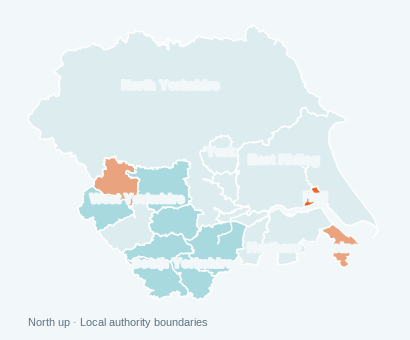
Compare all 15 authorities: exact counts and education deprivation
| Authority | All LSOAs | Overall IMD decile 1 | Education domain decile 1 |
|---|---|---|---|
| Hull | 168 | 70 (41.7%) | 71 (42.3%) |
| Bradford | 312 | 115 (36.9%) | 119 (38.1%) |
| North East Lincolnshire | 107 | 29 (27.1%) | 28 (26.2%) |
| Doncaster | 199 | 46 (23.1%) | 63 (31.7%) |
| Sheffield | 343 | 75 (21.9%) | 87 (25.4%) |
| Barnsley | 148 | 32 (21.6%) | 41 (27.7%) |
| Rotherham | 170 | 36 (21.2%) | 40 (23.5%) |
| Calderdale | 129 | 26 (20.2%) | 17 (13.2%) |
| Leeds | 488 | 84 (17.2%) | 88 (18.0%) |
| Wakefield | 215 | 37 (17.2%) | 49 (22.8%) |
| Kirklees | 260 | 35 (13.5%) | 43 (16.5%) |
| North Lincolnshire | 103 | 12 (11.7%) | 19 (18.4%) |
| East Riding of Yorkshire | 213 | 13 (6.1%) | 19 (8.9%) |
| North Yorkshire | 379 | 10 (2.6%) | 18 (4.7%) |
| York | 121 | 0 (0.0%) | 10 (8.3%) |
Each measure uses its own national deprivation ranking. These are neighbourhood shares, not population poverty rates or individual skills assessments.
TA calculations from MHCLG IoD2025 File 7: decile 1 neighbourhoods divided by all 2021 LSOAs in each authority. Regional denominator: 3,355 LSOAs. ONS May 2024 boundaries, generalised. Contains OS data and National Statistics data © Crown copyright and database right 2026.
West Yorkshire: follow the move towards targeted employment programmes
West Yorkshire Combined Authority (WYCA)’s Adult Skills Plan 2026 places substantial delivery through its five councils and FE Compact, alongside targeted competitions. Its current adult-training information describes the Bootcamp model evolving into Targeted Employment Programmes, or TEPs. A provider should follow the purpose and commissioning model, rather than search only for the familiar Bootcamps label.
The Adult Skills DPS, reference 79437, is advertised through YORtender and remains important to supplier access. Read the amendments, not just the headline portal field: the linked corrigendum changes the participation deadline to 30th August 2028, with the arrangement ending on 28th October 2028. The portal summary still displays a later 2033 date.
The amendment also explains why early preparation matters. Buyer filters determine which participants receive invitations, so suppliers need to keep their selections current. Joining while a tender is already live does not allow a provider to bid for that live opportunity. Registration is an access task to complete before the relevant competition.
Connect to Work (CtW) provides a separate employment-support example. The IPS procurement has a maximum value of £23.19m excluding tax through 31st March 2030 and requires at least 9,276 starts. Its submission deadline was 29th July 2026 and the procurement portal confirms it is closed, despite a landing page continuing to describe it as live. It should now be treated as a procurement to follow through award and mobilisation, not as an open bid.
Provider implication: build a proposition around a specific employment or progression problem. Show which employers will use the skills, how residents will be recruited and how the programme fits the authority’s targeted approach. Keep your supplier categories current before a relevant call-off appears.
DPS admission is a commercial priority. WYCA directs providers seeking its procured adult skills opportunities through the Adult Skills DPS, YORtender reference 79437. Admission must be complete before the relevant competition is released, and selected filters determine which invitations a supplier receives. A portal account or pending application is not enough. Grant-funded provision has separate arrangements.
In one application followed by TA, submission on 24th July 2026 had still produced no outcome by 21st October, despite repeated portal and email chasers. This is one documented case, rather than a standard assessment timescale. The planning lesson is clear: apply well ahead of demand, keep evidence current and seek written confirmation of admission instead of assuming the next tender will leave time to join.
South Yorkshire: distinguish allocated delivery from the next competition
South Yorkshire Mayoral Combined Authority (SYMCA)’s adult skills system combines substantial grant-funded college and council delivery with procured provision. Its March 2026 academic-year grant schedule names Sheffield College, RNN Group, DN Colleges Group, Barnsley College and Northern College, alongside council adult-learning services and smaller providers.
The schedule records rounded combined ASF and FCfJ amounts including £11.98m for Sheffield College, £5.25m for RNN Group, £4.47m for DN Colleges Group, £3m for Barnsley College and £2.95m for Northern College. These are dated allocation decisions, not a complete picture of every provider’s current revenue or local market share.
Wave 7 Skills Bootcamps were awarded on 18th August 2026 through the existing five-lot framework. The £1.5m programme funding period spans April 2026 to September 2027, with delivery commencing in August 2026. That is established delivery, not an open application round. The public award appendix is redacted, so it does not support a reliable list of individual Wave 7 winners.
The ASF framework is a separate route. Its last verified reopening closed at 11am on 14th July 2025. It should not be treated as a continuously open DPS, and no new admission window was verified at the review date. Monitor SYMCA’s tenders and ProContract for an explicit reopening or relevant competition.
The earlier standard Wave 7 rules also shape commercial viability: payments are 30% after the qualifying start milestone, 30% at completion and interview (or the applicable equivalent), and 40% for a qualifying outcome. The start milestone requires 14 qualifying days, at least 10 guided learning hours and initial assessment; payments are claimed in arrears. Employer commitments and a credible outcome route belong in the delivery and cash-flow model before recruitment begins.
The public ASF directory is still headed 2025/26. It can help identify historic delivery presence, but the current allocation decisions and programme-specific award notices are stronger evidence for a 2026/27 assessment. Do not carry an old Bootcamp supplier list forward without checking the current wave.
Employment support has its own delivery structure. CtW contracts name South Yorkshire Housing Association for Barnsley, Doncaster and Rotherham, and Shaw Trust for Sheffield. The recorded values are £7,413,744 and £4,942,496, respectively, for 1st October 2025 to 31st March 2027. These are contract values for that period, not extra annual ASF allocations.
Provider implication: identify the gap alongside established provision. That may be a technical specialism, practical employer experience, a local recruitment network or progression for an existing workforce. Confirm whether access is through a future competition, a current framework call-off or a permitted relationship with an appointed provider.
An awarded wave does not close every route into the programme. SYMCA held market engagement on 20th October 2026 for a separate open HGV and Passenger Carrying Vehicle (PCV) Bootcamps competition. The webinar’s indicative timetable set out publication on 22nd October, a 17th November submission deadline, December awards and delivery from February 2027. Use the issued tender and any subsequent clarifications under ProContract reference DN832061 to confirm the final timetable before committing bid resources.
The webinar proposed initial envelopes of £349,597.50 for HGV and £149,827.50 for PCV. Its public pre-market notice carried a £1 million estimated value and an extension option; the final tender must establish the contract scope and value. SYMCA’s Q&A said the provider’s business need not be based in South Yorkshire, while accessible local delivery was important. The driver competition has its own milestone arrangements: do not assume the earlier standard Wave 7 payment profile applies.
SYMCA describes its integrated settlement as a £1.3 billion package. The current government table totals approximately £1.35 billion across 2026/27 to 2029/30, covering transport, housing, regeneration and other responsibilities as well as adult skills. Revenue and capital lines have different horizons. This enables investment to be coordinated; it does not create a £1.3 billion training procurement. The skills figures here sit within that wider settlement. Read Integrated settlements: what changes for training providers?.
York and North Yorkshire: understand the three provider routes
York and North Yorkshire Combined Authority (YNYCA)’s current allocation schedule separates local grant-funded providers, grant-funded providers based outside the area, and procured contract-for-services providers. This is a useful starting point for competitor analysis because it shows the actual route and programme behind each allocation.
The 2026/27 schedule includes North Yorkshire Council, City of York Council, York College, Craven College and Askham Bryan College, as well as cross-border colleges and independent providers. Large council allocations include Tailored Learning. They should not be read as equivalent to a specialist Bootcamp contract.
The buyer’s February 2026 presentation identifies the Adult Skills and Learning DPS, RM6348, as its procured route and explains the location filters used for invitations. The system is now run by the Government Commercial Agency (GCA), which replaced Crown Commercial Service (CCS) on 1st April 2026. Being registered on a broad national system is insufficient if your declared delivery geography does not bring you into the buyer’s search.
North Yorkshire Council also has a separate Approved Provider List for training, learning, apprenticeships and exam centres. Its published terms allow applications through the arrangement’s term, and YNYCA is a permitted user. Confirm the current portal workspace and admission instructions before applying; this is distinct from the CA’s evidenced ASF procurement through GCA.
The current Bootcamp programme launched in August 2026. Its allocation schedule identifies named delivery, including Primed Talent, Wetherby Training, Enterprise Made Simple, Screen Yorkshire, Leep Talent, House Builder XL, GTEC Training and NSPP Vocational Training, alongside college allocations. Those entries establish funded provision in the schedule, not a fresh open tender.
The local delivery challenge includes dispersed rural and coastal communities alongside York’s employment base. Test venue access, travel patterns, employer aggregation and the practical viability of specialist cohorts. Digital delivery can widen reach for suitable learning, but it does not replace equipment, work experience or face-to-face support where the occupation requires them.
Provider implication: choose both your programme and your entry route. A rural employer cluster seeking technical upskilling needs a different model from community foundation learning or a screen-industry Bootcamp. Use current allocations to identify where your offer adds something specific.
YNYCA’s April 2026 ASF competition shows how much local evidence can matter without making local headquarters an entry condition. Its track-record question, worth 10%, asked first for adult skills delivery in York and North Yorkshire during the previous two years, while explicitly accepting recent relevant examples elsewhere. A separate 10% question required evidence from the bidder’s own conversations with residents, employers, industry networks and delivery partners. Published research alone attracted no credit unless the proposal explained how it would respond.
An incoming provider therefore needs more than a transferable course and a regional strategy quotation. Build employer and referral relationships before the tender, and show how delivery experience translates into the target catchment. What would make local delivery in your next region credible? sets out how to make that case.
Hull and East Yorkshire: a new devolved system with contracts already in place
Hull and East Yorkshire’s ASF devolution is already live from August 2026. By 29th September 2026 the combined authority was reporting that 2026/27 contracts had been awarded. Providers should approach this as a functioning delivery system, not an unallocated future budget.
The current allocation schedule separates grant recipients from procured contract rows. Hull College has a published grant total of £6,262,205, with separate procured provision also listed. Hull City Council’s grant total is £1,909,614, East Riding of Yorkshire Council’s is £1,636,801, and TEC Partnership Group’s is £1,617,570. These totals combine the streams shown in that particular schedule.
The eight procured rows name Blue Apple Training, Hull College, Humber Learning Consortium, Portull Training Services, SCL Education and Training, Skills-UK Education and Training, The Skills Network and Triage Centrum. Count the provider and the route together: a college can appear in both grant and procured delivery.
Cross-border provision is material. The authority records arrangements involving City of York Council and York College, and a reciprocal arrangement with Greater Lincolnshire. Those arrangements show that the Humber is an interconnected labour market, while funding eligibility and provider agreements still need to be checked programme by programme.
For ASF, the authority’s supplier guidance identifies Hull City Council as procurement lead using YORtender / PROACTIS, rather than the GCA DPS. It describes an Approved Provider List with evaluation linked to additional funding or a need for replacement or increased provision. Confirm the current assessment point; an application route does not mean an immediately funded contract is available.
Provider implication: connect the port, logistics, energy, manufacturing or agri-food proposition to a realistic learner catchment. Hull’s concentrated deprivation and East Riding’s more dispersed geography require different recruitment and attendance plans, even where the occupational content is similar.
Wave 7 Bootcamps were procured through Hull City Council’s Learning and Training DPS, with invitations limited to providers admitted under the relevant categories. Secure the right admission before a call-off appears, rather than expect a programme page to advertise an open application round. The buyer’s portal update on 9th November 2026 said internal governance was continuing and linked the lengthy process to significant market interest. TA’s review on 16th November 2026 recorded the outcome as pending. Build mobilisation around a confirmed decision and delivery timetable. The analysis of delayed funding awards explores the implications for providers.
North and North East Lincolnshire: the buyer sits across the regional boundary
North Lincolnshire and North East Lincolnshire belong in this regional fact file, but their devolved adult skills commissioner is Greater Lincolnshire Combined County Authority (GLCCA). Lincolnshire County Council manages relevant procurement and commissioning through PANACEA. The two councils must therefore remain visible in both your Yorkshire and Humber delivery map and your Greater Lincolnshire buyer watchlist.
The Adult Skills and Employment Programmes framework refresh is open for applications. It admits additional providers while existing suppliers retain their places and can apply for additional lots. The three lots cover non-accredited provision, accredited skills, and other skills and employment-related activity.
Issued buyer instructions set submissions for 30th November 2026, with appointments planned from 1st February 2027. Review the current opportunity note and confirm the exact cutoff and any amendments in PANACEA.
The advertised £87m including VAT is the estimated framework value across its scope. It is not an annual allocation, a guaranteed spend or a fund reserved for the two south-bank councils. Use the published framework reference PL24/111 and the buyer’s current instructions to follow the refresh.
North East Lincolnshire Council’s September 2026 programme update names TEC Partnership, Construction Skills People and University of Lincoln as delivering Bootcamps locally. Its case study also identifies Competum. On the North Lincolnshire side, North Lindsey College within DN Colleges Group and the council’s Adult Education and Community Learning service are important delivery anchors.
Provider implication: check how the issued framework documents translate admission into call-offs, local coverage and actual volumes. Bring evidence around ports, industrial transition, seafood, engineering, energy or logistics, with a clear explanation of where learners and employers will come from.
The 15 council areas to keep in your buyer map
The combined authority determines much of the adult skills system, but councils still matter as grant-funded providers, accountable bodies, community-learning commissioners, employment partners and referral networks. A council’s role can differ by programme.
The directory below distinguishes the strategic funding system from the local relationships a provider needs. Treat it as a practical buyer and delivery map, not a claim that every council has a live training tender. On 29th October 2026, government withdrew the July reorganisation decision covering Lincolnshire, North Lincolnshire and North East Lincolnshire. Continue using the existing northern Lincolnshire councils and programme leads while proposals are reconsidered.
Buyer and delivery geography
Find the lead. Build the local delivery relationships.
Choose a shaded area or a commissioning geography below to see the programme lead and local council network.
Select a numbered area
Selected geography
West Yorkshire
- Programme lead
- WYCA: devolved adult skills; Adult Skills DPS on YORtender.
- Delivery and access
- Five metropolitan councils operate local adult learning, community partnerships and learner referral routes.
- Local council network
- Bradford · Calderdale · Kirklees · Leeds · Wakefield
Complete directory: 15 council areas
| Council area | Upper-tier area | Commissioning geography |
|---|---|---|
| Barnsley | Barnsley | South Yorkshire |
| Bradford | Bradford | West Yorkshire |
| Calderdale | Calderdale | West Yorkshire |
| Doncaster | Doncaster | South Yorkshire |
| East Riding of Yorkshire | East Riding of Yorkshire | Hull and East Yorkshire |
| Kingston upon Hull, City of | Kingston upon Hull, City of | Hull and East Yorkshire |
| Kirklees | Kirklees | West Yorkshire |
| Leeds | Leeds | West Yorkshire |
| North East Lincolnshire | North East Lincolnshire | Northern Lincolnshire |
| North Lincolnshire | North Lincolnshire | Northern Lincolnshire |
| North Yorkshire | North Yorkshire | York and North Yorkshire |
| Rotherham | Rotherham | South Yorkshire |
| Sheffield | Sheffield | South Yorkshire |
| Wakefield | Wakefield | West Yorkshire |
| York | York | York and North Yorkshire |
District and borough boundaries follow ONS December 2024 geography. Programme leads are described separately from councils that help recruit, support and connect learners. Contains OS and National Statistics data © Crown copyright and database right 2026.
Specific local learning and employment roles
Bradford
WYCA grant-funded anchor; Skills for Work delivers adult learning and training. Local employer, community and referral relationships matter.
Calderdale
Calderdale Adult Learning has a current 2026/27 community offer supporting employment, volunteering and further learning; strategic ASF commissioning sits with WYCA.
Kirklees
Council skills and community-learning routes include first-step learning and progression with local partners; WYCA holds the devolved settlement.
Leeds
Council Tailored Learning and its community-provider network reach adults facing participation barriers; check council channels alongside WYCA procurement.
Wakefield
Council Adult Education Service delivers local learning and progression; WYCA’s plan identifies weaker access in South East Wakefield.
Barnsley
Direct ASF grant recipient in the March 2026 decision; Adult Skills and Community Learning and Pathways to Work form local access routes.
Doncaster
Direct grant recipient; Doncaster Skills Hub holds ASF and Tailored Learning. The council also publishes employment-related grant calls.
Rotherham
Pathways to Work and economic inactivity commissioning are material council roles. RNN Group appears in the current regional grant table; the council is not listed there as an ASF grant holder.
Sheffield
Direct adult-learning grant recipient; community education and Opportunity Sheffield employment commissions sit alongside regional skills contracts.
York
City of York Council is a YNYCA grant-funded adult-learning provider and CtW partner. It also has a smaller HEYCA cross-border grant allocation.
North Yorkshire
Council adult learning is a major YNYCA grant recipient and CtW partner. Its training Approved Provider List is a separate route from the CA’s GCA procurement.
Hull
Hull City Council is an adult-learning grant recipient and the procurement operator for HEYCA ASF through YORtender / PROACTIS.
East Riding of Yorkshire
Council adult learning has substantial Tailored Learning within its HEYCA grant. Local venues and referrals matter across dispersed catchments.
North Lincolnshire
Council Adult Education and Community Learning provides accredited and tailored learning. GLCCA is the strategic skills commissioner; Lincolnshire County Council runs relevant procurement.
North East Lincolnshire
Local skills and Bootcamp promotion, community-provider intelligence and employment referrals. GLCCA funding and Lincolnshire County Council procurement cover the area.
Who is already delivering, and where could your offer fit?
Use four different types of evidence: a current allocation shows funded provision; an award identifies a contract; a course catalogue shows delivery presence; and a framework list shows admission. None alone establishes market share, performance or spare subcontracting capacity.
The current York and North Yorkshire and Hull and East Yorkshire schedules are particularly useful because they identify provider routes and programme components. The expandable tables retain those distinctions. South Yorkshire’s March 2026 grant figures are presented as dated decisions. West Yorkshire and south-Humber evidence is labelled according to the programme and source available.
Large FE groups are both potential competitors and possible partners, depending on the procurement and their own plans. The useful question is what your offer adds: an employer network, specialist equipment, an underserved catchment, occupational experience, a higher technical step or better retention for a particular group.
Before approaching an incumbent, check whether subcontracting is permitted, what approval is needed, who owns recruitment and outcomes, and whether the proposed funding and payment terms support your delivery costs. An allocation is evidence of a funded relationship; it is not evidence that the provider is seeking partners.
Provider evidence / explore the lists
Compare the programme and the evidence, then assess the gap.
York and North Yorkshire · 27 allocation rows · 2026/27
| Provider | Route | Total published allocation |
|---|---|---|
| Askham Bryan College | Local grant | £372,623.64 |
| City of York Council | Local grant | £1,484,008.17 |
| Craven College | Local grant | £684,044.11 |
| North Yorkshire Council | Local grant | £2,953,823.70 |
| York College | Local grant | £846,129.15 |
| Darlington Borough Council | Cross-border grant | £20,550.68 |
| Darlington College | Cross-border grant | £504,289.28 |
| East Lancashire Learning Group | Cross-border grant | £243,259.90 |
| Heart of Yorkshire Education Group | Cross-border grant | £203,339.03 |
| Luminate Education Group | Cross-border grant | £615,133.65 |
| Middlesbrough College | Cross-border grant | £122,208.25 |
| NCG | Cross-border grant | £85,168.59 |
| TEC Partnership | Cross-border grant | £777,426.62 |
| The Education Training Collective | Cross-border grant | £63,194.18 |
| Workers' Educational Association | Cross-border grant | £206,177.15 |
| Enterprise Made Simple | Procured contract | £404,950.00 |
| GTEC Training | Procured contract | £46,704.00 |
| House Builder XL Ltd | Procured contract | £133,076.00 |
| Leep Talent Limited | Procured contract | £187,200.00 |
| Maya Rail | Procured contract | £140,313.60 |
| NSPP Vocational Training Limited | Procured contract | £173,079.36 |
| Primed Talent Limited | Procured contract | £525,500.00 |
| Screen Yorkshire | Procured contract | £187,200.00 |
| The Portland Training Company | Procured contract | £273,440.00 |
| The Skills Network | Procured contract | £141,000.00 |
| Think Employment | Procured contract | £140,999.40 |
| Wetherby Training Limited | Procured contract | £420,000.00 |
Source: YNYCA schedule dated 1st August 2026. Totals cover the components assigned to each provider, including Tailored Learning, FCfJ and Bootcamps where shown. They are not core ASF alone or actual expenditure. Cross-border grants are explicitly identified by the buyer.
York and North Yorkshire · Bootcamp allocations · 2026/27
| Provider | Published Bootcamp allocation |
|---|---|
| Craven College | £99,900.00 |
| Heart of Yorkshire Education Group | £30,000.00 |
| Enterprise Made Simple | £404,950.00 |
| GTEC Training | £46,704.00 |
| House Builder XL Ltd | £133,076.00 |
| Leep Talent Limited | £187,200.00 |
| NSPP Vocational Training Limited | £48,000.00 |
| Primed Talent Limited | £525,500.00 |
| Screen Yorkshire | £187,200.00 |
| Wetherby Training Limited | £420,000.00 |
Source: the same YNYCA 2026/27 schedule. These Bootcamp amounts are already included in the provider totals above; they must not be added again.
Hull and East Yorkshire · 16 allocation rows · 2026/27
| Provider | Route | Total published allocation |
|---|---|---|
| Bishop Burton College | Local grant | £411,214.00 |
| Hull College | Local grant | £6,262,205.00 |
| East Riding of Yorkshire Council | Local grant | £1,636,801.00 |
| Kingston upon Hull City Council | Local grant | £1,909,614.00 |
| TEC Partnership Group | Local grant | £1,617,570.00 |
| Workers Educational Association | Local grant | £440,000.00 |
| City of York Council | Cross-border grant | £43,575.00 |
| York College | Cross-border grant | £67,000.00 |
| Blue Apple Training Ltd | Procured contract | £142,575.00 |
| Hull College | Procured contract | £262,455.00 |
| Humber Learning Consortium | Procured contract | £262,500.00 |
| Portull Training Services Ltd | Procured contract | £260,592.00 |
| SCL Education and Training Ltd | Procured contract | £207,060.00 |
| Skills-UK Education & Training Ltd | Procured contract | £91,943.00 |
| The Skills Network | Procured contract | £209,637.00 |
| Triage Centrum Ltd | Procured contract | £157,522.00 |
Source: HEYCA devolved adult skills allocations for 2026/27. Totals combine the listed core, Tailored Learning, FCfJ and SWAPs components; the schedule has no Bootcamps column. Hull College appears separately under grant and procured provision, so 16 rows do not mean 16 distinct providers.
South Yorkshire · 11 grant allocation rows · March 2026 decision
| Provider | ASF | FCfJ | Combined |
|---|---|---|---|
| Barnsley College | £2.60m | £0.40m | £3.00m |
| Barnsley MBC | £2.30m | £0.00m | £2.30m |
| Northern College | £2.75m | £0.20m | £2.95m |
| DN Colleges Group | £4.07m | £0.40m | £4.47m |
| City of Doncaster Council | £1.45m | £0.00m | £1.45m |
| RNN Group | £5.05m | £0.20m | £5.25m |
| Longley Park SFC | £0.07m | £0.00m | £0.07m |
| Sheffield City Council | £2.27m | £0.00m | £2.27m |
| Sheffield College | £11.58m | £0.40m | £11.98m |
| WEA | £0.50m | £0.03m | £0.53m |
| Chesterfield College | £0.15m | £0.03m | £0.18m |
Source: March 2026 approval for academic year 2026/27. Amounts retain the source’s rounding. The report’s aggregate total is internally inconsistent, so only individual published rows are reproduced. This is not a complete procured-provider or Bootcamp roster.
West Yorkshire · established delivery and community partners
| Organisation / network | Evidence and relevance |
|---|---|
| Luminate Education Group, Bradford College, Kirklees College, Calderdale College, Heart of Yorkshire Education Group, Shipley College and Leeds College of Building | Named college grant recipients in WYCA’s published allocation table. The download’s year label conflicts with its table heading; no current-year amounts are attributed here. |
| aalfy; The Conservation Volunteers (TCV Hollybush); Groundwork Yorkshire; Learning Partnerships; Leeds City College; Nari Ekta; PATH Yorkshire; RETAS; Swarthmore; Vera Media | Current Leeds Adult Learning partner directory. Community learning and learner access, not a list of new procurement awards. |
| Aim2Learn | Current provider information describes telecoms, digital, SIA and functional-skills activity in West Yorkshire. Market presence, not a verified contract value. |
Sources: WYCA allocation download, current council-branded Leeds partner directory and Aim2Learn’s current offer. Evidence types are deliberately retained; these entries do not establish a complete 2026/27 funded-provider roster.
Northern Lincolnshire · local delivery anchors and Bootcamp activity
| Organisation | Verified role |
|---|---|
| North Lindsey College / DN Colleges Group | Scunthorpe FE and adult-learning anchor. |
| North Lincolnshire Council AECL | Accredited and tailored adult learning under the approved 2026/27 accountability statement. |
| Grimsby Institute / TEC Partnership | Local FE anchor; TEC Partnership is also named in the council’s current Bootcamp delivery update. |
| Construction Skills People; University of Lincoln | Named by North East Lincolnshire Council as delivering Bootcamps locally in September 2026. |
| Competum | Local provider named in the same council Bootcamp-to-employment case study. |
| Franklin Adult Learning; Learning4Life-Gy; Think Employment | Named in North East Lincolnshire Council’s adult-learning directory. Course presence, not asserted new CCA awards. |
Sources: current council and provider pages, including North East Lincolnshire’s 10th September 2026 programme update. These examples show local activity; they do not imply a complete award list, exclusivity or market share.
Look beyond the course budget
CtW and related employment programmes can influence the learner pipeline, employer relationships and in-work retention. Their contracts fund supported employment activity; they should not be treated as interchangeable with ASF or Bootcamp course funding.
West Yorkshire’s financial-year 2026/27 integrated settlement includes a £10,974,885 CtW component. South Yorkshire’s named delivery contracts are described above. For Greater Lincolnshire, national guidance identifies Lincolnshire County Council as accountable body, covering all three constituent councils, with a rounded £23.4m total programme grant and 6,000 starts. That is a multi-year, whole-area programme, not a south-Humber annual budget.
York and North Yorkshire’s CtW programme launched on 26th March 2026, with £10m through March 2030 and an aim to support more than 2,500 residents. Commissioned partners include North Yorkshire Council, City of York Council, Better Connect and Ingeus Employment. Its economic inactivity trailblazer is separate, with up to a further £10m for 2026/27 approved across resident support, employer activity and better coordination.
Hull and East Yorkshire’s £11.7m CtW programme is delivered by Shaw Trust, with partners including Working for Health CIC and Autism Plus. It targets up to 3,400 people. These are programme and delivery relationships to understand, not additional ASF allocations or open supplier competitions.
Apprenticeships offer another route where an employer has a job, a suitable occupational standard and the capacity to support training. Adult skills allocations cannot be used as a proxy for apprenticeship demand or an employer’s funding position. Establish the vacancy or workforce plan, the training route and the applicable funding rules.
Capital investment, industrial strategies and major developments can signal future skills demand. They do not automatically create a training contract. Use the relevant LSIP and employer engagement to establish the occupations, recruitment dates, technical requirements and supply-chain access before investing in new capacity.
Provider implication: build a connected local offer. The skills commissioner funds learning, employers define the capability they need, and employment and community partners help people enter and sustain the route. Make each relationship and responsibility explicit.
Use engagement to shape a deliverable specification
Pre-market engagement is the point to test whether the buyer’s intended model can reach the people and employers it wants. It is also the point to explain where a proposed lot, payment mechanism or timetable could prevent credible providers from participating.
The Greater Lincolnshire refresh illustrates the questions to resolve through engagement and the subsequent procurement documents. A framework can admit capable providers but still produce weak delivery if its call-offs package unrelated occupations together, assume unrealistic cohort sizes or leave recruitment and employer commitments unresolved. Ask questions that improve the specification as well as your own bid decision.
- Which occupations and levels are backed by current employer demand, and where is the gap in provision already funded?
- Which council areas and learner groups need additional reach, and what evidence will the buyer accept for local recruitment capacity?
- Will call-offs separate sectors, geographies and learner needs so that specialist providers can compete on a viable scope?
- What minimum cohort sizes, start windows and completion dates are realistic for practical training, rural catchments and employer release?
- Who is responsible for referrals, work experience, interviews, job outcomes and in-work support, and how will those commitments be evidenced?
- Which mobilisation, equipment, travel and learner-support costs are fundable, and when are providers paid?
- How will suppliers be selected for invitations, which filters apply, and when must admission be complete?
- When will engagement responses, procurement notices and clarifications be published, and how will participants be notified?
The next moves to put in your regional plan
Prioritise routes that match both your capability and your current access. A large published budget with an established provider base is a different commercial proposition from a scheduled framework refresh or a targeted gap in existing delivery.
Commissioning watchlist: 21st October 2026
Act on the route’s current status. Use the newest notice and buyer-issued instructions when dates or portal summaries differ.
| System | Verified position | Provider action |
|---|---|---|
| West Yorkshire | DPS amendment governs access; TEP model evolving. CtW IPS tender closed. | Keep supplier categories current; monitor targeted calls and award/mobilisation information. |
| South Yorkshire | Separate HGV/PCV competition set out at the 20th October 2026 market engagement. | Check DN832061 for the issued terms and timetable; the webinar indicated bids by 17th November 2026. |
| York and North Yorkshire | 2026/27 provider allocations published; current Bootcamp delivery underway. | Check RM6348 admission and location filters; identify the gap beside funded provision. |
| Hull and East Yorkshire | ASF contracts awarded; Wave 7 Bootcamps used the council’s Learning and Training DPS. | Follow award notifications and keep the relevant DPS admission current. |
| Northern Lincolnshire / Greater Lincolnshire | Advertised engagement dates have passed; tender publication was estimated for 9th November 2026. | Check PANACEA for issued documents, the application timetable and permitted clarification routes. |
TA view: choose a local role you can prove
Yorkshire and the Humber offers major urban skills markets, new devolved systems, industrial transition and distinct rural and coastal delivery challenges. The opportunity is real, but the route into it varies by commissioner, programme and place.
Choose an occupational problem, a learner or employer group and a realistic catchment. Understand the funded providers already serving that market, demonstrate the missing contribution you can make, and prepare for the buyer’s actual access route. A credible regional strategy is built from those local decisions.
Sources and scope
Research checked on 21st October 2026. Primary evidence includes the approved 2026 to 2029 LSIPs for West Yorkshire, South Yorkshire, York and North Yorkshire, Hull and East Yorkshire and Greater Lincolnshire; national 2026/27 adult skills grant determinations and integrated settlement tables; current provider allocation schedules; authority decisions and procurement notices; programme pages; and CtW guidance and awards. Deprivation uses MHCLG’s English Indices of Deprivation 2025, File 7, and ONS local authority boundaries. The SSA crosswalk, calculated totals and commercial implications are TA analysis. Funding periods, geography and provider evidence types are retained explicitly. Full references and source discrepancies are held in the editorial evidence record.
Continue the thinking
England’s skills sectors
Compare the national picture across all 15 subject areas.
What makes local delivery credible?
Turn your chosen geography into a convincing delivery case.
Shape the opportunity before the tender
Use buyer engagement to test and strengthen your proposition.